


998
By Lizzy Chirkpi
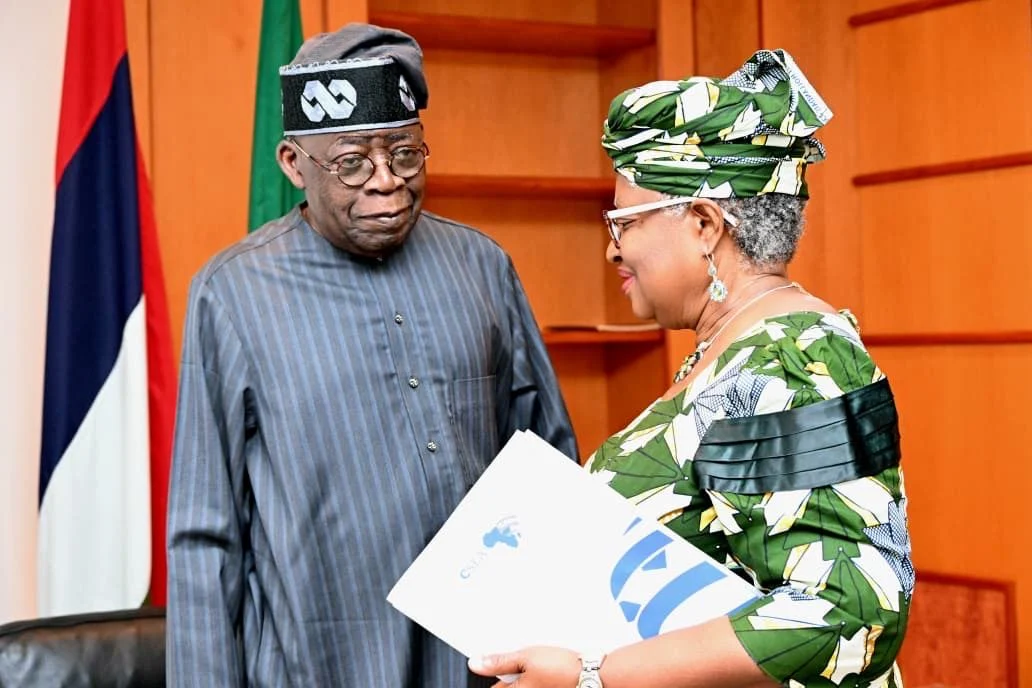
The Director-General of the World Trade Organisation (WTO), Dr. Ngozi Okonjo-Iweala, has commended President Bola Tinubu for taking bold steps to stabilise the nation’s economy amid ongoing reforms.
Addressing reporters after a meeting with President Tinubu in Abuja on Thursday, Dr. Okonjo-Iweala acknowledged the government’s efforts in bringing some stability to an economy that had been grappling with structural challenges and policy uncertainty.
“We think that President Bola Tinubu and his team have worked hard to stabilise Nigeria’s economy, and you cannot really improve an economy unless it is stable,” she stated.
The former Nigerian Finance Minister, emphasised that while economic stability is a critical first step, the country must now focus on inclusive growth and the creation of social safety nets to cushion the harsh impacts of reforms.
“Nigeria now needs to grow the economy, and we need to build social safety nets, so that people who are feeling the pinch of the reforms can also have some support to be able to weather the hardship,” she said.
“That is the next step. So, how do we build social safety nets to help Nigerians cushion the hardship they are feeling, and then, how do we grow the economy so that we can create more jobs and put more money in people’s pockets? These are the issues that we discussed with Mr. President.”
President Tinubu took office on May 29, 2023, following the eight-year tenure of President Muhammadu Buhari. He inherited an economy facing high inflation, mounting debt, dwindling foreign reserves, and a heavily subsidised fuel sector that had long strained public finances.
One of Tinubu’s first major economic decisions was to end the fuel subsidy regime, a policy move he announced in his inaugural speech. While the move was applauded by economists as a necessary step to free up public funds and reduce fiscal pressure, it had immediate and painful consequences for ordinary Nigerians.
Fuel prices skyrocketed, with a litre selling for as much as ₦1,200 in some parts of the country. This, in turn, triggered a surge in transportation costs and food prices, deepening the hardship faced by millions, especially those in lower-income brackets.
The government has since pledged to reinvest savings from the subsidy removal into infrastructure, social programmes, and job creation initiatives. However, critics argue that relief for the poor has been slow in coming, and economic pain continues to mount.