


836
By Lizzy Chirkpi
The Senate has approved a ₦54.46 trillion federal spending framework for 2026, alongside a downward review of Nigeria’s crude oil benchmark price to $60 per barrel, signalling a cautious fiscal stance aimed at protecting the economy from global uncertainties.
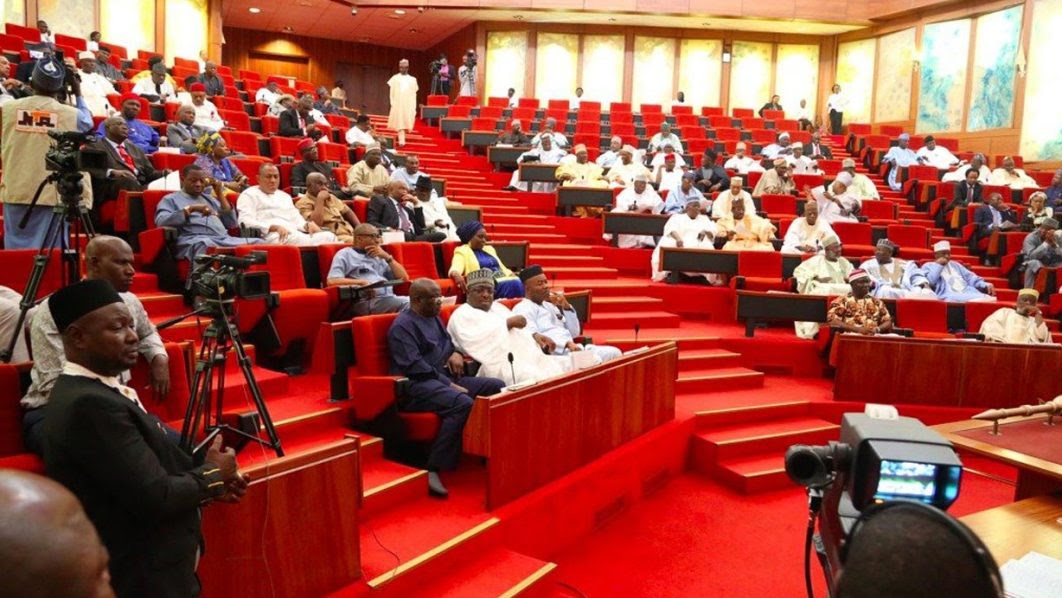
The decisions followed the adoption of the report on the 2026–2028 Medium-Term Expenditure Framework (MTEF) and Fiscal Strategy Paper (FSP), presented at plenary on Tuesday by the Chairman of the Senate Committee on Finance, Senator Sani Musa. The session was presided over by Senate President Godswill Akpabio.
In a move reflecting concerns over geopolitical tensions and volatility in the global energy market, lawmakers reduced the proposed 2026 oil benchmark from $64.85 to $60 per barrel. Benchmarks of $65 and $70 per barrel were approved for 2027 and 2028 respectively. The committee said the adjustment was necessary given the fragility of oil prices amid ongoing conflicts in Europe and the Middle East.
Despite the conservative price outlook, the Senate retained crude oil production targets of 1.84 million barrels per day (mbpd) for 2026, rising to 1.88mbpd in 2027 and 1.92mbpd in 2028, expressing confidence in sector reforms and efforts to stabilise output.
On key macroeconomic indicators, the Senate endorsed projected exchange rates of ₦1,512 to the dollar in 2026, ₦1,432.15 in 2027 and ₦1,383.18 in 2028, in line with the Central Bank of Nigeria’s strategy to stabilise the naira through stronger fiscal and monetary coordination.
Inflation is expected to ease gradually over the medium term, with projections of 16.5 per cent in 2026, 13 per cent in 2027 and nine per cent in 2028. Lawmakers attributed the outlook to sustained efforts by monetary authorities to curb inflationary pressures.
The framework also maintains real GDP growth projections of 4.68 per cent for 2026, 5.96 per cent for 2027 and 7.9 per cent for 2028, driven by ongoing economic reforms and anticipated gains from newly enacted tax laws expected to take firmer effect from 2026.
A major focus of the committee’s report was the effective implementation of the new tax regime as a catalyst for growth. It recommended the introduction of a National Scanning Policy under the National Single Window of the Nigeria Revenue Service, in collaboration with relevant agencies, to improve revenue assurance, block leakages, enhance transparency, facilitate trade and strengthen national security.
Under the approved framework, total federal expenditure for 2026 stands at ₦54.46 trillion, while retained revenue is estimated at ₦34.33 trillion. New borrowings, both domestic and external are projected at ₦17.88 trillion, with debt servicing obligations put at ₦15.52 trillion. The fiscal deficit is estimated at ₦20.13 trillion.
The spending plan allocates ₦1.376 trillion for pensions, gratuities and retirees’ benefits. Capital expenditure, excluding transfers, was sustained at ₦20.131 trillion, alongside statutory transfers of ₦3.152 trillion and a Sinking Fund provision of ₦388.54 billion. Recurrent (non-debt) expenditure was approved at ₦15.265 trillion, while special intervention funds for recurrent and capital spending were set at ₦200 billion and ₦14 billion respectively.
Several senators described the assumptions underpinning the framework as realistic and achievable. Senator Mohammed Tahir Mongono urged speedy passage of the MTEF and the budget, stressing their importance to national development.
“We must fast-track approval of the MTEF and budget, as these are the foundation of the country’s economic aspirations,” Mongono said.
Senator Adetokunbo Abiru (Lagos East) commended the cautious revenue projections, particularly the stronger focus on non-oil income, noting that oil revenue had consistently underperformed in recent years. He described the moderated 2026 revenue outlook as prudent.
Senators Aminu Abas and Adams Oshiomhole also backed the revised exchange rate and oil production benchmarks, saying they better reflected market realities and Nigeria’s historical production capacity.
In his closing remarks, Senate President Godswill Akpabio thanked lawmakers and committees involved in the MTEF and FSP review, noting that while economic projections may evolve, the approved framework offers a credible basis for planning.
“We are hopeful that the approved recommendations will drive sustainable economic growth, fiscal discipline and transparency in the coming years,” Akpabio said.
The Senate is expected to move next to detailed consideration of the 2026 budget, with plans to conclude the process in the coming weeks to guide Nigeria’s economic direction from 2026 to 2028.