


By Oscar Okhifo
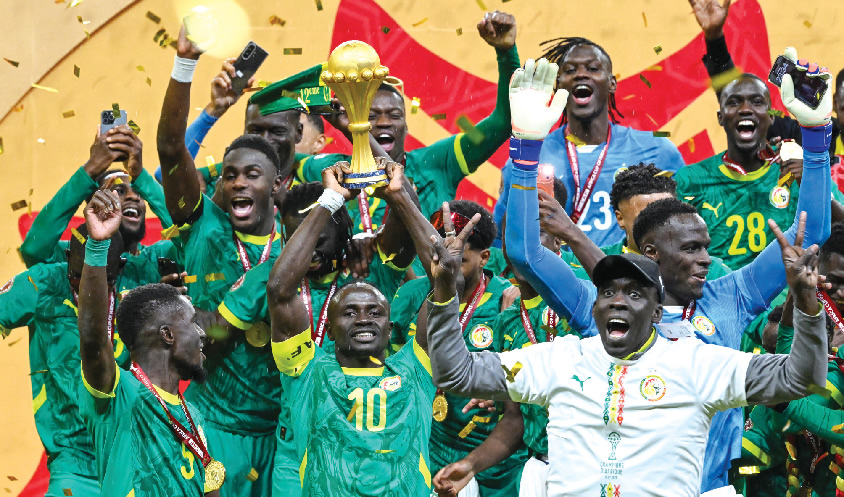
Senegal have been reinstated as champions of the 2025 Africa Cup of Nations (AFCON) after the Court of Arbitration for Sport (CAS) overturned a controversial decision by the Confederation of African Football (CAF) to strip the country of the title and award it to Morocco.
The ruling, delivered on Tuesday, November 24, 2026, upheld an appeal by the Senegalese Football Federation (FSF), restoring the Teranga Lions’ 1-0 victory over hosts Morocco in the final played in Rabat on January 18, 2026.
However, Morocco has rejected the verdict, questioned the integrity of the arbitration proceedings and vowed to pursue all available legal avenues to challenge the decision.
The controversy stemmed from a series of contentious incidents in the closing minutes of regulation time during the final at the Prince Moulay Abdellah Stadium in Rabat, where both teams were locked in a goalless encounter.
Senegal initially celebrated what appeared to be a stoppage-time goal by Ismaila Sarr. However, referee Jean-Jacques Ndala of the Democratic Republic of Congo had blown his whistle for an alleged foul by Senegal defender Abdoulaye Seck on Morocco captain Achraf Hakimi.
The decision triggered protests from Senegalese players, with tensions escalating shortly afterwards when the referee, following a VAR review, awarded Morocco a penalty for a challenge involving Senegal defender El Hadji Malick Diouf and forward Brahim Diaz.
Angered by the decision, Senegal coach Pape Thiaw instructed his players to leave the pitch in protest, forcing a suspension of play for approximately 15 minutes.
Senegal captain Sadio Mane, however, intervened and persuaded his teammates to return, allowing the final to continue.
Morocco’s Diaz subsequently attempted a Panenka-style penalty, but his effort was saved by goalkeeper Edouard Mendy.
The match went into extra time, where Pape Gueye scored the decisive goal in the 94th minute to secure a 1-0 victory and Senegal’s second AFCON title.
The dramatic conclusion to the final later developed into a major disciplinary and legal dispute between the two football federations.
CAF’s Disciplinary Board initially considered the incidents and imposed sanctions on players, officials and the two federations.
However, following an appeal by Morocco, CAF’s Appeals Board, on March 17, 2026, overturned the outcome, ruling that Senegal had forfeited the match by leaving the pitch without the referee’s authorisation.
Invoking Articles 82 and 84 of the AFCON regulations, the board awarded Morocco a 3-0 victory, stripped Senegal of the title and declared the North African country champions.
Senegal rejected the decision and approached CAS on March 25, seeking to have the result achieved on the pitch restored.
In its unanimous decision on Tuesday, the three-member CAS panel set aside the CAF Appeals Board ruling and reinstated the earlier decision of CAF’s Disciplinary Board.
The tribunal held that the authority to stop or resume the match rested with the referee, whose decisions in that regard were protected under the football principle known as the field of play doctrine.
CAS explained that Articles 82 and 84 of the AFCON regulations applied to circumstances in which a team’s conduct caused the referee to permanently abandon a match.
Since the referee had restarted the game and allowed it to reach its conclusion, the tribunal held that the provisions could not be invoked to declare Senegal the losers.
CAS Secretary-General Matthieu Reeb said the referee had acted within his authority.
“The referee (Jean-Jacques Ndala of the Democratic Republic of Congo) did not commit any error of law,” Reeb said.
He added: “There could only be one winner in this final, just as there could only be one winner in this legal process. The law has spoken. I think we simply have to accept the decision of the Court of Arbitration for Sport.”
Reacting to the ruling, FSF President Abdoulaye Fall described it as a victory for justice and the country’s football.
“The Court of Arbitration for Sport has delivered justice for sport,” Fall said.
He also reaffirmed Senegal’s relationship with Morocco, saying: “I wish to strongly reaffirm the bonds of brotherhood that unite us with the Royal Moroccan Football Federation (FRMF) and the Moroccan people.”
Fall said Senegalese football would now look towards the future with confidence and enthusiasm, within an Africa united by the values of sport.
Senegal’s star forward, Mane, also welcomed the decision, saying it had brought joy to the team and the country.
“The decision of the Sport Arbitral Court to restore Senegal to its title of African champions fills us with joy,” he said.
He thanked supporters at home and abroad for standing by the team throughout the controversy, adding: “Your trust has given us strength in the most difficult times.”
Mane also extended goodwill to Morocco, describing the two countries as brotherly nations and expressing hope that football would continue to strengthen their relationship.
Morocco’s Royal Moroccan Football Federation, however, has refused to accept the outcome and announced plans to challenge the decision through available legal channels.
In a statement, the federation questioned the integrity and credibility of the arbitration proceedings, alleging that its concerns about the process had not been adequately addressed.
It specifically raised allegations of communication between German arbitrator Ulrich Haas, a member of the CAS panel, and FSF President Fall approximately 48 hours before the verdict was delivered.
The Moroccan federation argued that the alleged contact compromised the credibility of the proceedings and faulted the tribunal for failing to give adequate consideration to its request for appropriate legal consequences.
It also accused CAS of failing to consider the position adopted by the International Football Association Board (IFAB) and FIFA on players leaving the pitch without the referee’s permission.
“Consequently, the Royal Moroccan Football Federation has decided to initiate all necessary legal proceedings to challenge the CAS decision,” the statement said.
The Senegalese side has denied the allegation of improper contact.
A spokesperson for the FSF told Reuters: “That is false. There was no telephone contact on Sunday or on any other day.”
CAS also confirmed that it received a challenge against arbitrator Haas from the Moroccan federation shortly before the ruling was announced.
The tribunal said its International Council of Arbitration for Sport (ICAS) Challenge Commission found insufficient evidence at the time to warrant delaying the announcement of the decision.
CAS added: “Ulrich Haas strongly denies any direct contact at any moment with the parties involved in this procedure.”
Senegal’s lawyer, Sidy Diagne, described the ruling as a tremendous victory for the country.
“We could not allow the honour of Senegal, the Senegalese nation and its entire people to be trampled on like that under the pretext of legal proceedings that called into question the very essence of the sport, which is football,” he said.
“For us, this is a tremendous victory.”
Meanwhile, CAF has pledged to respect and implement the CAS ruling.
In its reaction, the African football governing body said: “CAF respects the CAS award and will take all the necessary measures to implement it.”
South Africa’s Sports Minister, Gayton McKenzie, also commended Senegal for pursuing the dispute through the appropriate legal channels.
“Senegal deserves credit for how it handled the last eight months. It didn’t give up and it didn’t take the fight to the streets. It took its case to the proper forum and trusted the process,” he said.
“That should be the example for every federation on our continent.”
The CAS ruling restores Senegal’s second AFCON title, following its maiden triumph in 2022, while stripping Morocco of the championship it had been awarded in March.
However, Morocco’s decision to pursue further legal action suggests that the controversy surrounding the dramatic final may not be over.