

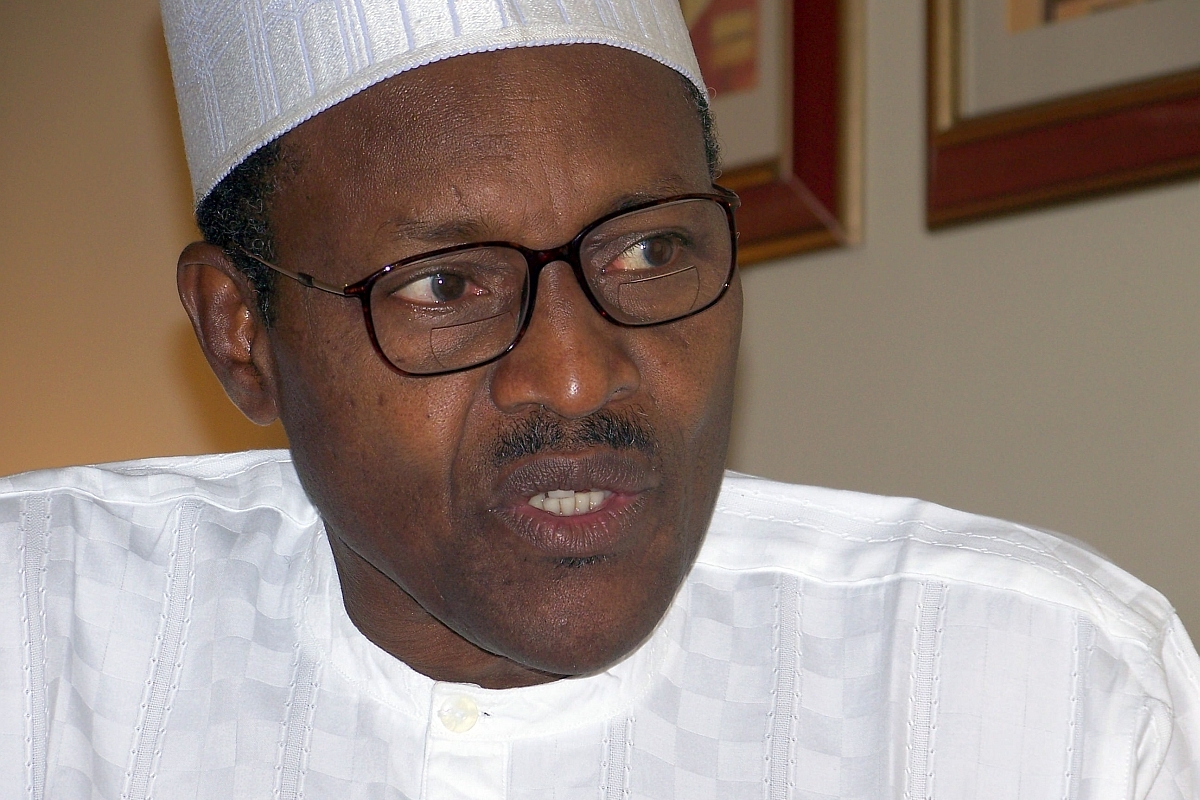

On his emergence as Nigeria’s President last year, President Muhammadu
Buhari was faced with two broad choices; Continue the larcenous state of
corruption he met when he cane in or cap the corruption well head and move
the country away from the hugely predatory state through deliberate
actions and policies that will cleanse the badly desecrated Augean stable
and redirect the values that rule a country that had vicariously bled from
perilous and corrupt leadership. Having campaigned on the mantra of
Change, it was not a hard choice to make. He must topple the old sordid
order and install a new cleansed order that will govern not only the
conduct of governance but the general life in a serially abused country.
Added to this was the fact that Buhari had to replace the same order that
has ensured that a country so richly blessed and hugely endowed but which
was practically writhing on all fours when he came to power. Nigeria,
under the Jonathan regime Buhari succeeded, was a painted sepulcher. It
was a grave dabbed with flattering white emulsion. Forget about the
nonsense of Nigeria being Africa’s largest economy, forget the padded
presentation of flattering GDP, forget about the feel-good statistics that
were dripping from the previous government’s so-called economic team,
there was nothing on ground to suggest that Nigeria had an economy; talk
not of the largest in Africa. We had a gangsters heaven where oil was sold
and shared in such fashion that jarred humanity’s decency. That was termed
a robust economy and all other sectors that should drive a normal economy
were killed in a frenetic rush for oil money.
All infrastructures needed as props to an economy were dead, unemployment
was soaring in such mad fashion such that it took a mere advertisement of
3,000 immigration jobs for millions to flood every available public space
in Nigeria and many were trampled to death for jobs that never came. In
short, Nigeria was an extension of hell on earth. Yet, oil price went as
high as $140 per barrel and Nigeria exceeded its OPEC quota but life
diminished to that in a state of nature in the same period. You are wont
to hear one of the campaigners of the outgone Jonathan era tell you how he
used to get rice and pure water free of charge in that era yet it tells
quite a story that a regime that reaped so huge from an oil boom
purportedly used tens of trillions of Naira it reaped from oil sake to
import rice for its citizens!
In a country where the artificial fruits of corruption value chain had so
distorted the value system, enriched quite a good number of knights of the
rotten order, given millions of others false hopes of security, Buhari
knew he made a very risky choice by seeking to topple the corrupt order
than had thrived since independence. He knew that most Nigerians are like
the Israeli rabble who care less of history or tomorrow but whose only
interest is the now, now and now. The Israeli mob were mobilised to rebel
against Moses on their way to the Promised Land with such blasphemies that
Moses should have left them to be wiped out in abject slavery in Egyot,
being fed with morsels of captivity and being clobbered to death than for
them to temporarily lack bread on their way to the Promised Land. For
them, as for Nigerians today, there would be no tomorrow. Yesterday is
gone and today is what matters. Buhari knew all these things before he
decided to change the same system which, in the long run, has finished off
Nigeria and would have buried it if the country was so unfortunate to have
continued with the Jonathan government.
Come to think of it, can any of the people struggling desperately to mount
a political campaign of how things are under Buhari today tell us what
would have happened if Jonathan had continued in power and carried on in
his sordid ways and met oil at $27 a barrel when, as at the time he left,
oil was still selling above $60 and 23 states were bankrupt and couldn’t
pay workers salaries running up to one year? Could any of those
frantically working the mob up to revolt against Buhari just because he
had plugged the rat holes from which they crumbled this country, tell us
what would have happened if a Jonathan had met oil at $27 a barrel when
his government borrowed half a trillion Naira to pay federal civil
servants’ salaries when oil was still selling above $70 a barrel? It would
have been so disastrous that bynow, Nigerians would have been cutting
themselves up and eating were it not for the coming of Buhari. Facts are
sacred. A government that got 23 states bankrupt and borrowed half a
trillion Naira to pay civil servants salaries when oil was above $60 a
barrel would have buried the country were it to still be in power when oil
plummeted to $27 a barrel. This is the fact those who have made it a daily
catena reminding us of how life has been hard under Buhari are either
ignorant of or want to hide from others in the process of reviving a
nefarious interest.
So Buhari was aware that his decision to stop corruption and such massive
plundering of state resources as happened under Jonathan, was bound to be
unpopular among a citizenry who have been left with no option than
improvise corrupt ways to live. For one, he knew that those that
criminally benefited from corruption will not watch and allow themselves
to be brought down. They must fight, with the huge resources they have
stolen and in cahoots with their ilk littered all over the country. He
knew they will fight in different forms and guises so he is not surprised
at what is happening today. Perhaps, that is why he had remained stoically
committed to what he is doing despite the antics of these rouges. Again,
he knew that it will be easy to recruit the masses, collective victims of
corruption, to mass against such redemptive actions by just promising them
bread and butter. He knew that in embarking on the mission to rid
corruption from the country’s body fabric, he would come to a head-on
collision with a formidable and well stacked brigade; ready to lay down
their lives to ensure that such system that had so empowered them is nit
replaced. That is what exactly is happening today.
Nigeria is in recession, that’s a fact. No one is denying it. No one is
disputing the fact. No one is disputing the discomforts that attend it.
Buhari is not mincing words about it. He had, at each stop of the mending
work he us doing, pleaded with Nigerians to be patient. The ground has to
be cleared, tilled and the drops tended to fruition before we expect
harvest. It is as natural as it is logical. Moreover the recession we are
suffering today was long foretold. Eminent economists and social
commentators warned that we will be where we are today if we did nothing
to meaningfully use the oil boom Jonathan frittered away like worthless
rag. When the regime and its acolytes were carrying Byzantine plundering,
many people warned that the oil dollars that was funding that bizarre
licentiousness will run out someday. The government never listened. No
effort was made to improve our facilities. Nothing was done to create
opportunities and employment for the teeming jobless youth as nothing but
egregious freeloading thrived and this in turn, grew a culture and life of
extreme debauchery and idolatrous consumerism where the country indulged
in unrestrained importation of freebies and junkies. The bubble was soon
to burst as the country bankrupted on the eve of Jonathan’s exit from
power when states couldn’t pay salaries, talk not of engaging in any
meaningful capital project and his government had to borrow a hefty half a
trillion Naira to pay salaries when oil was still going for a princely sum
compared with what we have today.
Yes, Nigeria is in recession and the Buhari Government has rightly
admitted this. Nigeria is in recession because oil price thumbed. Nigeria
is in recession because displaced politicians sponsored criminals and
outlaws to destroy oil pipelines and halved Nigeria’s oil export quota
because they want to ‘avenge’ their political loss. Most importantly,
Nigeria is in recession because the Jonathan government which harvested a
providential oil boom supervised the wholesome plunder of the money that
would have been saved, as other nations do, to avoid what we are facing
today. Nigeria is in recession because previous governments presided over
the complete ruination of our infrastructures, neglected every other
source of revenue, refused to invest in agriculture, healthcare,
education, power, roads, rails, industry, trade and commerce. Nigeria is
in recession because previous governments adamantly refused to diversify
our economy but stuck to free sharing of oil accruals. None of these was
caused by Buhari but by those that mismanaged our good fortunes, looted
every available resources and left the country for dead.
But Buhari is the solution and has undertaken quite brave measures to save
the country . He is frontally tackling the recession in quite a unique
way. He had outlawed corruption and in the process, saved our meager
resources for the country. He has invested handsomely in agriculture,
solid minerals, power, roads, railways, education, health and other vital
sectors that undergird a solid economy. He has clearly gone beyond oil in
financing our national budgets and has stabilized the polity such that in
the period of recession, states that went bankrupt when Jonathan was
selling oil at above $60 a barrel are now sure of paying their workers.
The only thing that has been put out of circulation is stolen and illicit
money and it is a matter of time before those hooked on corruption value
chain source more legal and decent means of survival.
With Buhari’s prescription, we can see that even in the period of
recession, roads that were left to rot for the decades when we were
swimming in oil money are being rehabilitated today. We can see that it is
during this recession that modern rails which formed topics for fairy
tales when we had so much petro-dollars are beginning to become real. We
can see that huge investments are now being made in capital regenerative
projects in a moment of recession than when we had more than enough
dollars in our kitty. We can see that self sustenance in agriculture is
becoming real during this recession. We can see that the much hackneyed
diversification of our economy is happening in this period of recession.
We can see that he had dealt corruption a bloody nose despite the
orchestrated antics of the pro-corruption brigade. He has taken measures
previous leaders had been afraid to take or were too compromised to take
because he is carrying no baggage. He is a long distance runner unlike his
opponents who are just people of the moment. He is rugged, determined and
steely both in his character and in his resolve to turn Nigeria’s most
gloomy moment to her most glorious.
Peter Claver Oparah
Ikeja, Lagos.
E-mail: peterclaver2000@yahoo.com