


1.5K
By Tracy Moses
President Bola Ahmed Tinubu and Vice President Kashim Shettima will lead the All Progressives Congress Presidential Campaign Council as chairman and vice chairman respectively, with former Zamfara State governor, Senator Abdulaziz Yari, appointed Director-General.
The composition of the campaign council, announced on Saturday in a statement signed by presidential spokesman, Bayo Onanuga, formally sets in motion the APC’s political machinery for the 2027 presidential contest, with the governing party relying on a combination of senior party leaders, serving governors, lawmakers, technocrats and media strategists to prosecute its campaign.
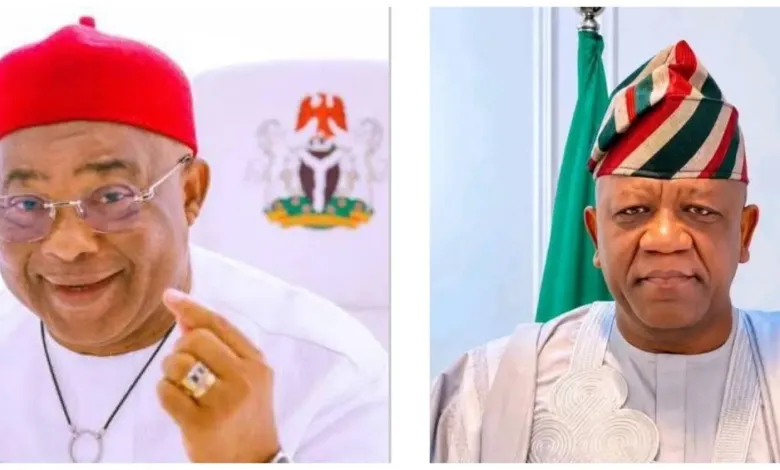
Imo State Governor, Hope Uzodimma, was named secretary of the council, while APC National Secretary, Senator Ajibola Bashiru, and Hadiza Bala-Usman will serve as deputy secretary and assistant secretary respectively.
APC National Chairman, Professor Nentawe Yilwatda, will serve as another vice chairman of the council.
Yari’s appointment places the former governor and influential northern politician at the centre of the party’s presidential campaign as the APC seeks a fresh mandate for President Tinubu.
The campaign council will be supported by an advisory body comprising former APC National Chairman, Bisi Akande; veteran politician, Segun Osoba; former Imo State governor, Senator Rochas Okorocha; former APC National Chairman, Senator Abdullahi Adamu; and Senator Florence Ita Giwa.
Senate President Godswill Akpabio, House of Representatives Speaker Tajudeen Abbas and Yobe State Governor Mai Mala Buni have been appointed deputy directors-general responsible for the South and North.
They will work alongside Senator Opeyemi Bamidele and Deputy Senate President Jibril Barau in coordinating the party’s campaign across the two broad geopolitical blocs.
Former Edo State governor, Senator Adams Oshiomhole, has been assigned as deputy director-general in charge of mobilisation, while the President’s Chief of Staff, Femi Gbajabiamila will serve as Deputy Director-General in charge of administration.
House of Representatives member, James Faleke, who played a major role in the APC’s 2023 presidential campaign, returns as Deputy Director-General in charge of election planning, coordination and monitoring.
Faleke will oversee zonal election directors including Senator Olushola Adeyeye in the South-West, Dr Ngozi Olejeme in the South-South, Senator Uche Ekwunife in the South-East, Muntaqha Rabe in the North-West, Ahmed Muhammed Ketso in the North-Central and Senator Sani Danladi in the North-East.
The election planning directorate will have Stella Okotete, Engineer Abdullahi Garba Ramat and Audu Maikori as secretaries.
In the legal department, Muiz Adeyemi Banire will serve as director, assisted by Dr Liman Hassan and Babatunde Ogala. Other members include Attorney-General of the Federation and Minister of Justice, Prince Lateef Fagbemi; former Katsina State governor Ibrahim Shema; Worgu Boms and Dr Kingsley Tochukwu Udeh.
The media and strategic communication directorate will be coordinated by Minister of Information and National Orientation, Mohammed Malagi, alongside former presidential spokesman Dele Alake, Bayo Onanuga and Lanre Issa-Onilu.
Tunde Rahman, Sunday Dare, Daniel Bwala and Felix Morka will serve as coordinating Deputy Directors.
Abdulaziz AbdulAziz, Temitope Ajayi, Arabinrin Aderonke and Frederick Nwabufor were named coordinating secretaries of the media directorate.
Segun Dada, who handled the New Media Directorate during the 2023 campaign, returns to head the same department, with Solomon Arowolo as secretary.
The council also named five spokespersons, led by Alake. Others are Alwan Hassan, Ayobami Oyalowo, Kemi Asekun-Shittu and Adamu Fanda.
The announcement comes as political activity ahead of the 2027 general elections gathers momentum, with the APC seeking to consolidate its hold on the presidency while opposition parties and emerging political coalitions position themselves for a major challenge.
For the governing party, the campaign is expected to focus heavily on defending the economic reforms introduced by the Tinubu administration, including the removal of fuel subsidy, exchange-rate reforms and efforts to increase domestic production and investment.
Those reforms have also generated significant public debate over rising living costs and household hardship, making the government’s economic record one of the major issues likely to dominate the campaign.
Tinubu, however, has repeatedly maintained that his administration’s reforms are laying the foundation for long-term economic growth and prosperity.
In his charge to members of the newly constituted council, the President urged them to work relentlessly to secure victory for the APC, while asking directorate leaders to accommodate other party members who were not included in the formal list.
“We have delivered on our campaign promises and set our country on a path of economic progress.
“We are definitely out of the dark tunnel and are now at the cusp of reaping the benefits of a prosperous economy that will benefit all Nigerians,” the statement quoted President Tinubu as saying.
The President urged the campaign team to take its message to Nigerians with confidence, saying the party had “many achievements to trumpet,” and should use them to inspire hope across the country.
“Let us soundly defeat all those forces who plan to take our country backwards,” he added.
The structure of the campaign council also reflects the APC’s attempt to combine political mobilisation with a stronger emphasis on election planning, legal preparedness and media operations.
The return of Faleke to election planning and Dada to New Media provides continuity from the party’s previous presidential campaign.
Yari’s emergence as Director-General is particularly significant given his experience as a former governor, federal lawmaker and prominent figure in northern Nigerian politics.
With Tinubu and Shettima at the head of the structure, the APC campaign will now have to translate the administration’s record into a nationwide political message capable of sustaining the president’s support base while winning over voters dissatisfied with the government’s performance.