


1.7K
By Myke Agunwa
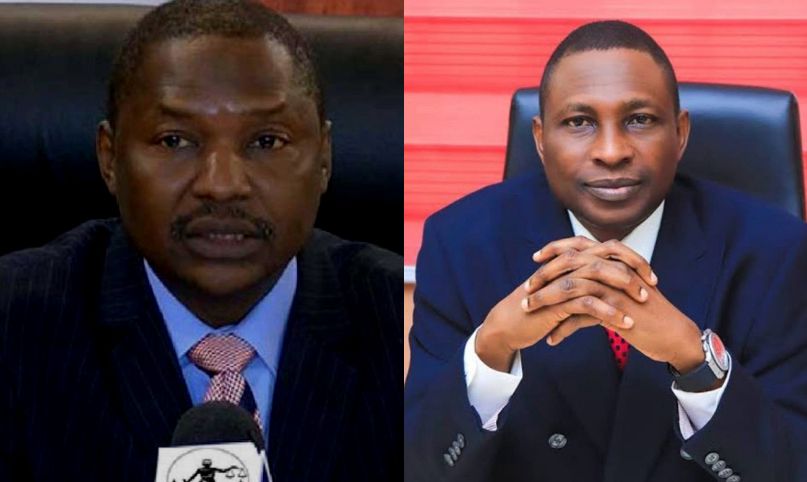
Former Attorney-General of the Federation and Minister of Justice, Abubakar Malami (SAN), has accused the Chairman of Economic and Financial Crimes Commission (EFCC) Ola Olukoyede, of harboring personal vendetta and demanding his immediate recusal from his case.
In a statement released on Wednesday by Mohammed Bello Doka his media aide, Malami described the EFCC’s actions as “retaliatory persecution” disguised as law enforcement, rooted in unresolved issues from a 2020 judicial commission of inquiry.
Referring to Chapter 9 of the Justice Ayo Salami Judicial Commission of Inquiry Report, which addressed the conducts of senior EFCC officials Malami stated, “No person is permitted to sit in judgment over a matter in which they have a personal interest or prior exposure. The applicable test is the reasonable apprehension of bias, not proof of actual malice. Where such apprehension exists, recusal is mandatory, not optional”.
Malami, who served as AGF under former President Muhammadu Buhari, pointed out that Olukoyede served as secretary to the EFCC when the Commission was being investigated. He explained that Chapter 9 of the Salami Report contains “serious findings” implicating senior EFCC officials, including those in key positions like Olukoyede, creating a clear conflict of interest.
He went further to state that “Any reasonable observer would conclude that Abubakar Malami, (SAN), cannot receive an impartial investigation or prosecution under the present leadership of the EFCC”.
He thereafter invoked the legal principle of recusal, arguing that a “reasonable apprehension of bias” not just proven malice, mandates Olukoyede’s withdrawal.
The former minister further alleged grave violations of his constitutional rights, including unlawful restrictions on personal liberty (Section 35), denial of fair hearing (Section 36), and “trial by media” through selective leaks aimed at prejudicing public opinion.
He accused the EFCC of attempting to criminalize lawful policy decisions from his tenure and relying on questionable witnesses, including individuals convicted abroad and serving sentences.
Reiterating his readiness to face a neutral investigation, Malami demanded, “The immediate recusal of the EFCC Chairman from all matters relating to Abubakar Malami, SAN;
“The intervention of the Attorney-General of the Federation to ensure that this matter is transferred to a neutral and independent investigative authority;
“The prompt institution of charges, if any, before a competent court of law, where evidence — not vendetta — will prevail”.
He explained that “If the EFCC is allowed to function as an instrument for the settlement of personal scores, then the rule of law itself is imperiled”.