

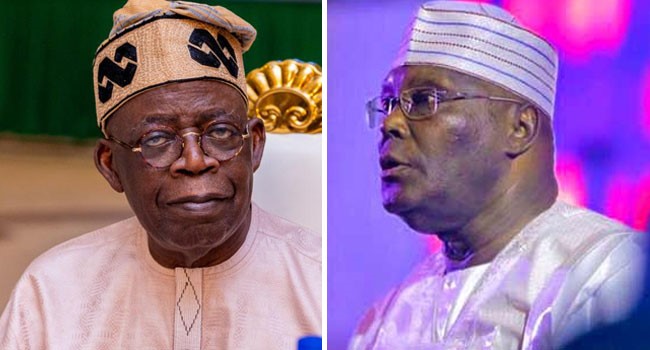

Former Vice-President Atiku Abubakar has accused President Bola Tinubu of turning the Nigerian National Petroleum Company Limited (NNPCL) into a political tool, questioning whether the ₦66-per-litre petrol discount introduced by the company serves the public interest or the president’s political ambitions.
Atiku accused the administration of seeking public applause for the price reduction without explaining who would bear the cost, whether NNPCL’s board approved the decision or how the company would account for the revenue it would forgo.
He made the allegations in a statement issued on Saturday by Phrank Shaibu, Director of Strategic Communication for the African Democratic Congress (ADC) Presidential Campaign Council.
“Tinubu wants Nigerians to cheer for ₦66 off a litre before they ask who ordered NNPCL to surrender the money,” Atiku said.
“He wants credit for the discount without showing the board approval, the cost or the account that will carry it. Nigerians are not so desperate for relief that they have forgotten how to ask a simple question: who pays for Tinubu’s applause?” he added.
The criticism comes amid continuing concerns over petrol affordability in Nigeria, where fuel prices significantly affect household spending, transport fares, food distribution and business operating costs.
Nigeria’s petrol market has undergone major changes since Tinubu announced the removal of the petrol subsidy in May 2023. The policy ended the previous arrangement under which the government kept pump prices artificially low, shifting more of the cost of fuel consumption to motorists and businesses.
The resulting price increases have placed additional pressure on household budgets and business expenses, making any reduction in pump prices politically significant.
Against this backdrop, Atiku questioned the decision to use NNPCL’s commercial margins to fund the discount, arguing that the arrangement raised concerns about the company’s independence and financial accountability.
The ADC presidential candidate for the 2027 general election maintained that NNPC Limited should operate as a commercial enterprise under the Petroleum Industry Act rather than serve as a source of funding for politically motivated announcements.
“NNPC Limited is no longer the old NNPC corporation. The Petroleum Industry Act established it to operate as a commercial company,” he said.
“Yet the Presidency announces a discount, claims the applause and tells NNPCL to surrender its margin,” he added.
Atiku asked whether the government had exercised its rights as NNPCL’s shareholder through established corporate procedures or directed the company to absorb the cost without adequate scrutiny.
“Is the government exercising its rights as shareholder through proper corporate channels, or treating NNPC Limited as a drawer of campaign money it can open whenever an election approaches?” he asked.
He also accused the administration of applying market principles inconsistently, arguing that officials invoke market forces to explain high petrol prices but turn to NNPCL’s commercial margins when the president needs a politically popular announcement.
Atiku further questioned the nationwide accessibility of the discount, arguing that motorists who live far from NNPCL retail outlets might struggle to benefit from the price reduction.
The statement put NNPCL Retail’s network at just over 900 filling stations, compared with Nigeria’s estimated population of 242 million.
Atiku argued that the discount’s practical value would depend on whether motorists could access participating stations without incurring additional transport costs or spending excessive time in queues.
“Must a driver burn petrol travelling to an NNPCL station, spend time in a queue, download an app and pay through it to save ₦66 on each litre? How much of the saving survives the journey?” he asked.
He also questioned how motorists would benefit if their nearest NNPCL station was far away or had run out of petrol.
“Tinubu announces relief for the whole country, then delivers it through a fraction of its filling stations. A press release can reach every Nigerian in a second. His discount cannot,” Atiku said.
The former vice-president also demanded clarification on the financial implications of the discount, asking whether NNPCL’s board had approved the arrangement before the Presidency announced it and what financial projections informed the decision.
He questioned how much revenue the company would forgo and where the cost would be reflected in its accounts.
“Where is NNPCL’s board in this performance? Did it approve the decision before the Presidency announced it? What figures did it examine? What margin will the company forgo, and where will that cost appear in its accounts?” he asked.
Atiku also rejected the administration’s reported distinction between the discount and a fuel subsidy, arguing that the economic cost would remain regardless of the terminology used.
“The administration says this is not a subsidy. Changing the name of a cost does not make it disappear,” he said.
A reduction in the price paid by consumers must ultimately be absorbed somewhere in the supply chain. Depending on the arrangement, the cost could fall on a company’s profit margins, another participant in the supply chain or a public budget. Determining who bears the cost requires details of the discount’s financing and accounting treatment.
The criticism adds to the longstanding political rivalry between Atiku, who challenged Tinubu in the 2023 presidential election, and the president, whose administration has defended its economic reforms as necessary to address structural problems in the economy.
Atiku has repeatedly criticised the government’s economic policies, while the administration has maintained that its reforms are intended to improve economic stability and address distortions associated with previous arrangements.
In the latest statement, Atiku challenged Tinubu over their differing approaches to petrol affordability, referring to an earlier disagreement over his proposal for a transparent production subsidy.
“Bola, you mocked my proposal for a transparent production subsidy. Now you have borrowed its central lesson, that Nigerians need targeted relief, and come back with an app coupon lasting 30 days at a handful of stations,” he said.
He added: “Nigerians need fuel made affordable across the country, not ₦66 they must queue to collect.