

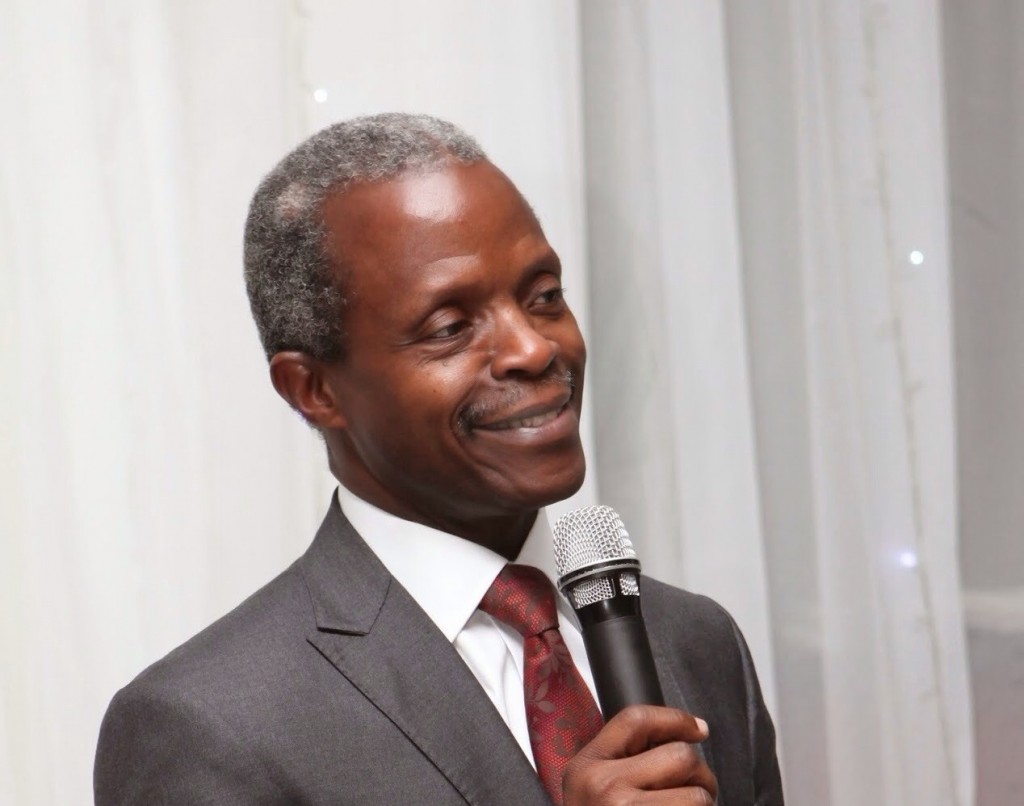

Nigeria lost about $15B to fraudulent and corrupt practices in the
security equipment spending during the last administration, Vice
President, Prof Yemi Osinbajo, SAN, has disclosed, even as he spoke of
hope that the implementation of the 2016 budget would commence soon.
“By the grace of God in the next few days we will begin the implementation
of one of the most ambitious budgets in our history. Ambitious not just in
its size but more in its broad range of fiscal and other socio-economic
policies,” according to the Vice President.
The Vice President spoke today at the book presentation of the
Ibadan-based elite group, House of Lords, which just published an indepth
analysis by different experts titled “Nigeria: The Challenges of Growth
and Development, ” at the University of Ibadan.
While observing that the Buhari presidency has kept on a sustained fight
against corruption, the Vice President said the country simply cannot
sustain the shocking level of public sector corruption in particular.
Said he: “When you look at the sheer amount of money that have been
embezzled, the sheer amount of money lost from any of these various cases
of corruption, you will find that far too much has been lost. ”
Continuing he disclosed that “it was discovered a few days ago that the
total amount of money lost just to corruption in part of…and provision
of security equipments in the military is closer to 15 billion US
dollars.”
While the nation’s foreign reserves is now around about $27B, Prof
Osinbajo, driving home the stark significance of the such corruption,
noted that the $15 billion figure “is more than half of the current
foreign reserves of the country.”
He then told the audience made up of top Nigerian elites drawn from
academics, business and the professions that what the Buhari presidency is
“trying to do is to ensure that there are consequences for corruption and
we try to send a message that anyone who is found to have been corrupt
would not only dislodge the property they have stolen but will also pay
for it in terms of the sanctions of the law.”
According to him, “I believe strongly that it is important to send a
message that no public officer can steal the resources of this country and
expect to escape. I hope the message would be loud and clear and it will
inform behaviour in the future.”
Throwing a challenge to the generality of the Nigerian elite, Prof
Osinbajo said “the limits of the growth and development of most nations
largely depend on the strength of the value-driven influence of their
elite, indeed it is evident that the reason for the development and growth
of most societies is not resources, but values, (otherwise African
countries will be the most developed.)
Citing the example of Singapore to back up his submission, the VP noted
that the reason why the “tiny, resourceless island is richer than most of
sub-Saharan Africa with its vast resources is values: hard-work,
integrity, innovation promoted by a committed elite. Thus the custodian
elite especially in largely poor and illiterate societies has a huge
responsibility.”
He said that responsinility is what he called “The burden of privilege.”
He explained: “I have argued elsewhere that the privileged, or the elite
both individually and collectively have a responsibility, an obligation to
society, to plan it, organise it, order or reorder it and above all to
make sacrifices for it, for the maximum benefit of all.”
Continuing he added: “This is the burden of privilege. It is their
-elite-obligation individually and collectively to chart the course for
the millions. They define and house the ethos and the public sense of the
people. It is their expected role to find common cause across professions,
vocations, ethnicities and faiths, defining the minimum terms and
conditions for the safety, security, growth and prosperity of the
community.”
Furthermore he stated that the elites “define clearly what is lofty, what
is noble, what is deserving of honour and how these values can be
sustained, preserved and enforced. This is the burden of privilege. The
French describes it as “Noblese oblige” –nobility obligates or perhaps
more correctly for our purpose, privilege obligates. Society fails when
the elite abdicates its role.”
Based therefore on the recent past of the country, the Vice President
lamented that “to a large extent the ethical space has been vacated by the
Nigerian elite. In its place are all manner of excuses and false
justifications of bad behaviour. Today ethnicity and religion protect
corruption and abuse of power. Mediocrity is encouraged by the subjection
of merit to variations of quota systems. Quotas are not in themselves
wrong, but must be the exceptions not the rule.”
He stated three principles that the Nigerian elites ought to accept and
pursue to ensure nation’s growth and development:
The first is integrity-a rigorous maintenance of transparency,
accountability in governance
The second: the discipline of implementation, which encapsulates planning,
timeliness and precision.
And third: the rigorous enforcement of rules, law and order.
“Each of these is founded on ethical constructs that are established,
nurtured and protected by the elite. In doing so the elite must understand
its responsibility, the obligations that the privilege of education,
status and providence confers.”
“It was the aristocratic elite in the United Kingdom that presented the
MagnaCarta Libertatum: a charter of human freedoms that has become the
template for constitutional rights anywhere in the world. Those barons,
not lawyers, crafted the high-minded words of that charter including those
that through the ages undergird the enduring notions of the rule of law
and judicial integrity namely: “To none will we sell, to none deny or
delay, right or justice.”
“Similarly it was the American elite that drew up the words of its
Constitution and its other documents enabling personal autonomy and free
enterprise. The puritans a small but powerful group entrenched the
Anglo-American concept of hard work, creativity and trustworthiness, their
reward is that the work ethic said to be responsible for the success of
the industrial revolution is named after them, ‘the puritanical work
ethic.’ ”
“There is very little reason why concepts such as “Omoluabi,” or
equivalents which conflate notions of a person, character and
introspection should not be insisted upon and established.
It is my humble submission so, that it is the business of the Nigerian
elite through its most revered social institutions to promote the values
that are fundamental to development and growth. Policies are often only as
good as the character and commitment of its implementers.”