


1.6K
By Oscar Okhifo
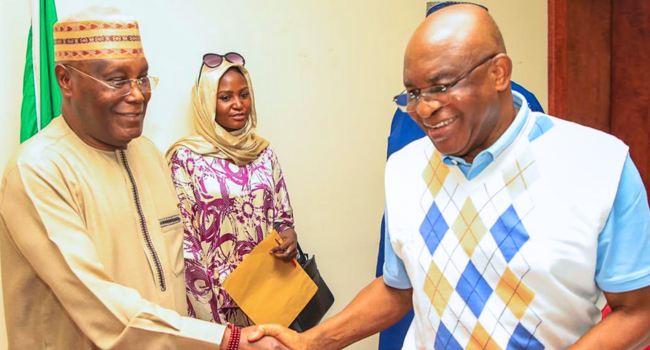
Former Vice President, Atiku Abubakar, ex- Senate President, David Mark and other opposition figures have raised an alarm over what they described as threats to Nigeria’s multi-party democracy.
In a joint statement issued on Sunday, the leaders accused the Federal Government of using anti-corruption and security agencies to intimidate opposition figures ahead of the 2027 general election.
In the statement, equally signed by Peter Obi, Bode George, John Odigie-Oyegun, Lawal Batagarawa, and other prominent opposition figures, the leaders expressed concern over what they described as growing threats to democratic governance in Nigeria.
According to them, key national institutions, particularly the Economic and Financial Crimes Commission (EFCC), the Nigeria Police, and the Independent Corrupt Practices and Other Related Offences Commission (ICPC), are increasingly perceived as tools of selective justice and political persecution rather than impartial enforcers of the law.
They alleged that state power is being deployed not primarily to combat corruption but to target perceived political adversaries, with the broader objective of silencing opposition voices and dismantling Nigeria’s plural democratic structure.
The statement noted that Nigerians are witnessing a covert agenda aimed at bringing all state governments under the control of the ruling All Progressives Congress (APC), not through transparent electoral contests but through pressure allegedly exerted on opposition governors using anti-corruption investigations.
They said recent defections of opposition governors to the ruling party have reinforced public suspicion that intimidation, rather than ideological conviction, is driving political realignments.
The opposition leaders further alleged that the strategy extends beyond elected officials to include key opposition figures viewed as central to emerging political coalitions, warning that if unchecked, the trend could gravely endanger Nigeria’s democratic future.
They accused the EFCC of selective prosecution, claiming that allegations against members of the ruling party are often ignored while opposition figures face swift investigations and media trials, sometimes on the basis of unproven claims.
They cited instances where former ministers allegedly implicated in financial scandals resigned under public pressure but were never charged, while others remained in office for months despite unresolved controversies, stepping down only after sustained public outcry.
According to them, the absence of subsequent prosecutions in such cases has further eroded public confidence in the anti-corruption campaign.
The statement warned that the perceived erosion of the EFCC’s independence risks turning a critical national institution into an instrument of political intimidation, with potentially destabilizing consequences as the country approaches another election cycle.
The opposition leaders called for the immediate depoliticization of the EFCC and a return to its statutory mandate of preventing and prosecuting economic and financial crimes without political bias.
They also urged Nigerians to remain vigilant against any attempt to transform the country into a de facto one-party state.
To strengthen preventive anti-corruption efforts, the statement proposed “embedding anti-graft operatives directly into government payment and expenditure processes at the federal, state, and local government levels, alongside amendments to the EFCC Act to support this approach.”
They further demanded “the establishment of an independent review body, in consultation with the Attorney-General of the Federation and the National Assembly, to conduct a comprehensive review of public accounts at all tiers of government from 2015 to 2025 and publish its findings.”
The proposed body, they said, “should be chaired by an eminent judge and include representatives of civil society organisations, professional bodies, security agencies, anti-graft institutions, and all political parties represented in the National Assembly.”
The opposition leaders pledged to engage Nigeria’s international partners, including the United States, United Kingdom, Canada, the European Union, the World Bank, and the United Nations, to raise concerns over what they described as the increasing politicization of Nigeria’s anti-corruption institutions.
They called on Nigerians across party lines, regions, and faiths to defend democratic values, warning against silence in the face of injustice and stressing that Nigeria belongs to all citizens, not to a single party or leader.