


473
By Lizzy Chirkpi
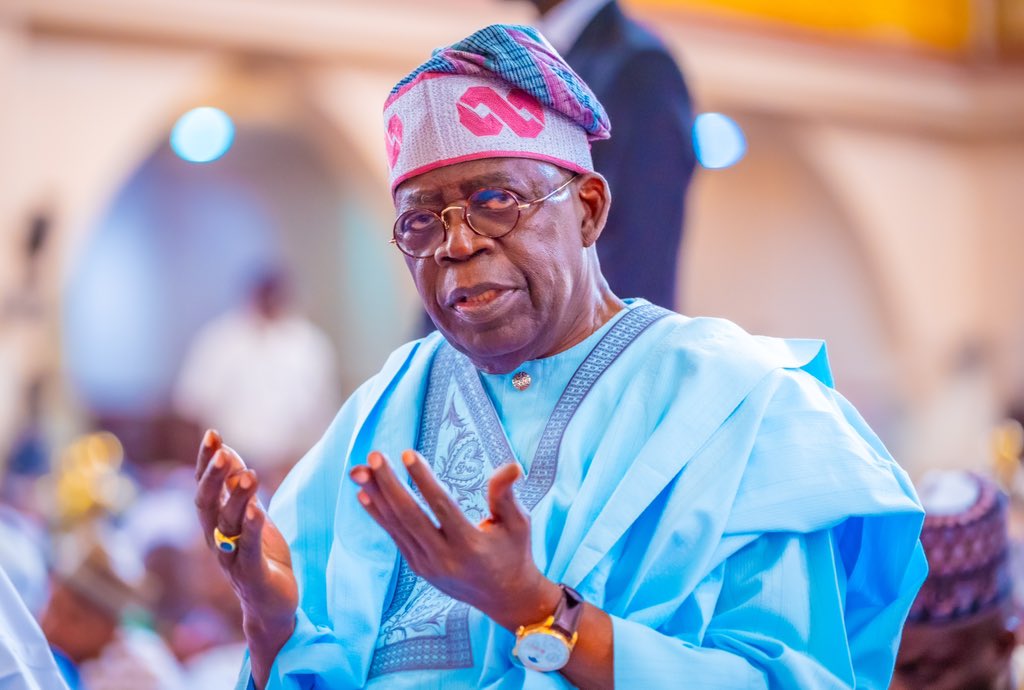
Former federal lawmakers under the platform of the National Forum of Former Legislators (NFFL), have endorsed President Bola Tinubu as their sole candidate for the 2027 general election and called for the constitutional entrenchment of rotational presidency as a means of sustaining national unity beyond 2031.
The resolutions were contained in a communiqué issued at the end of the NFFL 2026 National Summit, themed “National Unity and Nation Building Beyond 2031,” held on Saturday at the NAF Conference Centre, Kado, Abuja.
Presenting the communiqué, the forum said its deliberations were guided by the need to deepen democracy, promote trust among Nigeria’s diverse regions and ensure long-term political stability.
“We reaffirm that dialogue, consultation and peaceful engagement must always remain Nigeria’s primary tool for resolving political, social and regional challenges,” the communiqué stated.
“Nigerian issues must be resolved by Nigerians through dialogue, constitutional and democratic means.”
On the issue of power rotation, the former legislators resolved that the presidency should return to the North in 2031, in line with the principles of equity, inclusion and national balance.
“In keeping with the spirit of fairness and national balance, we affirm that the presidency should return to the Northern region in 2031, after the completion of the Southern presidency,” the communiqué read.
To eliminate uncertainty and recurring political tension, the forum further urged that the principle of rotation be clearly embedded in the Constitution.
“We call for the constitutional entrenchment of rotational presidency to promote fairness, strengthen national unity and provide clarity for future generations,” it said.
The NFFL also passed a vote of confidence in th President Tinubu-led administration, resolving that he should be supported to complete two full terms in office.
“In order to consolidate ongoing reforms, strengthen national unity and deepen democratic governance, we collectively resolve that the current President of the Federal Republic of Nigeria should be supported to complete the full eight years,” the communiqué stated.
“We therefore adopt President Bola Ahmed Tinubu as our sole candidate for the 2027 general election.”
The forum reaffirmed its commitment to a united, peaceful and prosperous Nigeria, calling on political leaders and citizens to uphold democratic values and national cohesion.
“We call on all political leaders, institutions and citizens to uphold the values of democracy, justice and national cohesion in the collective interest of our great nation,” the communiqué concluded.
Speaking at the summit, Chief of Staff to the President, Rt. Hon. Femi Gbajabiamila, warned that Nigeria’s survival and relevance in a rapidly changing global order depend fundamentally on national unity, describing cohesion as a “strategic necessity” rather than a moral option.
Gbajabiamila, who also convened the summit, told former lawmakers from across the country that global instability has made experienced leadership and internal cohesion more critical than ever.
“We meet at a moment when the world appears unsettled and uncertain of its direction,” he said.
“Yet it is precisely in moments such as these that leadership is most needed. Your willingness to convene and contribute once more to national discourse speaks volumes about your enduring commitment to the idea of Nigeria.”
He conveyed President Tinubu’s goodwill to the forum, describing the NFFL as a reservoir of experience that continues to guide the administration’s policy direction.
“President Tinubu has asked me to convey his profound appreciation to the National Forum of Former Legislators for your sustained dedication to nation-building,” Gbajabiamila said.
“He continues to draw strength, insight and guidance from the depth of political judgment, legislative experience and administrative wisdom that this Forum embodies.”
According to him, the institutional memory represented by former lawmakers must not be allowed to fade.
“The institutional memory represented in this room is a national asset of immense value,” he said.
“It must be deliberately harnessed to inform present choices and illuminate future pathways.”
Gbajabiamila stressed that nation-building transcends electoral cycles and individual administrations.
“Nation-building is not an event, nor the exclusive responsibility of any single administration,” he said.
“It is a continuum.”
Quoting the opening lines of the Constitution, he said Nigeria was never intended to be a collection of rival groups.
“Those words affirm that Nigeria was never meant to be a collection of rival camps, but one people bound together by a shared hope and a common future,” he said, adding that unity was “a solemn duty we owe to one another.”
He warned that internal divisions would weaken Nigeria’s ability to navigate an evolving global order.
“In a world that increasingly rewards scale and strategic clarity, internal disunity weakens national capacity,” Gbajabiamila said.
“A divided nation struggles to project strength, negotiate effectively or protect its interests.”
Prolonged disunity, he added, would expose the country to economic and security risks.
“Disunity at this moment does not merely delay progress; it multiplies risk, magnifies vulnerability and transmits insecurity across generations,” he warned.
Describing rotational presidency between the North and South as a stabilising political mechanism rooted in national wisdom, Gbajabiamila cautioned against allowing personal ambition to undermine national balance.
“The principle of a rotational presidency stands as one of the clearest expressions of principled compromise in the service of our national interest,” he said.
“No personal aspiration should be allowed to endanger the hard-won balance that sustains our country.”
He also warned against identity-based politics, noting that ethnic and religious mobilisation for political gain erodes trust and weakens the state.
“When political competition amplifies ethnic suspicion or religious fear, it corrodes trust and weakens the foundations of the state,” he said.
Highlighting government initiatives, Gbajabiamila cited the establishment of development commissions across all six geopolitical zones, major infrastructure projects and social programmes as evidence of inclusive governance.
“Infrastructure development has been positioned as a unifying force,” he said, referencing the Lagos–Calabar Coastal Road and the Sokoto–Badagry highway as projects designed to connect regions and reinforce shared national purpose.
In his concluding remarks, he urged political leaders and citizens to rise above division.
“The work of national unity is not glamorous,” he said.
“It requires listening when it is easier to shout, compromising when it is tempting to dominate, and trusting when suspicion seems safer.”
“May history record that when Nigeria stood at a crossroads, we chose the harder path of unity, the longer road of cooperation, and the higher calling of nationhood.”
Earlier, NFFL National Coordinator, Hon. Raphael Igbokwe, said the forum’s position on power rotation followed extensive consultations across the country.
“Following our Northern and Southern dialogue sessions, we collectively agreed that in the interest of unity, peace and national progress, the South should complete its eight-year term,” Nnanna said.