


558
By Daniel Adaji
The Federal Government has unveiled a new digital platform aimed at improving transparency, efficiency, and service delivery in Nigeria’s marine and blue economy sector.
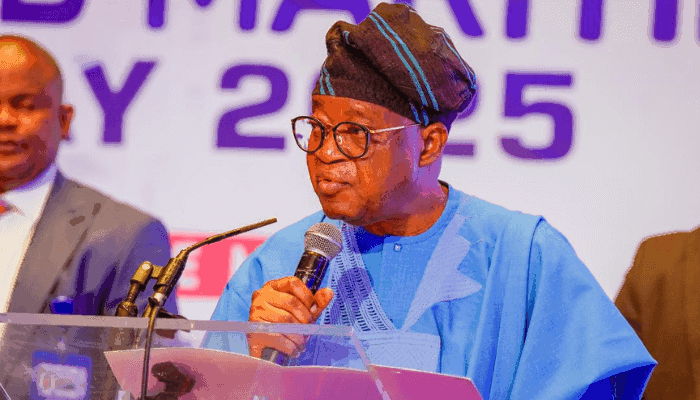
The Enterprise Content Management System (ECMS) was officially launched on Wednesday by the Minister of Marine and Blue Economy, Dr. Adegboyega Oyetola, alongside the Head of the Civil Service of the Federation, Mrs. Didi Walson-Jack, at the Ministry’s Fourth Quarter 2025 Stakeholders and Citizens Engagement held in Abuja.
The event brought together regulators, private sector operators, investors, development partners, and other stakeholders across the marine and blue economy value chain. It was held under the theme, “Positioning Nigeria’s Marine and Blue Economy for Investment, Innovation and Expansion: The Pathway.”
Speaking at the event, Oyetola described the launch of the ECMS as a major milestone in the Ministry’s digital transformation and institutional reform agenda, noting that the system would strengthen transparency, accountability, and operational efficiency.
“A digitally enabled Ministry is a more responsive Ministry. Through the ECMS, we are streamlining workflows, strengthening records management, improving decision-making, and enhancing our capacity to support investors, operators, and partners with speed, clarity, and integrity,” he said.
The Minister said the stakeholder engagement marked a defining moment in the Federal Government’s drive to position the marine and blue economy as a critical pillar of economic diversification, growth, and global competitiveness.
According to him, the forum was designed to deepen transparency, accountability, partnership, and shared ownership of reforms in line with the Renewed Hope Agenda of President Bola Tinubu.
Highlighting the sector’s potential, Oyetola said Nigeria’s long coastline, vast inland waterways, and strategic geographic location offer significant opportunities in maritime trade, fisheries, aquaculture, logistics, tourism, and related services, with the capacity to drive inclusive growth, job creation, and regional integration.
He outlined key achievements recorded by the Ministry in the past year, particularly in fisheries and aquaculture, where local fish production rose from 1.1 million metric tonnes to 1.4 million metric tonnes. While acknowledging that the figure remains below Nigeria’s estimated annual consumption of 3.6 million tonnes, he said the improvement reflects targeted interventions, improved coordination, technology deployment, and better planning within the sector.
The Minister also disclosed that the Ministry has begun engagements with financial institutions to provide single-digit interest loans to fishermen nationwide. He said the initiative is aimed at expanding access to affordable finance, boosting productivity, empowering operators, and curbing illegal, unreported, and unregulated fishing.
On the global front, Oyetola said Nigeria’s election into Category C of the International Maritime Organization (IMO) and its emergence as Chairman of the Conference of Ministers of the Fisheries Committee for the West Central Gulf of Guinea reflect renewed international confidence in the country’s maritime governance, leadership, and policy direction.
He added that the Ministry’s reform drive has attracted national recognition, citing a 96 per cent performance rating by the Central Results Delivery Coordination Unit (CRDCU), positive assessments by the Presidential Enabling Business Environment Council (PEBEC), and recent National Bureau of Statistics data ranking water transportation among the five fastest-growing sectors of the Nigerian economy.
In her remarks, Walson-Jack commended the Ministry for its reforms and achievements, describing the ECMS as a significant step toward paperless governance and improved records management within the public service.
She said the platform would strengthen institutional memory, reduce bureaucracy, improve accountability, and align the Ministry with the Federal Civil Service’s wider digital transformation agenda, while also enabling faster and more efficient service delivery.