


By Lizzy Chirkpi
A Ghanaian Member of Parliament, Dominic Napare, has called on ECOWAS member states to strengthen climate early-warning systems and ensure that critical weather information reaches governments and vulnerable communities early enough to prevent deaths, displacement and destruction.
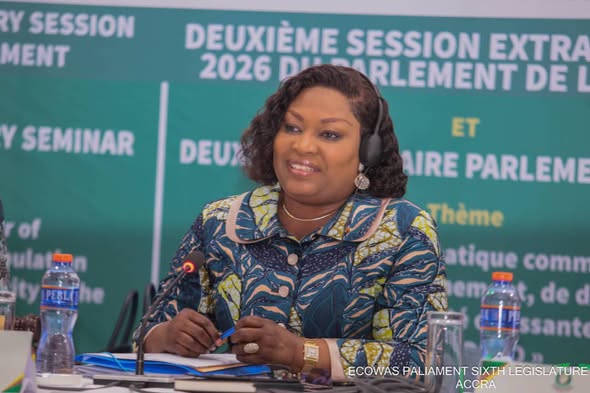
Napare made the call in an interview on the sidelines of the Second Extraordinary Session of the ECOWAS Parliament and Second Parliamentary Seminar in Accra, Ghana.
The seminar, which runs from September 21 to 28, 2026, is focused on the theme: “Climate Change as a Driver of Environmental Degradation, Population Displacement and Rising Insecurity in the ECOWAS Region.”
Napare said climate-related risks could no longer be treated as isolated environmental problems, given their growing implications for food security, livelihoods, health, agriculture, poverty, migration and regional security.
He called for a more coordinated regional approach to climate emergencies, particularly through improved collection, sharing and dissemination of weather and climate information.
“If we really have warnings…,” Napare said, stressing the need to ensure that early warnings translate into timely action at the community level.
His comments come amid growing concern over the ability of African countries to prepare for and respond to increasingly frequent extreme weather events.
The World Meteorological Organisation’s State of the Climate in Africa 2025 report, released in June 2026, said extreme weather and climate-related events affected at least 13 million people and caused more than 3,000 reported deaths across Africa in 2025.
The WMO also reported that floods accounted for more than half of reported climate-related events on the continent, while only about 40 per cent of African countries had multi-hazard early-warning systems in place.
The issue is particularly important for West Africa, where weather and climate risks frequently cross national borders.
The ECOWAS Commission has acknowledged the need for stronger regional data sharing. In April 2026, a meeting of the Regional Committee of Heads of Disaster Management in West Africa recommended that ECOWAS facilitate mechanisms for integrating and sharing data, particularly for flood monitoring and forecasting, to enable member states to access relevant information and tools rapidly.
The recommendation is consistent with Napare’s call for weather information to move quickly from forecasting agencies to governments and communities that need to act on it.
ECOWAS has also been strengthening its early-warning architecture. In February 2026, the commission said its ECOWAS Warning and Response Network, ECOWARN, was reviewing data-collection systems and related challenges as part of efforts to improve early warning, preventive diplomacy and human security across the region.
In November 2025, ECOWAS and the African Development Bank launched an initiative aimed at strengthening the regional organisation’s early-warning and response capacity, including the integration of climate-change considerations into early-warning systems.
Napare’s intervention comes as regional institutions are already examining ways to improve the flow of information, coordination and preventive action.
At the Accra seminar, other experts similarly warned that rising temperatures, erratic rainfall, drought, flooding, rising sea levels and land degradation were placing increasing pressure on communities, infrastructure and livelihoods across the region.
The Speaker of the ECOWAS Parliament, Hadja Mémounatou Ibrahima, said at the opening that climate disruption was increasingly being experienced through declining land productivity, retreating coastlines, flooded neighbourhoods, loss of livelihoods and the relocation of communities.
The challenge, however, is not simply producing forecasts.
Effective early-warning systems require reliable weather observations, accurate forecasting, communication channels capable of reaching exposed communities, and institutions that can translate warnings into evacuation, emergency response and other preventive measures.
The WMO has similarly identified collaboration among meteorological services, disaster-management agencies and local authorities as essential to improving preparedness and response in Africa.
Napare, who represents Sene East in Ghana’s Parliament, is also a member of Ghana’s delegation to the ECOWAS Parliament. Ghana’s Parliament lists him as a member of the Local Government and Rural Development, Education, and Ways and Means committees, as well as Ranking Member of the Parliamentary Affairs Committee.
With climate-related hazards increasingly affecting agriculture, settlements, infrastructure and human mobility, discussions in Accra are placing renewed emphasis on moving from climate warnings and commitments to coordinated preventive action.