


782
By Daniel Adaji
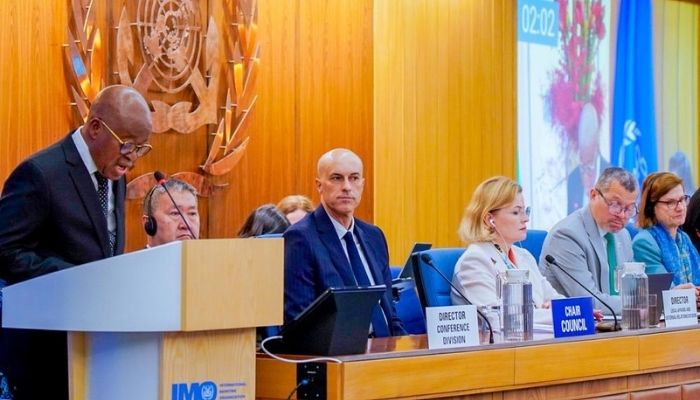
Nigeria has reclaimed its seat on the International Maritime Organisation (IMO) Council after a 14-year absence.
This marks a major diplomatic and economic milestone for the country’s maritime sector and signalling renewed confidence in its global maritime governance.
The breakthrough, achieved in 2025 after a keenly contested election, came under the leadership of the Minister of Marine and Blue Economy, Dr. Adegboyega Oyetola, according to a statement issued on Wednesday, by his Special Adviser, Dr. Bolaji Akinola.
Akinola said “the return to the IMO Council has restored Nigeria’s international maritime standing, strengthened its influence in shaping global maritime regulations, reinforced its leadership role in Africa and reaffirmed international confidence in the country’s maritime governance.”
He described the development as one of several long-standing constraints that were dismantled in 2025, a year he characterised as a turning point for the sector.
Beyond the IMO victory, the statement outlined a string of reforms that have repositioned the marine and blue economy as a key pillar of Nigeria’s economic diversification drive.
“One of the most visible achievements was the resolution of the Apapa gridlock, which for more than two decades paralysed the Lagos port corridor and disrupted trade. By early 2024, coordinated policies, operational discipline and infrastructure optimisation eased congestion, reduced cargo dwell time, lowered logistics costs and restored port efficiency,” he noted.
The Ministry also secured approval in 2025 for Nigeria’s first comprehensive port upgrade and modernisation in over 50 years, a move expected to align local ports with global standards, attract larger vessels and strengthen the country’s role as a maritime and logistics hub for West and Central Africa.
In another regulatory breakthrough, compliance certificates were issued for the Bakassi Deep Sea Port and the Ondo Deep Sea Port to the governors of Cross River and Ondo states respectively, clearing the path for accelerated investment, construction and eventual operations, while expanding national port capacity and regional trade connectivity.
Access to maritime finance also received a boost with the establishment of the Regional Maritime Development Bank in 2025, resolving a 16-year stalemate that had constrained funding for shipping, port development and maritime services.
Closely linked to this was the approval for the Nigerian Maritime Administration and Safety Agency to commence the long-awaited disbursement of the Cabotage Vessel Financing Fund, which had remained idle for over two decades. The activation is expected to strengthen indigenous ship ownership and competitiveness.
On the policy front, the Federal Executive Council approved Nigeria’s first-ever National Policy on Marine and Blue Economy in May 2025. The framework integrates shipping, ports, fisheries, aquaculture, marine tourism, offshore energy, seabed resources and environmental sustainability into a unified national strategy, aimed at improving coordination, attracting investment and driving inclusive growth.
The statement also highlighted gains in maritime security, noting that sustained deployment under the Deep Blue Project has helped maintain zero piracy incidents in Nigerian waters, enhancing investor confidence and regional leadership. In fisheries, Nigeria recorded an increase of 300,000 metric tonnes in fish production in 2025, the first rise in more than a decade, supporting food security and local value chains.
Akinola said “the cumulative impact of these developments has laid a solid foundation for sustainable growth in the sector, with 2025 standing out as a defining year of bold reforms and tangible outcomes.”
He added that the Minister remains committed to supporting indigenous ship owners, boosting fish production and building on the gains already recorded.