


384
By Daniel Adaji
Minister of Marine and Blue Economy, Dr Adegboyega Oyetola, on Tuesday faulted the proposed 2026 budget of the ministry, describing the ₦10.5 billion allocation as inadequate and misaligned.
Oyetola also drew attention to what he described as a budgetary misalignment, disclosing that the 2026 budget of the Council for the Regulation of Freight Forwarding in Nigeria was wrongly domiciled under the Federal Ministry of Transportation instead of the Ministry of Marine and Blue Economy.
He said the error weakened clarity in oversight and disrupted policy coherence within the maritime logistics value chain.
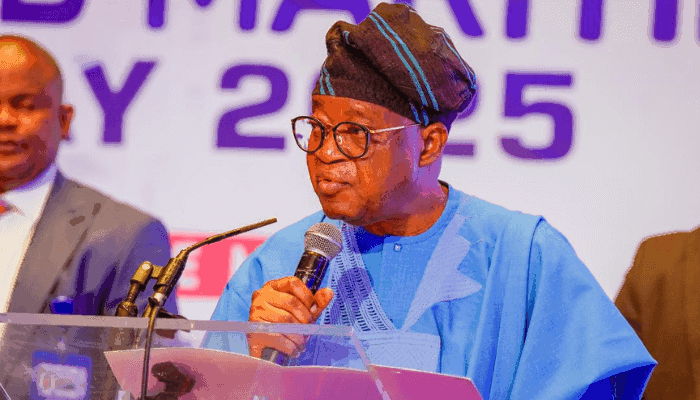
Oyetola raised the concerns while presenting and defending the ₦10,499,984,667.10 budget proposal of the Federal Ministry of Marine and Blue Economy before a joint sitting of the Senate Committee on Marine Transport and House of Representatives committees overseeing maritime-related sectors.
He said the funding level could only sustain basic operations and would fall short of driving reforms or growth in a sector critical to trade, transport efficiency and food security.
Breaking down the proposal, the minister explained that ₦8.24 billion was earmarked for capital expenditure, ₦453.86 million for overheads, and ₦1.81 billion for personnel costs.
He stressed that the ministry supervises interconnected subsectors, ports, shipping, inland waterways, fisheries and aquaculture, which together account for over 90 per cent of Nigeria’s international trade by volume and play a central role in economic competitiveness and national nutrition.
He noted that despite being self-funding, agencies such as the Nigerian Ports Authority, Nigerian Maritime Administration and Safety Agency, and the Nigerian Shippers’ Council were facing operational constraints due to excessive deductions at source by the Office of the Accountant-General of the Federation.
According to him, the practice had weakened liquidity and reduced operational flexibility, leading to port congestion, higher logistics costs, delayed cargo movement, revenue losses and inflationary pressures, turning what should be an accounting issue into a national economic concern.
On inland waterways, the minister appealed for increased funding to address recurring accidents and loss of lives, noting that water transport is globally recognised as cheaper than road haulage.
He said Nigeria’s dependence on roads for over 80 per cent of freight movement had worsened road infrastructure and driven up the cost of goods, arguing that safer and more efficient waterways would ease pressure on roads and lower logistics costs.
Addressing fisheries and aquaculture, Oyetola said Nigeria’s annual fish demand of over 3.6 million metric tonnes far outstripped domestic production of about 1.4 million metric tonnes, sustaining imports valued at more than one billion dollars annually.
He added that post-harvest losses of up to 30 per cent further constrained supply, even as fish remained one of the most affordable sources of animal protein for Nigerian households, assuring that efforts were ongoing to boost local production and reduce imports.
Providing background on the ministry’s funding challenges, the minister disclosed that in 2025, the revised capital budget of ₦3.53 billion recorded an actual cash release of only ₦202.47 million, representing about 1.7 per cent, while overhead releases stood at 35 per cent.
He said engagements were ongoing with the Ministry of Budget and Economic Planning to close the funding gaps in line with the Federal Government’s economic diversification agenda anchored on the marine and blue economy.
In response, Chairman of the Senate Committee on Marine Transport, Senator Wasiu Eshilokun, assured that the National Assembly would give the proposals thorough consideration, citing the strategic importance of the marine and blue economy to national development and economic resilience.