

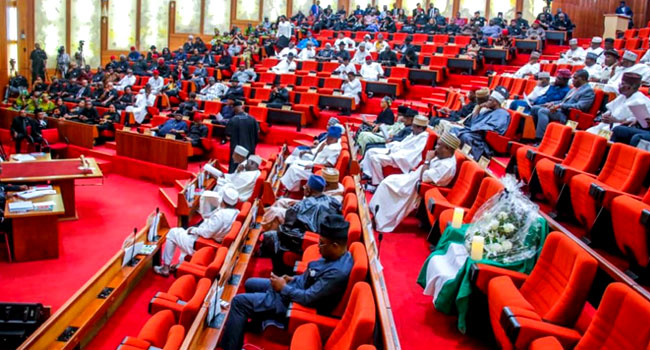

The Senate has moved to curb the export of Liquefied Petroleum Gas (LPG), insisting that locally produced cooking gas must first meet domestic demand before any surplus is shipped abroad.
The move followed an investigative hearing by the Senate Committee probing the supply and distribution of LPG, amid growing concerns over rising cooking gas prices, inadequate local supply and the continued approval of export licences.
Chairman of the committee, Senator Jarigbe Agom Jarigbe, said the Senate was determined to ensure adequate domestic supply and make cooking gas more affordable for Nigerians.
He said the investigation was also aimed at enforcing President Bola Tinubu’s Executive Order 9, which seeks to address challenges in the domestic petroleum and gas sector.
Jarigbe maintained that the interests of Nigerians must not be undermined by export activities at a time when consumers were grappling with high prices and inadequate supply.
“We think that LPG has to be supplied to the domestic market for the good of the common man. That is why Mr President came up with Executive Order 9 to ameliorate the sufferings of our people. We are here as representatives of our people, and we have to enforce that and make sure it is carried out,” he said.
The committee also resolved to summon the Group Chief Executive Officer of the Nigerian National Petroleum Company Limited (NNPCL) and the Managing Director of Chevron to appear before it on December 1, 2026.
The decision followed the failure of the two oil industry executives to attend Wednesday’s investigative hearing.
Jarigbe described their absence as a serious affront to the institution of Parliament, stressing that the summons was an official resolution of the committee.
The senator, however, declined to conclude that the export of LPG amid domestic shortages was part of a deliberate arrangement, saying the ongoing investigation would establish the facts.
He disclosed that the probe would examine revenues generated from LPG exports between 2023 and 2026, particularly whether the proceeds were properly remitted into the Consolidated Revenue Fund as required by law.
“We are going to look at the revenues generated from exported LPG from 2023, 2024 to date, and examine the repatriation of the funds because they are expected to be paid into the Consolidated Revenue Fund. We are interested in that,” he said.
Jarigbe expressed optimism that addressing the supply imbalance would help reduce cooking gas prices, noting that increased availability in the domestic market would ease the burden on consumers.
He also addressed concerns over the propane and butane composition of LPG supplied in Nigeria, explaining that the proportions could be adjusted through blending to meet domestic requirements.
According to him, industry stakeholders had attributed some of the concerns to the 80:20 propane-to-butane ratio. He, however, maintained that the composition could be reversed to 80 per cent butane and 20 per cent propane for local consumption.
On the absence of the Standards Organisation of Nigeria (SON) from the team responsible for enforcing industry standards, the committee chairman described it as an administrative oversight.
He urged the relevant agency heads to improve coordination and ensure that the gap was addressed.
The senator added that the committee had received explanations from agencies that honoured its invitation and that its decisions were informed by their submissions.
Meanwhile, the Nigeria Customs Service (NCS) disclosed that 223.699 metric tonnes of LPG were exported in 2024 and 2025.
Deputy Comptroller-General of Customs, Caroline Kemen Naigwan, who represented the service at the hearing, told lawmakers that approximately 190.8 metric tonnes were exported in 2024, while 32.8 metric tonnes were recorded in 2025.
She said the Customs Service had no record of LPG exports from Escravos in 2026.
Naigwan explained that exporters were required to obtain export clearance certificates from the Federal Ministry of Industry, Trade and Investment and submit the necessary declarations through the Customs Service’s automated platform.
She said a review of the agency’s records showed no LPG export declarations from Escravos in 2026, despite previous approvals granted to some companies.
According to her presentation, NNPCL had secured approval to export 400 metric tonnes of LPG, while Chevron had an approved export volume of 306.4 metric tonnes.
She further disclosed that Wale Hydrocarbon, which operates within the Free Trade Zone, received approval to export 161,000 metric tonnes of LPG in 2025.
The Customs official, however, cautioned against confusing approved export quotas with actual shipments, maintaining that the service had no record of LPG exports from Escravos in 2026.