


By Oscar Okhifo
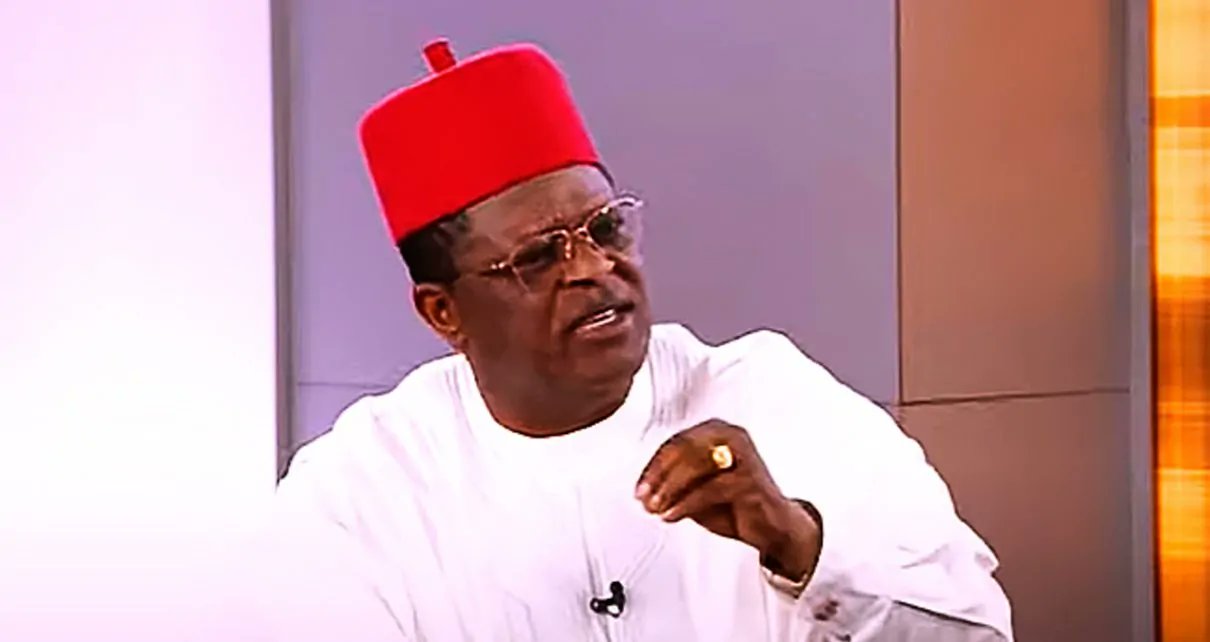
The Minister of Works, Senator David Umahi, has sparked debate over the limits of political rhetoric after declaring that anyone who does not wish President Bola Tinubu and Ebonyi State Governor Francis Nwifuru to secure second terms should never have another second tenure in life.
The remark has raised questions about democratic freedom, political intimidation and the circumstances under which statements made during political campaigns may warrant investigation under the law.
Umahi made the statement on Sunday, October 18, in Abakaliki during a South-East sensitisation campaign covering Ebonyi North and Central senatorial zones. The event was organised as part of the mobilisation efforts of the Tinubu/APC 2027 Presidential Campaign Council.
Expressing confidence in the re-election prospects of both leaders, Umahi said: “President Bola Tinubu is going to win a second tenure. Governor Francis Nwifuru is going to win a second tenure. Anyone that does not wish Tinubu and Nwifuru second tenures, may he not have a second tenure in his life.”
Although Umahi is entitled to campaign for Tinubu and Nwifuru, his choice of words raises questions about whether such rhetoric encourages democratic participation or portrays political disagreement as disloyalty deserving of punishment.
In a multiparty democracy, the right to support an incumbent is no more legitimate than the right to oppose one. Citizens must be free to support candidates of their choice, reject sitting officeholders or change their political allegiances without fear of intimidation.
Political loyalty should not be a condition for participation in public life, just as no political party or officeholder can claim ownership of the electorate. Ultimately, re-election is determined by voters through the ballot box.
Candidates seeking fresh mandates are expected to persuade the electorate through their records in office, policies and promises rather than language that could be interpreted as hostile to those who support alternative candidates.
Umahi’s position as a serving minister and a senior figure in the ruling party’s presidential campaign gives his remarks added political significance. Public officials are expected to recognise that political pluralism, peaceful competition and the freedom to disagree are fundamental principles of democratic governance.
Other remarks attributed to the minister at the campaign event have also drawn attention to the tone of the mobilisation exercise.
According to reports of the event, Umahi said the APC would target victory in 95 per cent of polling units in Ebonyi State and declared that the state was firmly behind the ruling party.
He also reportedly pledged to defend Tinubu and Nwifuru and vowed to tackle anyone who insulted the President, while citing federal infrastructure projects as reasons residents should support the administration.
Political parties are entitled to mobilise supporters and defend their candidates. However, political leaders must distinguish between legitimate opposition, criticism of public officials and conduct that threatens public peace.
Statements that could reasonably be understood as threats or attempts to intimidate political opponents should not be dismissed simply because they are made during campaigns. Where a statement meets the legal threshold for a criminal threat or incitement, the relevant authorities have a responsibility to investigate and, where the evidence warrants it, prosecute those responsible, irrespective of their political standing.
This raises a broader question about the consistent application of the law when politically influential individuals make statements that could threaten public peace or encourage hostility.
Nigerians are entitled to ask whether the relevant authorities will respond appropriately to such concerns, particularly where no investigation has been publicly announced. However, the absence of publicly known action does not, in itself, establish that the police have failed to act.
The police and other relevant authorities must assess each statement on its facts, context and the applicable law. Freedom of expression protects robust political debate, but it does not automatically place credible threats or criminal incitement beyond the reach of the law.
The distinction is important. Offensive or provocative political rhetoric does not automatically constitute a criminal offence or legally defined hate speech. Any decision to investigate or prosecute must be grounded in the content of the statement and the relevant legal provisions, rather than partisan pressure or political considerations.
Beyond the legal questions, the wider democratic principle is clear: Nigerians must be free to support or reject any candidate without intimidation. Public office should not shield anyone from scrutiny, and political influence should not determine who is held accountable under the law.
The issue, therefore, is not whether Tinubu and Nwifuru have the right to seek second terms. They do. Their opponents equally have the right to contest against them, campaign for alternative candidates and persuade voters to reject the incumbents.
Ultimately, it is the electorate, not political threats, curses or declarations of political ownership, that must determine who earns a second term.