


669
By Tracy Moses
A renewed push for constitutional reform dominated discussions on Friday as stakeholders examined a proposal to introduce reserved legislative seats for women in Nigeria. At the centre of the debate was Chidozie Ajah, a gender advocate and constitutional scholar, who argued that the country must address long-standing structural barriers that have historically limited women’s participation in politics.
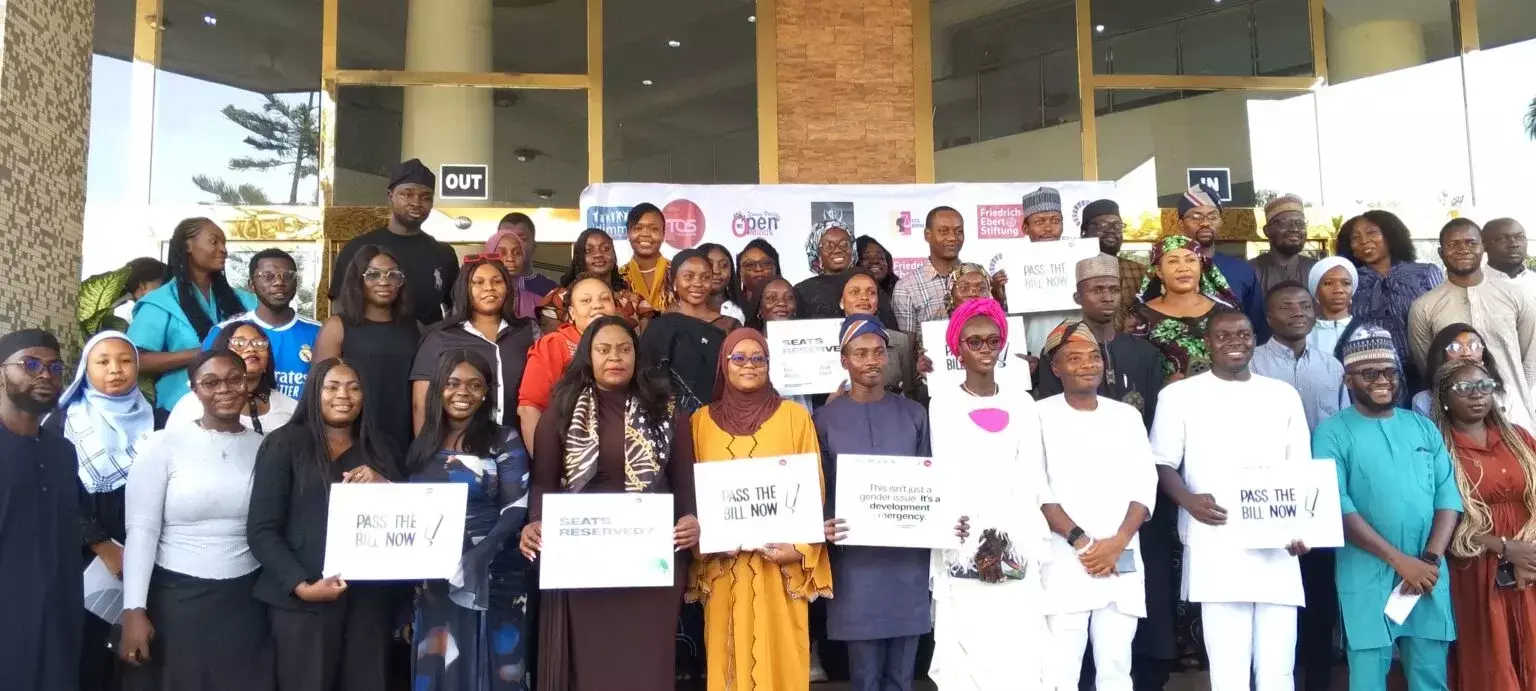
Speaking during a one-day media training organised by the TOS Foundation for National Assembly correspondents, titled “Strengthening Reporting on the Reserved Seats for Women Bill,” Ajah said the low number of women contesting elections is not due to lack of competence or ambition but decades of cultural, religious, and societal conditioning.
“The numbers show the weight of the barriers women have faced for more than a century,” Dr. Ajah said, citing the 2023 general elections. Out of over 1,000 senatorial contenders, only 92 were women, while for the House of Representatives, just 288 women ran out of more than 3,000 candidates.
He dismissed the stereotype that women do not support one another at the polls, highlighting historical examples such as Queen Amina to underscore that Nigerian women have always possessed the capacity to lead.
Nigeria’s global ranking in women’s political representation, he added, is a cause for concern. With only 4.7 percent female representation in the National Assembly, 17 seats in the House and four in the Senate, the country ranks 184th worldwide. “We call ourselves the giant of Africa, yet women hold less than five percent of legislative seats in a nation where they constitute half the population,” he said.
The proposed constitutional amendment seeks to create additional seats reserved exclusively for female candidates—37 in the Senate (one per state and one for the FCT) and 37 in the House of Representatives. At the state level, each assembly would receive three reserved seats, totalling 108 nationwide. This arrangement is expected to run for four electoral cycles (16 years) before review.
However, the Senate Committee reviewing the bill has proposed reducing the Senate’s reserved seats from 37 to six. Ajah noted that even if fully adopted, women would still account for only about 13.6 percent of the National Assembly, an improvement but still below global standards.
“This is not a favour,” he maintained. “It is a necessary correction. Our democracy is functioning at half capacity, and including women makes it stronger, more legitimate, and more stable.”
Addressing concerns about cost and potential political abuse, Ajah explained that the financial implication amounts to about one percent of the national budget, minimal compared to long-term economic gains. He cited a McKinsey report estimating that Nigeria could boost its GDP by up to $229 billion if women are fully integrated into governance and economic life.
He further stressed that the reserved seats would still be contested democratically. “These are not appointments. Women will campaign, canvass, and compete just like men,” he said.
Ajah also highlighted global evidence showing that women legislators are more likely to champion policies on healthcare, education, welfare, and grassroots development, areas often overlooked in male-dominated legislatures. He emphasised the central role of women in peace-building and community conflict resolution.
Adaora Sydney-Jack, a facilitator at the training, said the media would play a pivotal role in shaping public perception of the proposed reform. She urged journalists to avoid portraying women as beneficiaries of charity and instead highlight competence, leadership, policy experience, and measurable achievements.
Drawing examples from Rwanda, Senegal, and Tanzania, countries where reserved seats have significantly advanced women’s political participation, Sydney-Jack noted that gender-sensitive reporting is crucial to normalising women’s leadership. She encouraged reporters to avoid gendered language, stereotypical framing, and undue focus on marital status or appearance in political reporting.
A headline re-framing exercise at the training illustrated the power of narrative. For example, “Woman Emerges Party Candidate” was transformed into “Education Advocate Wins Party Primary After Policy-Focused Campaign,” shifting the focus from gender to merit.
With tensions expected as the bill gains momentum, journalists were urged to prioritise fact-checking, maintain editorial independence, and resist sponsored narratives or orchestrated smear campaigns. Facilitators advised reporters to ask substantive, policy-driven questions rather than gendered or condescending ones during interviews.
“Reserved seats can either be symbolic or truly transformative,” facilitators noted. “The media’s framing will play a defining role in determining which direction Nigeria takes.”
Journalists were encouraged to approach the constitutional debate with heightened responsibility, recognising that the stories they tell could shape whether Nigerians see the proposal as an issue of fairness
or dismiss it as political charity.