


2K
By Oscar Okhifo
The leadership crisis within the African Democratic Congress (ADC) has escalated, with the party dragging the Independent National Electoral Commission (INEC) before the Federal High Court in Abuja over what it describes as unlawful interference in its internal affairs.
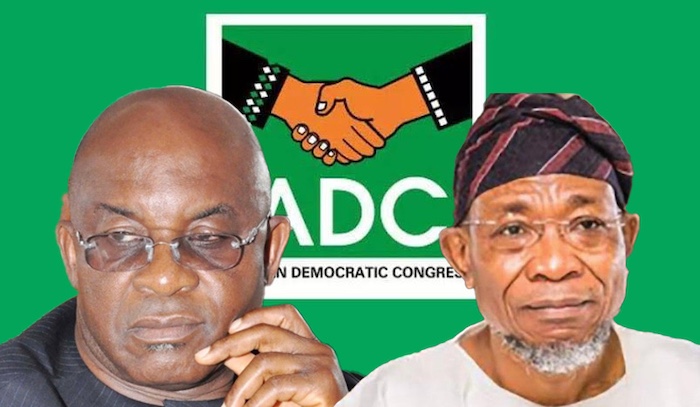
At the heart of the dispute is the delisting of David Mark and former Osun State governor, Rauf Aregbesola, from INEC’s official portal as National Chairman and National Secretary of the party.
Through his counsel, Sulaiman Usman (SAN), the ADC is urging the court to direct INEC to reinstate the party’s National Working Committee as it stood before the crisis deepened.
The suit stems from INEC’s April 1 decision to remove the party’s leadership from its records, a move the Mark faction argues violates a subsisting Court of Appeal ruling which mandated all parties to maintain the status quo ante bellum, the last undisputed leadership arrangement.
The development has further exposed the widening cracks within the party, transforming what began as an internal disagreement into a high-stakes battle for control ahead of the 2027 general elections.
Currently, two rival blocs have emerged; one loyal to Mark and the other led by Nafiu Gombe, each asserting legitimacy and seeking formal recognition from INEC.
While the case is pending in court, tensions escalated in Abuja as supporters of the Gombe faction staged a protest at the headquarters of the Independent National Electoral Commission (INEC), a day after Mark, Obi, Kwankwaso and others led a massive protest to same place.
Gombe and his group are insisting they are the legitimate leadership of the party.
Gombe, who is also contesting the chairmanship position, was quoted as saying:
“We are the legitimate leadership of this party, and any attempt to sideline us will not stand.”
He also warned against what he described as attempts by “political opportunists” to hijack the party structure.
Amid the uncertainty, the party’s founding chairman, Ralph Nwosu, said the ADC would not suspend its activities.
Nwosu stated:
“We will not allow INEC to derail our programmes,” insisting that the party had complied with electoral laws and duly notified the commission of its schedule.
He added that preparations for congresses and the national convention were already underway and would proceed as planned, with or without INEC’s participation, to validate the party’s leadership structure ahead of 2027.
On its part, the Independent National Electoral Commission (INEC) has not hidden the reason behind its action, insisting it acted in line with existing court pronouncements and directives.
However, the development has left the commission caught between two rival claimants, protests, and legal interpretations of court orders.
Now sandwiched between competing factions and mounting pressure, observers say the same temple of justice may ultimately be the arbiter of relief, as all sides turn to the courts for final clarity on the legitimate leadership of the ADC.
However, legal opinions remain divided over INEC’s handling of the matter, with some experts suggesting that the commission may have erred in its approach under the leadership of Joash Amupitan.
There are also concerns over whether the case will be fast-tracked, given its implications for election preparations. Some observers warn that prolonged litigation could disrupt the ADC’s congresses and national convention, potentially weakening its structure ahead of 2027.
In addition, speculation persists that ongoing crises within major opposition parties may be politically motivated to weaken competition ahead of the next general elections, a claim the ruling All Progressives Congress (APC) and presidential allies have consistently denied.
As the legal battle continues, attention now shifts to how quickly the courts will act and whether the ADC can stabilize its structure before the next electoral cycle intensifies