


By John Azu
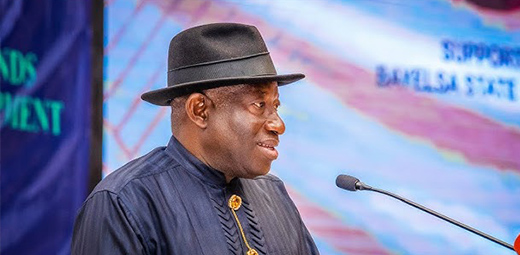
Former President Goodluck Jonathan has filed a preliminary objection and counter affidavit challenging the suit questioning his eligibility to contest the 2027 presidential election.
This is as a Federal High Court in Abuja on Friday fixed Monday, May 11 to hear the suit before it.
Justice Peter Lifu on Friday, while adjourning the suit, directed that all the replies must be filed and served on the parties as the timetable of the Independent National Electoral Commission (INEC) for political activities was tight.
“I am inclined to bend backward to accomodate the plaintiff in making this adjournment,” he said.
An Abuja-based lawyer, Johnmary Jideobi, who brought the action, is seeking a clarification on the constitutional eligibility of Jonathan and asking INEC to stop his interest to seek re-election.
Earlier, counsel to Jideobi, Ndubuisi Ukpai, asked the court for time to respond to the preliminary objection, counter affidavit and memorandum of conditional appearance filed by Jonathan’s lawyers.
In response, lead counsel to Jonathan, Chris Uche (SAN) informed the court that since matter was filed, they only got to know through media reports, noting that the question of his client’s eligibility had been determined by the high courts and the Court of Appeal.
He observed that the lawyer who filed the action was not in court because he has realised the futility of the action.
In the main suit, Jideobi prayed the court to issue an order restraining Jonathan from presenting himself to any political party as a candidate for the 2027 election.
He submits, among others, for a determination of “whether in view of the combined provisions of sections 1(1), (2) and (3) and 137(3) of the 1999 Constitution, the 1st defendant is eligible, under any circumstances whatsoever, to contest for the office of the president of the Federal Republic of Nigeria.”
Jideobi argued that Jonathan had exhausted the constitutional limit allowed for a president, having completed the tenure of the late Umaru Musa Yar’Adua before serving another full term after the 2011 election.
In an affidavit filed in support of the suit, Emmanuel Agida, who deposed on behalf of the plaintiff, said Jonathan was sworn in as president on May 6, 2010, following Yar’Adua’s death a day earlier.
In his counter affidavit, Jonathan also submitted that the plaintiff lacked the locus standi to bring the action and that the action seeks to breach his constitutional right to contest the presidency.
Among the contents deposed to by Emmanuel Tsebo, he averred, among others that ‘the 1st Defendant (Jonathan) was thereafter duly elected as President in the 2011 general elections.
“That the 1st Defendant completed his tenure in 2015. That the 1st Defendant has not been elected as President more
than once.”
Yahoo Mail: Search, Organize, Conquer