


1.3K
By Lizzy Chirkpi
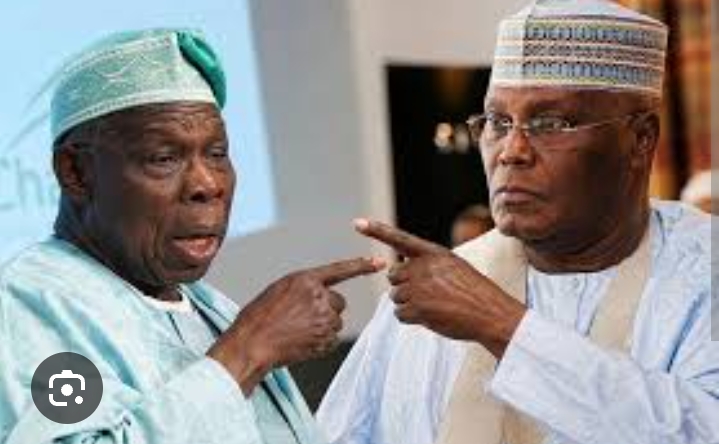
Former Vice President Atiku Abubakar has fired back at former President Olusegun Obasanjo over fresh claims surrounding their bitter political history, accusing the former president of deploying lies, political manipulation and orchestrated deceit to undermine him.
In a statement on Sunday issued by his media adviser, Paul Ibe, Atiku said Obasanjo’s latest allegation that he mobilised the late former Speaker of the House of Representatives, Ghali Umar Na’Abba, to impeach him was baseless and contradicted by key political actors who witnessed events during the 1999–2007 administration.
Describing the claim as part of what he called Obasanjo’s recurring attempts to discredit Atiku ahead of successive election cycles, Ibe declared that the former president’s narrative was now “falling apart like a pack of cards.”
“Obasanjo’s campaign of lies, political manipulation and orchestrated deceit against Atiku for over 20 years is finally falling apart like a pack of cards,” he said.
Obasanjo had reportedly alleged on July 23 that Atiku who is the presidential candidate of African Democratic Congress (ADC) was behind moves by Na’Abba to remove him from office during their tenure.
But Ibe challenged the claim, citing former House Chief Whip Abubakar Bawa Bwari, a major political actor during the period, as contradicting the former president’s account.
According to the statement, Bwari maintained that Na’Abba never sought Obasanjo’s removal, while Atiku acted as an intermediary between the presidency and lawmakers during the political crisis.
He also disputed another narrative surrounding the relationship between Obasanjo and Atiku ahead of the 2003 presidential election.
He cited a video in which former Abia State governor, then of the Peoples Democratic Party, Orji Uzor Kalu, said Atiku knelt before PDP governors to secure their support for Obasanjo’s re-election, rather than Obasanjo kneeling before Atiku.
“Atiku knelt down. We were like 17 governors. He knelt down for us and said that he did not want to be disloyal to Obasanjo,” Kalu was quoted as saying.
Ibe said Kalu’s account also suggested that PDP governors had contemplated replacing Obasanjo with Atiku because of growing concerns over the former president’s leadership style.
“Atiku was almost a President. We had gotten everyone to postpone the convention and had gotten what we needed to move forward. But he said, ‘This man trusted me and gave me the opportunity to work with him. I cannot betray Obasanjo,’” Kalu said, according to Ibe.
The Atiku camp also reopened the bitter 2007 controversy surrounding the Petroleum Technology Development Fund (PTDF), which became a major point of confrontation between the two leaders as Atiku challenged Obasanjo’s third-term ambitions and sought the presidency.
Ibe recalled that Obasanjo had written to the Senate seeking an investigation into alleged diversion of PTDF funds involving Atiku.
Atiku denied wrongdoing and temporarily waived his immunity as vice president to submit himself to investigation, maintaining that the funds were secure in fixed deposit accounts and that the allegations were politically motivated.
Ibe further cited the account of the late Awujale of Ijebuland, Oba Sikiru Kayode Adetona, in his autobiography, Awujale, alleging that the Economic and Financial Crimes Commission (EFCC), under Nuhu Ribadu, was used to pressure businessman Mike Adenuga in connection with the PTDF controversy.
According to excerpts cited by Ibe, Adenuga was arrested and questioned by the EFCC in July 2006 amid allegations that he had received PTDF funds from Atiku to finance the licence for Globacom.
Adetona, however, reportedly wrote that Adenuga obtained a loan from BNP Paribas with which he paid for the Globacom licence.
Ibe also cited Adetona’s account that after Adenuga was questioned and released, Obasanjo subsequently met him at a social event and invited him to Ota, where the former president allegedly solicited his assistance with the construction of the administration block of Bells University.
“Obasanjo used the EFCC to hound Adenuga in his desperation to nail Atiku over the PTDF issue,” Ibe alleged.
The statement further claimed that Adenuga eventually went into exile amid the pressure but returned to Nigeria after Obasanjo left office.
Ibe said the absence of any subsequent prosecution of Adenuga, in his view, cast doubt on the allegations against the businessman.
The latest exchange adds another chapter to the long-running political rupture between Obasanjo and Atiku, whose relationship deteriorated sharply during their second-term administration and culminated in Atiku’s 2007 presidential bid against the political establishment led by Obasanjo.
Atiku, now the presidential candidate of the African Democratic Congress (ADC), is again at the centre of opposition politics ahead of the 2027 general election.
Ibe maintained that the renewed allegations against Atiku would not withstand scrutiny, arguing that accounts from key actors of the period were challenging the historical narrative surrounding the former vice president.
“The facts are catching up with the fiction,” Ibe declared. “After more than two decades, the political narratives constructed against Atiku are beginning to collapse under the weight of the testimony of those who were actually there.”