

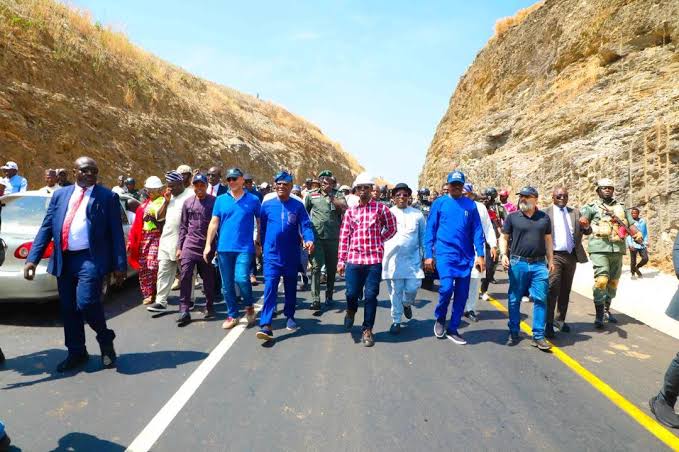

The completion of the long-abandoned Apo-Karshi Road has opened up fresh prospects for tourism, improved transportation and economic development in the Federal Capital Territory (FCT), with Minister of the FCT, Nyesom Wike, promising to transform the corridor into a major tourist destination.
However, beyond the excitement surrounding the project’s completion and its emerging recreational appeal, the circumstances that led to its abandonment have renewed concerns about accountability for contractors who collect public funds but fail to execute government projects.
Wike, who spoke on Wednesday during an inspection of the road in Abuja, said President Bola Tinubu ordered the termination of the original contract after the indigenous contractor failed to deliver the project despite receiving full payment.
He said the President’s intervention paved the way for the contract to be re-awarded to another contractor, given the strategic importance of the road to residents and the development of the FCT.
“This road was awarded in 2010 to an indigenous contractor. We did all we could to persuade the contractor to ensure that the job was fully implemented, even though we had fully paid. But the contractor was not forthcoming,” he said.
Wike explained that after the matter was brought to Tinubu’s attention, the President directed that the contract be terminated and re-awarded to another company.
The minister said the administration was undeterred by criticisms that trailed the award of the new contract, insisting that its priority was to deliver projects that would improve the lives of residents.
“When this contract was awarded, some people were asking how we could award it at that amount. But we were not deterred. All we were concerned about was the happiness and comfort of the people,” he said.
Expressing satisfaction with the quality of work, Wike described the Apo-Karshi Road as one of the most publicised projects undertaken by the Federal Capital Development Authority (FCDA), noting that the difficult terrain made its completion particularly remarkable.
He said reactions on social media showed that many Nigerians were surprised that a project of such scale and engineering complexity could be successfully executed in the country.
According to him, the road reflects the Tinubu administration’s commitment to infrastructure development, urging Nigerians to assess the government’s performance holistically rather than judge it based on isolated issues.
“Look at what is going on in Abuja today, the level of infrastructure and how it has turned out to be a tourist centre. I am happy that people are happy and that Nigerians have seen the infrastructure development being carried out by the Tinubu administration,” he said.
Wike also acknowledged the role of journalists in drawing public attention to the project, saying their reports had helped Nigerians appreciate the scale of work undertaken.
On the proposed commissioning, the minister said the FCT Administration was working around the President’s schedule, as several other projects were being lined up for inauguration.
He disclosed that the administration had inspected projects at the ISEX, Southern Parkway and Kaura District, while between 10 and 12 projects under construction were also being considered for commissioning.
He expressed hope that Tinubu would inaugurate the Apo-Karshi Road before the end of November, adding that the administration would make efforts to persuade the Presidency to accommodate the project in the President’s schedule.
On plans to provide public facilities to support the road’s emerging status as a tourist destination, Wike said the administration would develop appropriate amenities in collaboration with the relevant departments.
He, however, disclosed that he had rejected a proposal from the FCDA coordinator, explaining that the authority’s primary responsibility was road construction, while the department in charge of tourism would determine the facilities required.
“But be sure that I will make it happen as a tourist centre,” Wike assured.
Already, the completed road is attracting residents who visit the area for picnics, recreation and content creation, with its striking hilly terrain generating considerable interest on social media.
Beyond its recreational appeal, the road is also expected to provide a major alternative route for commuters and ease the notorious traffic congestion along the Nyanya-Karu corridor.
For years, gridlock along the axis has been a major source of frustration for motorists and residents travelling between satellite towns and the city centre.
With the completion of the Apo-Karshi Road, commuters hope that its full utilisation will help redistribute traffic, reduce pressure on the Nyanya-Karu corridor and improve journey times.
Its growing recreational appeal and potential to ease traffic congestion suggest that the road could deliver benefits beyond transportation. If Wike’s tourism promise translates into a properly developed destination, the corridor could attract more visitors, stimulate economic activities in surrounding communities and create opportunities for investment.
The provision of recreational facilities, visitor amenities and supporting infrastructure could also generate employment for residents and additional revenue for the FCT Administration, while accelerating development along the corridor.
The Accountability Question
However, the circumstances surrounding the project’s abandonment raise a broader question about the consequences for contractors who collect public funds but fail to execute government projects.
Wike’s disclosure that the original contractor had been fully paid before failing to deliver the road brings into focus the recurring problem of abandoned public projects and the apparent difficulty of holding defaulting contractors accountable.
Across the country, concerns persist over contractors who allegedly retain mobilisation funds and other payments after abandoning projects, while some become embroiled in prolonged legal battles that delay the recovery of public funds and the determination of responsibility.
The situation raises questions about when governments will begin to hold such contractors to account through effective contract enforcement, prosecution where criminal wrongdoing is established and the recovery of public funds.
For many Nigerians, completing abandoned projects is important, but ensuring that those responsible for their abandonment face appropriate consequences is equally necessary. Without meaningful sanctions, the failure of contractors to deliver projects after receiving public funds could continue to undermine infrastructure development and erode public confidence in government.