


By John Azu
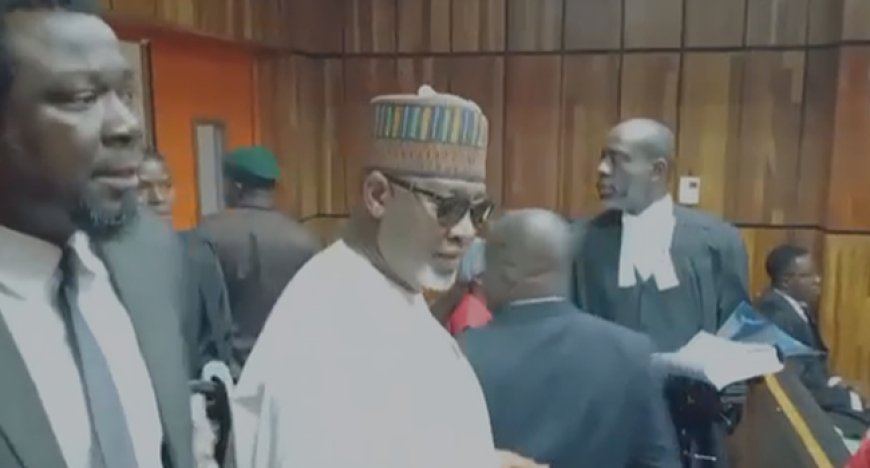
A prosecution witness in the ongoing trial of former Minister of Aviation and Aerospace Development, Hadi Abubakar Sirika, on Wednesday told the Federal Capital Territory High Court that due process was not followed in the award of consultancy contracts linked to the controversial Nigeria Air project.
The witness, Christopher Odofin, an investigator with the Economic and Financial Crimes Commission (EFCC) and the 12th prosecution witness in the case, alleged that consultancy contracts worth N898 million awarded to Tianaero Nigeria Limited were processed in violation of public procurement regulations.
Sirika is being prosecuted by the EFCC on an amended six-count charge bordering on alleged abuse of office and misappropriation of public funds exceeding N2 billion. He is standing trial alongside his daughter, Fatima Hadi Sirika; his son-in-law, Hamma Jalal Sule; and Al Buraq Global Investment Limited.
Led in evidence, Odofin told the court that the Federal Ministry of Aviation and Aerospace Development awarded a consultancy contract valued at N299 million to Tianaero Nigeria Limited and subsequently approved a contract extension worth N599 million for the same company.
According to him, investigations revealed that the first contract was awarded before the ministry obtained the mandatory Certificate of No Objection from the Bureau of Public Procurement (BPP), while the second contract extension was allegedly awarded without the agency’s knowledge or approval.
“Investigation into this case revealed that the Federal Ministry of Aviation and Aerospace Development wrote a letter to the Bureau of Public Procurement BPP, requesting a Certificate of No Objection to engage consultants in respect of the aforementioned contracts. My lord, this letter of request to BPP is dated 7th March 2022. Response to this request from the BPP is dated 6th April 2022 and the same response was received officially in the Ministry on the 7th April 2022, while the award of the contract to Tianaero, my lord is dated 4th April 2022. That is to say, my lord, that before the Ministry of Aviation and Aerospace Development received a response from BPP, the contract award letter had already gone out to Tianaero Limited,” he said.
The witness further alleged that the Bureau of Public Procurement was not informed about the extension of the consultancy contract.
According to Odofin, investigations also showed that Tianaero Nigeria Limited was owned by a German national, Gabriel Tilmann, whom he described as a close associate and friend of the former minister.
He told the court that the full contract sums were eventually paid to the company despite what he described as the absence of any tangible outcome from the Nigeria Air project.
The witness said the N299 million consultancy contract was paid in four tranches into the company’s Access Bank account between May and July 2022, while the N599 million contract extension was settled in two instalments through the company’s Guaranty Trust Bank account between October and December 2022.
Odofin also told the court that although Tianaero Nigeria Limited was registered in Nigeria, the company had existed for barely one year when it was selected as a consultant for the national carrier project.
The court was informed that a compact disc containing what the prosecution described as a verbal directive allegedly issued by Sirika to the ministry’s permanent secretary, instructing that the contracts be awarded to Tianaero Nigeria Limited, was scheduled to be played during proceedings.
However, the playback was deferred after technical difficulties prevented the court from viewing the material.
Justice Sylvanus Oriji subsequently adjourned the matter until July 8 and 9 for continuation of trial.
The Nigeria Air project, conceived as Nigeria’s proposed national carrier, was launched by the administration of former President Muhammadu Buhari as part of efforts to revive a national airline years after the liquidation of Nigeria Airways. The project, however, generated significant controversy following the unveiling of an aircraft painted in Nigeria Air livery shortly before the end of the administration, with critics questioning the transparency of the process, ownership structure and expenditure on the initiative.
The EFCC alleges that public funds were improperly expended in connection with the project, allegations that the defendants have denied. The trial continues.