

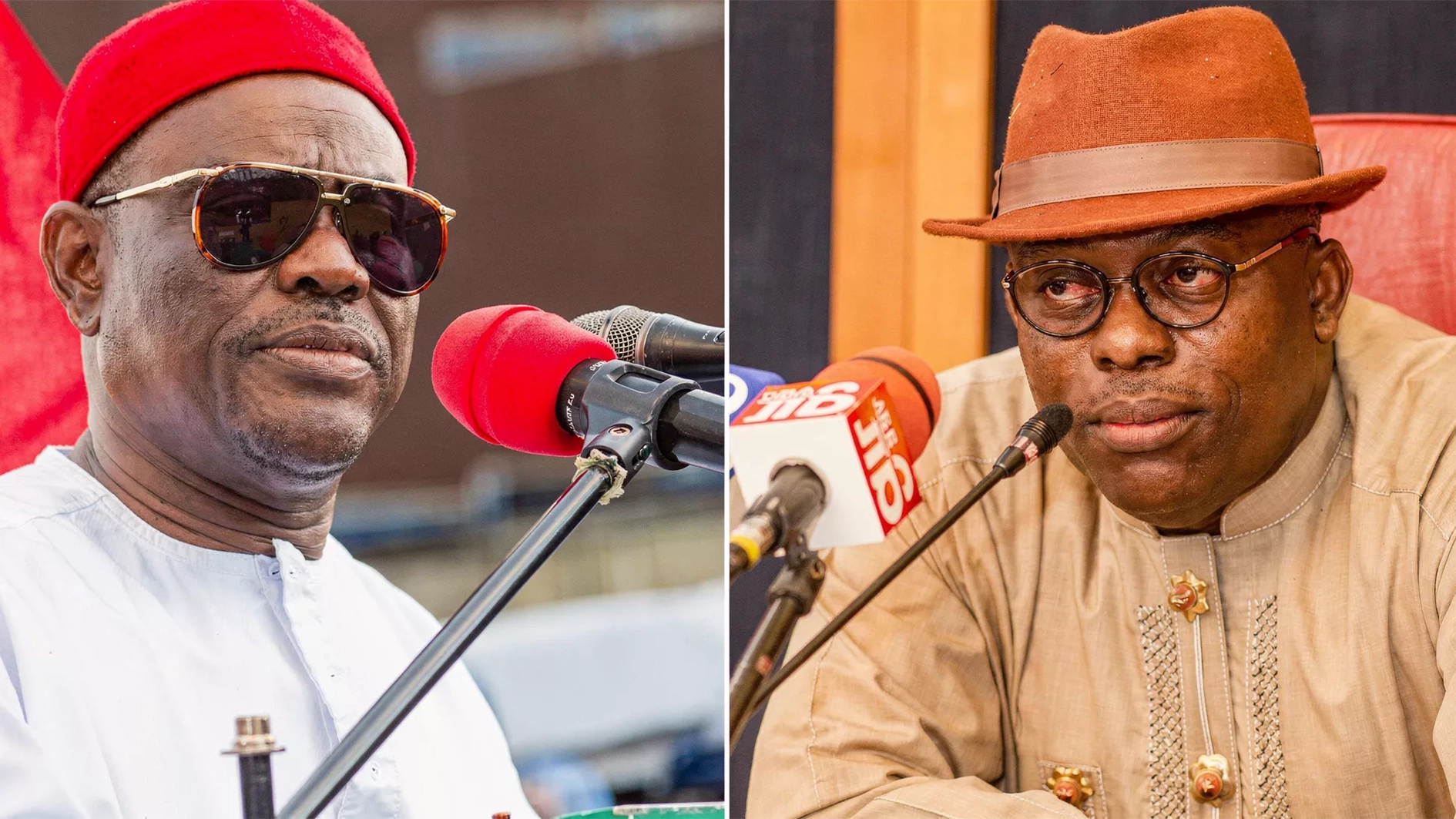

By Oscar Okhifo
Minister of the Federal Capital Territory (FCT), Nyesom Wike, on Tuesday declared publicly that he wanted Rivers State Governor Siminalayi Fubara to secure a second term in office, insisting that his support for the governor had always been genuine despite the political crisis that strained their once-close relationship.
Wike made the remarks during his monthly media briefing in Abuja, where he spoke extensively about the Rivers political crisis, his reconciliation with Fubara, and the circumstances that led to the breakdown of their relationship.
The former Rivers State governor recalled openly endorsing Fubara’s re-election bid during the inauguration of the state’s Ring Road project, arguing that completing the project would have made it difficult for anyone to prevent the governor from winning another term.
“We don’t like the truth. I flagged off the Ring Road and I said that day that if you complete this road, nobody will stop your second term. How do you endorse somebody more than that?” Wike said.
He stressed that Fubara emerged from his political structure and dismissed claims that his influence in Rivers politics amounted to political godfatherism.
“That’s right, you have to build a system and he’s from our political structure. Every group will have its own leader, but that does not make you a godfather,” he added.
Wike, who recently reconciled with Fubara after months of intense political tension, maintained that he had not lost anything from their dispute, suggesting instead that the governor had more to lose if he was unable to pursue another term.
“Those of us who love you, Fubara, feel so bad. If I don’t love him, why would I support him?” the minister stated.
His remarks are expected to reignite debate over the power struggle that divided Rivers State’s political establishment and polarized supporters of both leaders over the past year.
Fubara and Wike became embroiled in a prolonged political crisis shortly after the governor assumed office. The dispute centred on control of the state’s political structure, the Rivers State House of Assembly, local government administration, and the leadership of the ruling political machinery.
The crisis deepened divisions within the Peoples Democratic Party (PDP) in Rivers State, with lawmakers and political appointees aligning with either the Wike or Fubara camp. The standoff attracted national attention and prompted repeated interventions by senior political figures and stakeholders who feared it could destabilise governance in the oil-rich state.
In recent weeks, however, both leaders have taken visible steps toward reconciliation, raising hopes that one of the fiercest political battles in Rivers State since Nigeria’s return to democratic rule in 1999 may finally be ending.
Wike’s latest comments contrast sharply with the widespread perception that he opposed Fubara’s political future. By publicly declaring that he wanted the governor to secure a second term, the FCT minister sought to portray himself as a steadfast supporter rather than an adversary.
Political observers believe the renewed warmth between the two leaders could reshape alliances ahead of future political contests in Rivers State. The reconciliation is also being closely watched by supporters on both sides, many of whom had expected the rivalry to continue.
The renewed rapprochement comes amid broader efforts to restore political stability in Rivers State and rebuild the fractured alliance between the two men. Wike’s comments suggest that, despite the fierce confrontation that once defined their relationship, he still regards Fubara as a member of his political family and insists that his support for the governor was never withdrawn.