

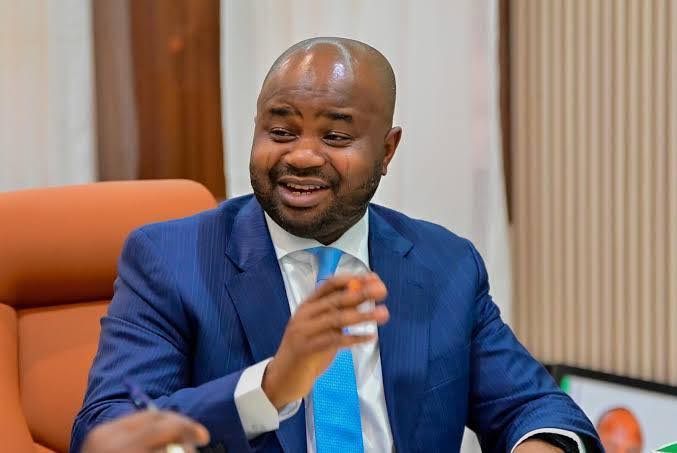

The Executive Chairman of the Nigeria Revenue Service (NRS), Zacch Adedeji, has said the naira could have depreciated to about N3,500 to the dollar if President Bola Tinubu had not implemented the economic reforms introduced since 2023.
Adedeji made the claim on Channels Television’s Politics Today on Sunday while defending the removal of the petrol subsidy, foreign exchange reforms and other policies of the Tinubu administration.
He argued that the reforms, though painful in the short term, had prevented a deeper economic crisis by addressing what he described as structural distortions inherited by the administration.
“If Mr. President has not stopped it, only God knows where this country will have been,” Adedeji said, referring to the removal of the fuel subsidy.
“The exchange rates today will have been roughly at 3,500. If that has not been done,” he added.
According to the NRS chairman, the administration inherited an economy weighed down by four major challenges: an unsustainable petrol subsidy regime, a fragmented foreign exchange market, an underperforming oil sector and a narrow tax base.
He said the situation was compounded by a trade deficit, negative foreign investment inflows, a $7bn foreign exchange backlog at the Central Bank of Nigeria and about N23tn in Ways and Means advances.
Subsidy would have cost N53tn
Adedeji dismissed arguments that the government should have built a financial buffer before removing the petrol subsidy, maintaining that subsidy payments were an expenditure rather than a source of revenue.
“Subsidy is not an income. It is like you are using your own money to buy the product. You borrow money to buy it at ten naira and you are selling it at ten naira,” he said.
He estimated that maintaining the subsidy under prevailing conditions would have pushed its annual cost to about N53tn.
“The subsidy today will have been N53 trillion,” Adedeji said.
He argued that ending the subsidy created incentives for private investment in domestic refining and reduced Nigeria’s dependence on imported petroleum products.
According to him, Nigeria’s domestic refining capacity has expanded significantly since the Tinubu administration came into office.
“Prior to 2023, I told you that we only have refinery capacity of 10,000 a day. Today, we have 700,000 refinery capacity,” he said.
Adedeji attributed the development largely to what he described as Tinubu’s “courageous decision” to remove the subsidy and create conditions for private-sector investment.
He said increased domestic refining would reduce pressure on foreign exchange, create jobs and improve Nigeria’s trade balance.
The NRS chairman also claimed that Nigeria was on course to become a net exporter of Premium Motor Spirit, saying such a development had not occurred in about four decades.
“Now that we become net exporter of PMS in this country. This is what has not happened in four decades,” he said.
Revenue rises to N4.5tn monthly
Adedeji also pointed to higher government revenue and increased allocations to the three tiers of government as evidence of the impact of the reforms.
He said monthly allocations had increased from about N700bn in 2023 to approximately N4.5tn.
“When we came on board, 2023, the total allocation monthly is around 700 billion. Today, we are sharing 4.5 trillion,” he said.
According to him, the increase has strengthened the capacity of state and local governments to pay salaries and fund development projects.
Adedeji, who previously served as a commissioner of finance in Oyo State, said the increased revenue had also helped reduce the frequency of salary-related crises in the states.
He argued that improved revenue should form part of the assessment of the reforms and their impact on ordinary Nigerians.
“If that is not happening [for] the common man, what is happening [for] the common man?” he asked.
Exports, capital inflows increase
The NRS chairman also cited growth in exports and capital inflows as signs that the economic reforms were beginning to reshape the economy.
He claimed that Nigeria’s exports had risen substantially from their pre-2023 level.
“Imagine our trade export today from 44 billion. Now we are exporting 7.5 trillion,” he said.
He linked the growth partly to increased domestic production and refining activities.
Adedeji also attributed increased capital inflows to executive orders and targeted incentives introduced by the administration.
“Just because of Mr President’s executive order and his targeted incentive, I bring it in more than 20 billion as inflows,” he said.
He further pointed to developments in the capital market, including the rise in the All-Share Index, as evidence that investors had benefited from the changing economic environment.
FX reform attracts investment
Defending the foreign exchange reforms, Adedeji said the previous multiple-exchange-rate regime discouraged investors and created distortions in the market.
He argued that investors would be reluctant to bring capital into Nigeria if they were unable to access foreign exchange at rates that reflected market realities.
“If you have a change rate at 463, and the official rate is probably at 1-2, you have zero capital importation,” he said.
He maintained that the reforms had removed a major obstacle to investment by making the foreign exchange market more transparent.
Adedeji also claimed that corporate earnings had improved significantly since the reforms were introduced.
“What you see in their corporate results, that their profit before tax or their earnings, it’s multiplied by six compared to where we started from,” he said.
Reserves, import cover improve
Adedeji further cited the country’s foreign exchange reserves as another indication of improved macroeconomic stability.
He said Nigeria had moved from a position where its reserves could cover less than two months of imports to a level he said could finance about 10 months of imports.
“External reserve… could not even import two months. Today, 51… this can take 10 months import for Nigeria,” he said.
He attributed part of the improvement to reduced dependence on imported petroleum products as domestic refining capacity expands.
According to him, reducing fuel imports would also reduce the demand for foreign exchange associated with petroleum imports.
Tax reforms drive revenue growth
Adedeji also linked the increase in government revenue to reforms in the tax system.
He said Nigeria had operated for decades with an outdated tax framework and that the administration was modernising revenue collection and broadening the tax base.
According to him, the NRS collected about N2.3tn in 2023, while collections increased to N20.3tn in 2025. He projected N27.1tn in 2026 and said the longer-term target was N40tn.
He argued that increased revenue was translating into higher allocations to state and local governments and greater capacity to fund public services.
‘Give reforms time to reach households’
While acknowledging concerns over inflation and the rising cost of living, Adedeji argued that structural reforms would take time to translate fully into improved household welfare.
He said the government’s immediate priority was to stabilise the fundamentals of the economy before the benefits could be broadly felt.
“Don’t forget that we are just less than three years in this movement,” he said.
“I’m trying to show a viewer. This is a start-up.”
He cited the student loan scheme, compressed natural gas initiatives, higher allocations to states, improved corporate performance and increased investment as measures that could eventually translate into better living conditions.
Adedeji said the government had also introduced interventions intended to cushion the effects of higher transportation and living costs following the removal of the subsidy.
He rejected claims that the reforms had simply made Nigerians poorer, arguing that their impact should be assessed against broader indicators such as investment, employment, government revenue, business performance and economic output.
‘Nigeria inherited distorted economy’
The NRS chairman maintained that the Tinubu administration inherited an economy facing serious structural challenges and deliberately chose to tackle them despite the immediate hardship associated with the reforms.
He said the government had prioritised correcting what it considered fundamental weaknesses rather than sustaining policies that were becoming increasingly difficult to finance.
“Economics is not run by emotion. They respond to the rules derived from the fundamentals,” Adedeji said.
The Tinubu administration began its reform programme shortly after the President assumed office on May 29, 2023, when he announced the end of the petrol subsidy in his inaugural address. The decision triggered an immediate increase in petrol prices and contributed to higher transportation and living costs.
The government subsequently implemented foreign exchange reforms, including the unification of exchange-rate windows, while introducing measures aimed at boosting domestic revenue, attracting investment and expanding local refining capacity.
The administration has continued to cite higher government revenue, increased refining capacity, stronger capital inflows and improvements in other macroeconomic indicators as evidence that the reforms are working.
Critics, however, have continued to point to high inflation, food prices and the cost-of-living crisis confronting households, arguing that improvements in macroeconomic indicators have yet to translate sufficiently into better living standards.
Adedeji maintained that reversing the reforms would carry a greater economic cost and insisted that the government’s policies were designed to address the underlying weaknesses in the economy.
“If Mr. President has not taken that decision at that time, only God knows where we will have been now,” he said.