


By Tracy Moses
The Nigeria Customs Service (NCS) generated N4.30 trillion in revenue in the first six months of 2026, representing 36.4 per cent of its N11.074 trillion annual target.
The performance was reviewed at the 65th Regular Meeting of the Nigeria Customs Service Board (NCSB), chaired by the Minister of Finance and Coordinating Minister of the Economy, Professor Taiwo Oyedele.
The Board noted that the Service had intensified revenue collection through the full deployment of the Unified Customs Management System, known as B’Odogwu, as well as expanded post-clearance and real-time audits.
Other measures highlighted at the meeting included the Authorised Economic Operator (AEO) and advance ruling programmes, deployment of geospatial technology, joint border patrols and increased engagement with the trading community.
The Board expressed its commitment to sustaining revenue mobilisation while improving trade facilitation and operational efficiency.
The revenue performance comes amid the Federal Government’s broader efforts to strengthen domestic revenue generation and reduce reliance on oil revenues in the face of fiscal pressures and rising expenditure demands.
Beyond revenue collection, the Board considered several administrative and operational matters, including appointments to the senior management cadre following the statutory retirement of some officers.
It approved the confirmation of one Deputy Comptroller-General of Customs (DCG) and five Assistant Comptroller-Generals of Customs (ACGs), in accordance with the Federal Character Policy as provided under Section 14(4) of the Nigeria Customs Service Act, 2023.
Constantine Dim from the South-East was confirmed as DCG, while Pascal Chibuoke and Ethelbert Nnaji, both from the South-East; Sani Yahaya from the North-Central; and Franklin Onyeka and Chibuzor Eyakwaire from the South-South were confirmed as ACGs.
The Board also approved the upgrade of the NCS Medical Corps to a sub-department to be headed by an Assistant Comptroller-General and supported by nine Comptrollers.
On recruitment, the Board received an update on the ongoing exercise and noted that successful candidates had been invited for documentation, physical and medical screening scheduled to commence on September 7, 2026.
The meeting also considered disciplinary cases involving officers of the Service. Following deliberations on appeals, the Board approved various outcomes, including dismissal, exoneration, warning, compulsory retirement and reinstatement, depending on the circumstances of individual cases.
In another major decision, the Board approved the Nigeria Customs Service De-Minimis Regulation, 2025, following a report by its Technical and Operations Committee.
The regulation is aimed at aligning the Service’s de-minimis framework with the provisions of the Nigeria Customs Service Act, 2023, which provides the legal basis for the administration and modernisation of customs operations.
The Board was also briefed on ongoing digital transformation initiatives, with progress reported across trade systems, human resources automation, NII infrastructure and other digital applications.
According to the Board, the initiatives are part of efforts to modernise customs administration, improve transparency and reduce manual processes that can hinder trade and revenue collection.
The Board further noted an invitation from the Federal Ministry of Finance for memoranda proposing amendments to the Nigeria Customs Service Act for possible consideration in the 2027 Finance Bill.
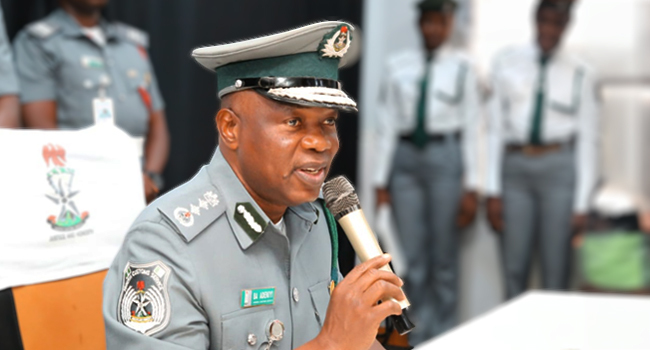
The Comptroller-General of Customs, Bashir Adewale Adeniyi, on behalf of the Nigeria Customs Service Board, congratulated the newly confirmed management officers and reaffirmed the Service’s commitment to accountability, institutional strengthening and sustained revenue mobilisation.
With N4.30 trillion already collected by the end of June against an annual target of N11.074 trillion, the Service will need to sustain and deepen its enforcement, digitalisation and compliance efforts in the second half of the year to close the revenue gap and meet its 2026 target.