


By Lizzy Chirkpi
The United States has commended the National Drug Law Enforcement Agency (NDLEA) for dismantling four clandestine methamphetamine laboratories linked to Mexican drug cartels in Nigeria, describing the operations as evidence of effective intelligence gathering and international cooperation.
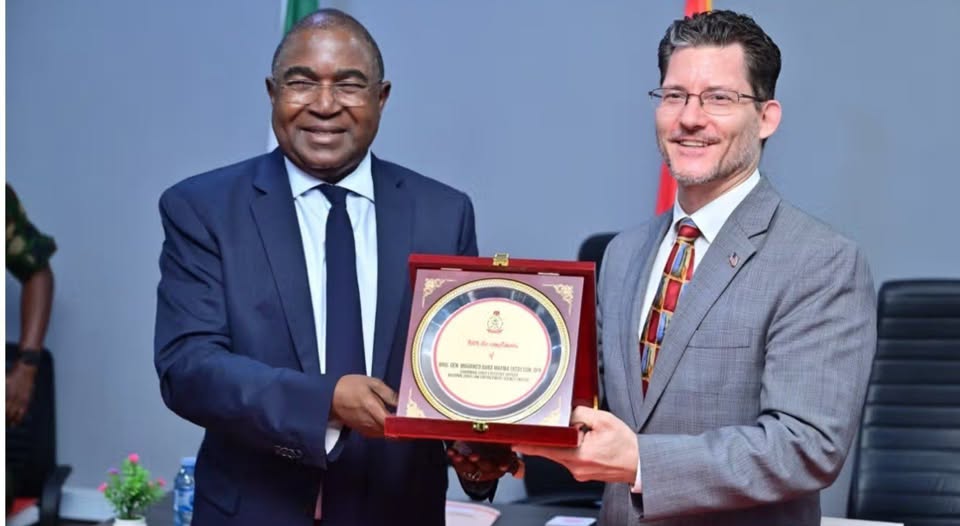
The commendation came from Michael Gonzales, the US Deputy Assistant Secretary of State for International Narcotics and Law Enforcement Affairs (INL) for Africa and the Middle East, during a visit to the NDLEA national headquarters in Abuja on Tuesday.
Gonzales, who was received by the agency’s Chairman, Brig. Gen. Mohamed Buba Marwa (retd.), and members of its management team, said Nigeria was his first choice for an official visit since his appointment four months ago because of its strategic importance and the NDLEA’s operational achievements.
He described Nigeria as a continental leader and economic powerhouse, adding that the agency’s record and longstanding partnership with the US made the country a natural starting point.
“When I was thinking where does it make the most sense to visit first, Nigeria was a clear answer,” he said.
Gonzales said he was particularly impressed by the NDLEA’s leadership and the successes recorded through collaboration with other Nigerian agencies.
“In addition to the very robust partnership between INL and NDLEA, I wanted to see firsthand where the magic happens, as we say in the United States,” he added.
He cited the four methamphetamine laboratory busts recorded by the agency this year as evidence of its commitment to intelligence-led investigations, cross-border cooperation and international best practices in combating illicit drug production and trafficking.
“The four meth lab busts just this year alone is a testament to the deployment of some of the best practices in our tradecraft,” he said.
The US official described counter-narcotics operations as critical to protecting communities in both countries, noting that the transnational nature of drug trafficking required sustained cooperation among law enforcement agencies.
“When I am talking to American audiences in the United States, I tell them there’s virtually no other issue of foreign policy that so tangibly affects the lives of every community, virtually every family across our country, than narcotics,” he said.
He warned that drug trafficking networks operated across national borders with few constraints, making international collaboration essential to disrupting their activities.
“The work that INL does in the United States and globally and the work that NDLEA does fundamentally delivers for the Nigerian people, for the American people,” he said.
Gonzales also drew attention to the growing shift from plant-based drugs to synthetic substances, which he said were often more difficult to detect and potentially more dangerous.
According to him, intensified pressure on drug cartels in the Western Hemisphere was pushing traffickers to explore alternative routes through Africa to reach markets in Europe, Asia and Oceania.
He called for a comprehensive strategy against transnational criminal organisations, including measures to disrupt the financial networks that sustain their operations.
Responding, Marwa said the NDLEA’s partnership with the US government, through INL’s institutional support and cooperation with the US Drug Enforcement Administration (DEA), represented a shared investment in the security of both countries.
He said drug trafficking, arms smuggling and terrorism financing were interconnected threats that required coordinated action.
“Crime has no borders, and neither does the threat. The drugs we seize, the arms we intercept and the terrorist financing we trace are not separate problems. When we seize narcotics and illicit weapons in the same operations and along the same routes, we are looking at the convergence of crime,” Marwa said.
He explained that proceeds from drug trafficking often financed arms purchases, which in turn sustained armed groups and terrorist organisations.
“Drug money buys guns, guns sustain armed groups, and armed groups sustain terrorism,” he said, warning that insecurity in the Sahel and the Lake Chad Basin could have consequences beyond the region.
Marwa disclosed that NDLEA operatives had dismantled what he described as Nigeria’s largest clandestine methamphetamine laboratory in a forest in Ijebu East, Ogun State, arresting three Mexican methamphetamine experts and their Nigerian collaborators.
He said illicit substances valued at more than $360m were recovered during the operation.
Barely four weeks later, the agency raided another industrial-scale laboratory in Tapa Village, Oyo State, arresting a Mexican methamphetamine expert and four Nigerian collaborators, he added.
Marwa said similar facilities had subsequently been dismantled in Enugu and Ebonyi states, with the operations linked to Mexican drug cartels.
“These were not isolated incidents. They show a deliberate attempt to turn Nigeria into a manufacturing hub,” he said.
The NDLEA chairman warned that the cartels were not setting up production facilities in Nigeria merely to supply the domestic market but were seeking to use West Africa as a transit corridor for distributing industrial quantities of methamphetamine internationally.
“Every meth-producing laboratory that we shut down is a supply line that never reaches an American street, and every cartel operative we arrest is one fewer in the pipeline,” Marwa said.
He described the work of the agency’s forensic chemists, investigators and tactical teams as a form of forward defence for American communities against the international drug trade.
Marwa also credited INL assistance with strengthening the NDLEA’s capacity in forensic and chemical analysis, professional training, financial crime investigations and equipment maintenance.
He said the partnership had contributed significantly to the agency’s enforcement record over the past five years, during which it arrested 96,157 drug offenders, including 250 drug barons, seized more than 15.8 million kilogrammes of assorted illicit drugs and secured the conviction of 16,691 traffickers, including major drug kingpins.
“This great partnership has fueled our offensives that yielded the arrest of 96,157 drug offenders, including 250 drug barons, the seizure of over 15.8 million kilograms of assorted illicit drugs and conviction of 16,691 drug traffickers, including the kingpins, in the last five years,” he said.
The NDLEA chairman, however, warned that any reduction or withdrawal of US assistance could create gaps that criminal networks and terrorist groups might exploit.
He urged Gonzales to convey to Washington the need to sustain and expand its support for the agency.
“INL support, as it is, should be maintained if not increased,” Marwa said.
He added that drug traffickers, arms dealers and terrorist groups continued to cooperate across borders, arguing that governments seeking to dismantle their networks must demonstrate the same level of coordination.