


With efforts being diverted towards the diversification of the nation’s
ailing economy, the Federal Government has described Dangote Fertilizer
and Petrochemical projects as credible industrials undertaken capable of
reducing poverty through generation of foreign exchange.
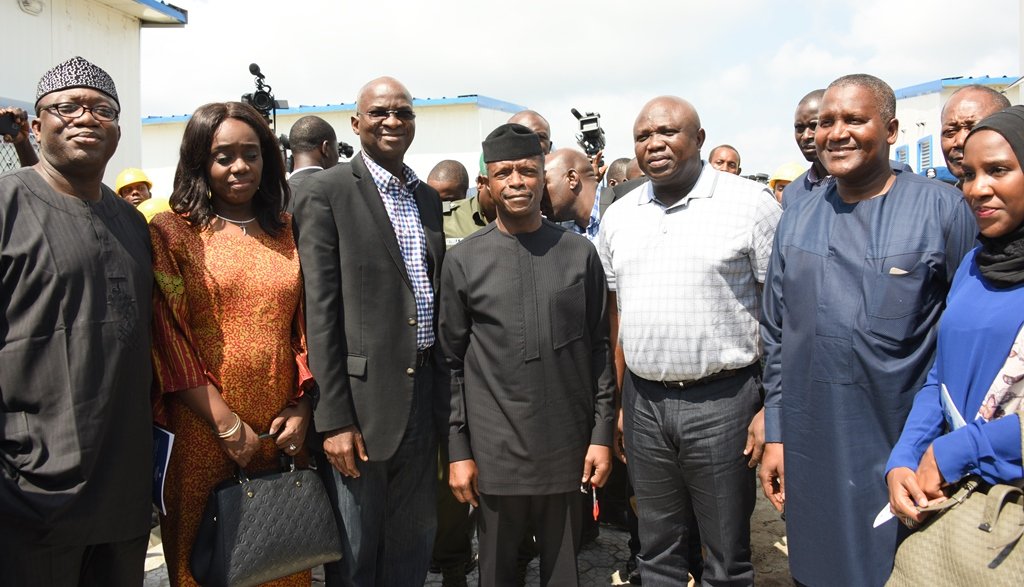
Vice-President, Professor Yemi Osinbajo and President of Dangote Group,
Aliko Dangote said the Dangote Refinery , Petrochemicals and fertilizers
reputed to be the biggest in Africa when completed offered hopes in the
quest for diversification of Nigeria’s economy from total dependence on
oil to other areas like Agriculture and Solid minerals.
Osinbajo who was on working visit to the site of the projects at Lekki
Free Trade Zone in Lagos in company with Ministers of Finance; Power,
Works and Housing; Solid Minerals Development as well as the Minister of
State for Trade and Investments expressed amazement at the size of the
projects and reiterated government’s preparedness to provide enabling
environment for businesses to thrive.
He commended the business acumen Aliko Dangote saying the projects
remained the most important in the country presently and must be supported
as it would help Nigeria’s economy when completed.
The Vice-President explained that the federal government would harness the
potentials of the private sector to make the nation economy recover
speedily.
Addressing newsmen on the visit by the Vice-President, Dangote explained
that the diversification of Nigeria economy was long over due and that one
sector that Nigeria can focuses on to rejuvenate the economy is
agriculture.
He stated that his investment in fertilizer is one sure way the
diversification into agriculture could succeeded because according to him,
it will amount to little if focus is directed to agriculture and
fertilizers would be imported.
Said he: It is agriculture is the way to go, but a critical component of
that sector is fertilizers, Nigeria has more arable land than China which
now is the biggest economy in the world, we can tap into our vast land and
produce what we need and even export the remaining.
“By the time we complete this project, there will be opportunity to take
on agriculture and say bye to poverty, because there will be jobs, no
sector has more job potential than agriculture”
Dangote said the project was an ambitious one and that when completed it
will give Nigeria a new economic direction in the quest for
diversification of the economy, as excess products would be imported to
give Nigeria the much needed foreign exchange. That is when
diversification starts.
Earlier, Dangote told the Vice-President that the $12 billion refinery
would have a capacity of 650,000 barrels a day. He assured that there will
be market for the refined products because even in Africa, only three
countries have effective functioning refinery with others importing from
abroad.
Dangote named the countries with refinery as Egypt, South Africa and Cote
‘de Ivore saying our refinery be ready in the first quarter of 2019.
Mechanical completion will be end of 2018 but we will start producing in
2019.”
When the projects fully take off in 2019, Dangote said it will effects
help the country save $5 billion spent on the importation of oil into the
country.
The Refinery, Petrochemicals and fertilizer in one spot according to him
is the single largest stream in the world. “This site is the biggest site
in the world, the refinery is the biggest single refinery in the world,
the petrochemicals is 13 times bigger than Eleme petrochemicals while the
fertilizer plant will be 10 times bugger than former National Fertilizer
company .He explained that the project with the $2 billion fertilizer
unit was the funded through loans, export credit agencies and our own
equity.
Speaking on the forex situation and the purchase of dollar from the
Central Bank, Dangote said the $161 million his companies bought during
that period from the central bank merely reflected the size of his
business and did not represent preferential treatment.
“We have been badly affected like any other company,” he said, arguing
that operational costs totaled $100 million each month due to recurring
expenses such as the purchase of parts for cement production and running a
fleet of 9,000 trucks.
“When you are talking about 20 billion dollars worth of projects, what is
161 million? One-hundred-and-sixty-one million dollars is what I need in
just six weeks,” he said.
“This week, the central bank removed the peg that has held the naira at
the official rate of 197 for the last 16 months, leading to a 30 percent
devaluation as the currency traded freely on the interbank market.
Dangote said the decline had pushed up costs.”This devaluation alone, we
have lost over 50 billion naira ($176 million),” he said.
“The gas, which is our main source of power, is priced in dollars. If
there is 40 percent devaluation, your price will go up by 40 percent.
Every single aspect of the production will go up by that percentage,” he
said