

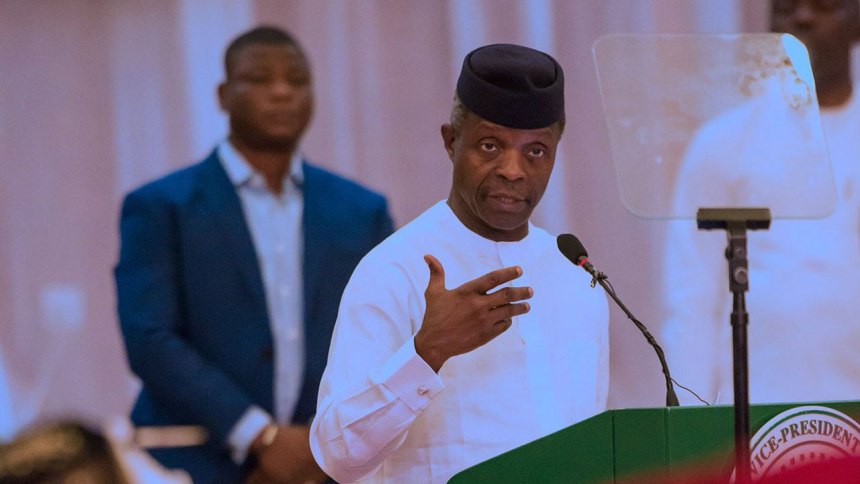

Vice President, Yemi Osinbajo, has replied former Vice President and a
presidential aspirant, Atiku Abubakar, who attacked his position on
restructuring.
Read full statement:
RE: OSINBAJO GOT IT WRONG ON RESTRUCTURING – ATIKU
Dear Editor,
Kindly permit me a response to a piece in your publication, titled
“Osinbajo got it wrong on Restructuring,” written, we are told, by my
illustrious predecessor in office, Alhaji Atiku Abubakar.
First, let me say that I really would have expected Alhaji Abubakar to at
least get the full text of my comments before his public refutal of my
views. But I understand; we are in that season where everything is seen as
fair game! He quoted me as saying that “the problem with our country is
not a matter of restructuring… and we must not allow ourselves to be drawn
into the argument that our problems stem from some geographic
re-structuring”.
Yes, I said so.
As the quote shows, I rejected the notion that geographical restructuring
was a solution to our national problems. Geographical restructuring is
either taking us back to regional governments or increasing the number of
States that make up the Nigerian federation.
As we all may recall, the 2014 National Conference actually recommended
the creation of 18 more States. And I argued that, with several States
struggling or unable to pay salaries, any further tinkering with our
geographical structure would not benefit us.
We should rather ask ourselves why the States are underperforming, revenue
and development wise. I gave the example of the Western Region (comprising
even more than what is now known as the South West Zone), where, without
oil money, and using capitation tax and revenues from agriculture and
mining, the government funded free education for over 800,000 pupils in
1955, built several roads, farm settlements, industrial estates, the first
TV station in Africa, and the tallest building in Nigeria, while still
giving up fifty percent of its earnings from mining and minerals for
allocation to the Federal Government and other regions.
I then argued that what we required now was not geographical restructuring
but good governance, honest management of public resources, deeper fiscal
Federalism, and a clear vision for development.
On the issue of deeper fiscal Federalism or restructuring, I explained how
the then Lagos State Government, led by Asiwaju Bola Ahmed Tinubu, decided
to fight for greater autonomy of States.
As Attorney-General at the time, it was my duty and privilege to lead the
legal team against the then Federal government, in our arguments at the
Supreme Court. I am sure that Alhaji Atiku Abubakar would remember these
cases on greater autonomy for States that I cite below, as he was Vice
President of the Federal Republic of Nigeria at the time.
At the Supreme Court, we won several landmark decisions on restructuring
Nigeria through deeper fiscal federalism, some of which our late converts
to the concept, now wish to score political points on.
It was our counter-claims alongside those of other littoral States, that
first addressed so comprehensively the issue of resource control. We
agreed with the oil producing States that they had a right to control
their resources. We argued, though unsuccessfully, that the Ports of Lagos
were also a resource, which should enable Lagos State, in the worst case,
to be paid the derivation percentage for proceeds of its natural
resources. Years later, we also filed an action at the Supreme Court
arguing that the Value Added Tax, being a consumption tax, should
exclusively belong to the States.
On the issue of who, between the Federal and State governments, should
have authority to grant building permits and other development control
permits, the Supreme Court, by a slim majority, ruled in our favour. It
held that, even with respect to federal land, States had exclusive
authority to grant building or other developments control permits.
In 2004, we created 37 new local governments in Lagos State. We believed
that we had a Constitutional right to do so and that in any event, a State
should have a right to create its own administrative units. Several other
States joined us and created theirs.
The Federal government’s response was to seize the funds meant for our
local governments, thus strangulating States like Lagos, which had created
new local governments. We challenged this at the Supreme Court. The court
held that the President had no right under the Constitution to withhold or
seize funds meant for the States. The allocations were not a gift of the
Federal Government to the States. They were the Constitutional right of
the States and local governments.
The court also agreed that States had a Constitutional right to create
local governments, pursuant to section 8 of the Constitution, but that
the creation remained inchoate until the National Assembly, by resolution,
amended the existing list of local governments to capture the newly
created LGs.
In response, we created by State Law, Local Council Development Areas
(LCDAs), to accommodate the newly created Local Government Councils until
such a time as the National Assembly would complete the process. But the
Lagos State Government took up the challenge to re-engineer its revenue
service, making it autonomous. With innovative management, tax collection
in Lagos became more efficient, and tax revenues continued to grow
geometrically. Today, the State earns more IGR than 30 States of Nigeria
put together!
Further, we contested the attempts of the then Federal Government to
create supervisory authority over the Finances of Local Governments by the
signing into law of the Monitoring of Revenue Allocation to Local
Governments Act, 2005. The Supreme Court also ruled in our favour,
striking down many provisions of the law that sought to give the Federal
government control over local government funding.
I have been an advocate, both in court and outside, of fiscal Federalism
and stronger State Governments. I have argued in favour of State Police,
for the simple reason that policing is a local function. You simply cannot
effectively police Nigeria from Abuja. Only recently, in my speech at the
Anniversary of the Lagos State House of Assembly, I made the point that
stronger, more autonomous States would more efficiently eradicate poverty.
So I do not believe that geographical restructuring is an answer to
Nigeria’s socio economic circumstances. That would only result in greater
administrative costs. But there can be no doubt that we need deeper fiscal
Federalism and good governance.
Alhaji Atiku’s concept of restructuring is understandably vague, because
he seeks to cover every aspect of human existence in that definition. He
says it means a “cultural revolution”. Of course, he does not bother to
unravel this concept. He says we need a structure that gives everyone an
opportunity to work, a private sector driven economy. Yes, I agree. These
are critical pillars of our Economic Recovery and Growth Plan (ERGP),
including our Ease of Doing Business Programme.
If, however, this is what he describes as restructuring, then it is clear
that he has mixed up all the issues of good governance and diversification
of the economy with the argument on restructuring.
Good governance involves, inter alia, transparency and prudence in public
finance. It involves social justice, investing in the poor, and jobs for
young people; which explains our School Feeding Programme, providing a
meal a day to over 9 million public school children in 25 States as of
today. Our NPower is now employing 500,000 graduates; our TraderMoni that
will be giving microcredit to 2 million petty traders; our Conditional
Cash Transfers giving monthly grants to over 400,000 of the poorest in
Nigeria. The plan is to cover a million households.
Surprisingly, Alhaji Atiku leaves out the elephant in the room –
corruption. And how grand corruption, fueled by a rentier economic
structure that benefits those who can use political positions or access to
either loot the treasury or get favorable concessions to enrich
themselves. This was a main part of my presentations the Minnesota Town
Hall meeting.
In arguing for good governance, I made the point that our greatest
problem was corruption. I pointed out that grand corruption, namely the
unbelievable looting of the treasury by simply making huge cash
withdrawals in local and foreign currency, was the first travesty that
President Buhari stopped.
I showed the OPEC figures from oil revenues since 1990. In four years from
2010 to 2014 the PDP government earned the highest oil revenues in
Nigeria’s history, USD381.9billion. By contrast the Buhari Adminstration
has earned USD121 billion from May 2015 to June 2018, less than 1/3 of
what Jonathan Administration earned at the same period in that
administration’s life. Despite earning so much less, we are still able to
invest more in infrastructure than any government in Nigeria’s history.
The difference is good governance, and fiscal prudence.
In the final analysis, restructuring in whatever shape or form, will not
mean much if our political leaders see public resources as an extension of
their bank accounts. This, I believe, is the real issue.
Prof. Yemi Osinbajo, SAN
Vice President, Federal Republic of Nigeria
4th September, 2018