

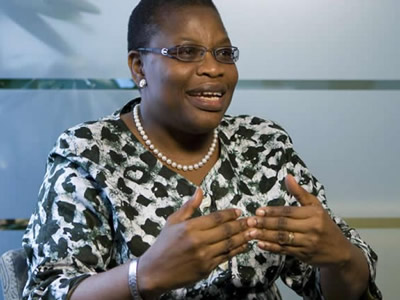

The federal Government Sunday said former Education minister, Mrs Oby Ezekwesili, lied when she alleged that the administrations of late Umaru Y’Ardua and Goodluck Jonathan squandered $67 billion in reserves left by the Olusegun Obasanjo’s administration.
Information minister, Labaran Maku who described the allegation as ‘factually incorrect” also faulted Ezekwesili on her swipe at the education sector where she held sway as education minister , describing the remark as self-indictment because the former minister has nothing to show for the N457 billion she received between 2006 and 2007.
Maku, who addressed the media in Abuja, “ at the end of May 2007, Nigeria’s gross reserves stood at $43.13 Billion, comprising the CBN’s external reserves of $31.5 billion , $9.3 Billion in the Excess Crude account , and $ 2.18 billion in the Federal government savings . These figures can be independently verified from the CBN records. The figure of $67 billion alleged in her statement is therefore clearly fictitious”.
On the use of reserves Maku said “ it is fallacious to say that the nation’s external reserves were dipped into or misapplied by the Federal Government. It is important to note that the Federal Government cannot dip its hands into external reserves. Like in other countries, the management of external reserves is one of the statutory mandates of the Central Bank of Nigeria (CBN). Section 2 sub-section (c) of the CBN Act (2007) states that the Bank shall “maintain external reserves to safeguard the international value of the legal tender currency” – in other words, to defend the value of the Naira. No President since the democratic dispensation has contravened this Act. Other uses of the reserves are to settle both public and private sector foreign currency obligations of Nigeria, including the importation of goods such as equipment for power sector. Whenever a ministry or agency of government needs to incur approved expenditure in foreign currency (e.g. payment of goods and services, settlement of external debt, etc) it must provide the naira equivalent to the CBN before the Bank sells the required foreign currency. As a former World Bank Vice-President for Africa, surely, Mrs. Ezekwesili must have known this.”
The Information minister also explained the roles played by oil prices and global financial crisis “… since President Obasanjo left office, the reserves have experienced fluctuations, rising from $43.13 billion in May 2007, peaking at $62 billion in September 2008 during the Yar’adua/Jonathan Administration when oil prices peaked at $147 per barrel, and falling subsequently to a low of $31.7 in September 2011. This fall in reserves was a result of the vicissitudes of the global financial crisis which caused CBN interventions in the currency market to defend the value of the naira. The Excess Crude savings, a component of the reserves, was also used to stimulate the economy at the height of the global financial crisis to the tune of about $1 billion (or 0.5 percent of our 2009 GDP). As a result, Nigeria is one of the few countries in the world that did not seek assistance from international financial institutions. It should be noted that the fiscal stimulus used to shore up the economy during that period was shared by all 3-tiers of government, including commitments of about $5.5 billion made under the Obasanjo Administration for power projects.”
Maku said the administration has restored macro-economic stability against the backdrop of global economic uncertainty, slow growth in the United States and high unemployment and unsustainable debt in europe.
According to him “In the first 3 quarters of 2012, Nigeria’s economy grew by about 6.4 percent and is set to continue at a similar pace in 2013 according to independent forecasts. We have reduced our fiscal deficit to only 2.17 percent of GDP in the 2013 budget, while rebalancing our spending in favour of capital expenditure. These achievements have already received strong endorsement from international ratings agencies. At a time when many advanced and emerging markets are being downgraded, Fitch and S&P have upgraded our sovereign credit ratings. The inclusion of Nigeria’s sovereign bonds in the emerging market bond indices of JP Morgan and Barclays also testifies to the growing confidence of the international investment community in our economy.”
On Ezekwesili’s tenure as Education minister Maku said “We also found Mrs. Ezekwesili’s interrogation of the educational system somewhat disingenuous and borderline hypocritical. During her tenure as Minister of Education between 2006 and 2007, she collected a total sum of N352.3 billion from direct budgetary releases. In addition, she received about N65.8 billion under the Universal Basic Education Commission (UBEC) Fund, and over N40 billion from the Education Trust Fund (ETF) during her time as Minister of Education. In view of these humongous allocations, a few legitimate questions arise. What did she do with all these allocations? What impact did it have on the education sector? One wonders if our educational system would have been better today if these allocations were properly applied.”