


By Bayo Davids
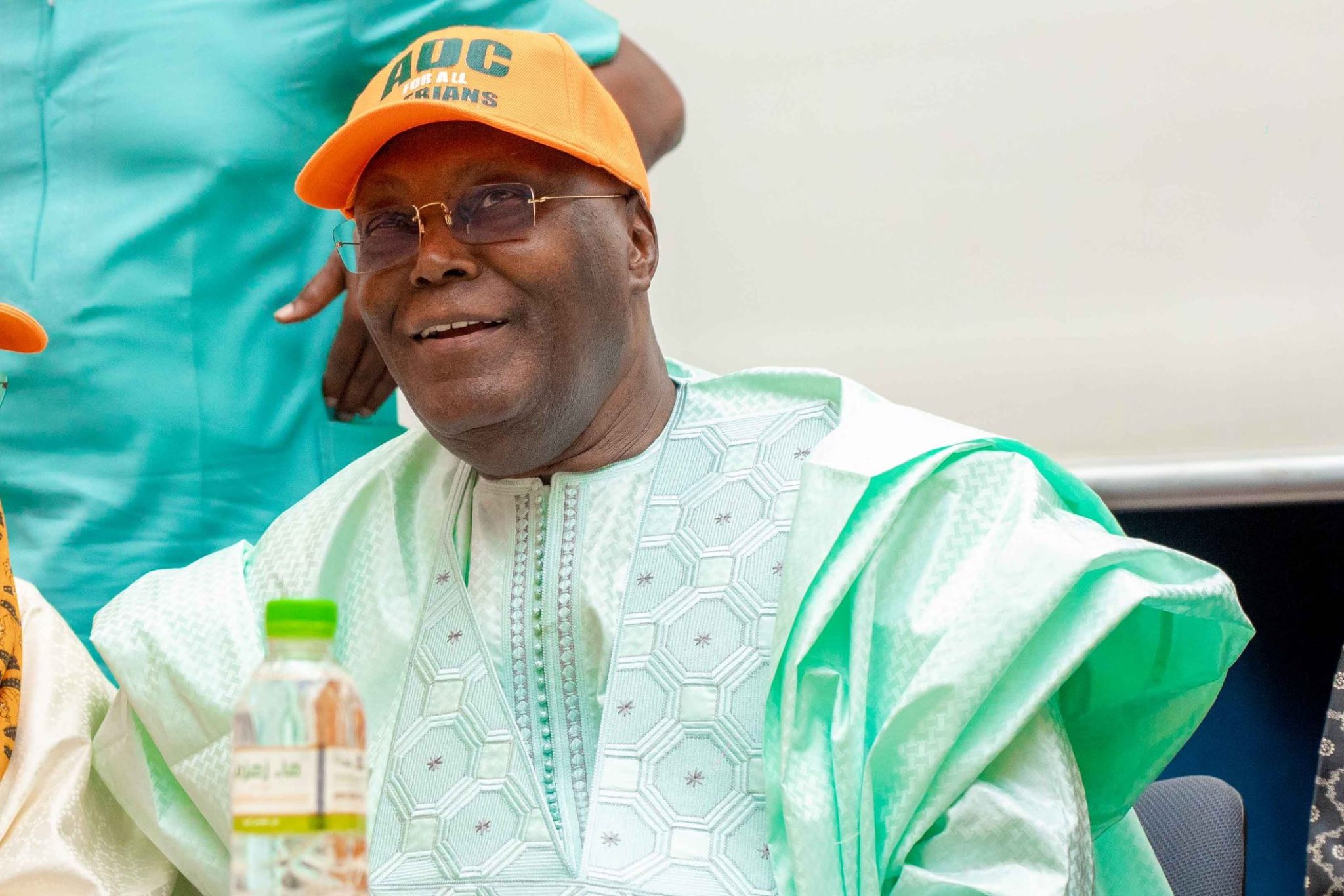
Former Vice President Atiku Abubakar has emerged as the presidential candidate of the African Democratic Congress (ADC) for the 2027 general election after defeating former Rivers State governor Rotimi Amaechi and businessman Mohammed Hayatu-Deen in the party’s presidential primary election.
Atiku secured a total of 1,846,370 votes in the exercise conducted across the 36 states and the Federal Capital Territory to clinch the ADC ticket, according to results announced in Abuja on Wednesday night.
Amaechi came second with 504,117 votes, while Hayatu-Deen polled 177,120 votes to finish third.
The results were announced by Chairman of the ADC Presidential Electoral Committee, Ikechi Emenike, while former Kogi State senator Tunde Ogbeha, who served as Chief Returning Officer, formally declared Atiku winner of the primary.
The exercise, which began on Tuesday at the Congress Hall of Transcorp Hilton Abuja, stretched into Wednesday after the electoral committee adjourned proceedings following the collation of results from 25 states.
Atiku dominated voting in several northern states and key South-West states, recording wide margins over his rivals.
In Kaduna State, he polled 108,784 votes, while Amaechi and Hayatu-Deen secured 4,454 and 2,434 votes respectively. He also swept Bauchi with 115,410 votes, leaving Amaechi with 1,127 votes and Hayatu-Deen with 1,845 votes.
The former vice president maintained his lead in Katsina, where he scored 74,444 votes against Amaechi’s 31,198 and Hayatu-Deen’s 17,951.
In Jigawa, Atiku secured 51,238 votes, while Amaechi and Hayatu-Deen polled 1,241 and 848 votes respectively.
He also recorded victories in Lagos and Ogun states, polling 37,783 and 25,634 votes respectively.
However, Amaechi delivered strong performances across parts of the Niger Delta, particularly in his home region.
The former Minister of Transportation won Rivers State overwhelmingly with 115,650 votes, while Hayatu-Deen polled 1,142 votes and Atiku managed only 912 votes.
Amaechi also carried Delta State with 35,325 votes, defeating Atiku, who scored 10,023 votes, while Hayatu-Deen got 6,032 votes.
In Bayelsa State, Amaechi secured 21,404 votes, compared to Atiku’s 1,470 and Hayatu-Deen’s 439 votes.
Hayatu-Deen’s only state victory came in Kwara, where he polled 8,442 votes to edge Amaechi, who scored 7,195 votes, and Atiku, who garnered 6,805 votes.
The outcome, however, was immediately overshadowed by protests from Amaechi and Hayatu-Deen, both of whom rejected the results and alleged irregularities in the conduct of the exercise.
The two aspirants accused the party leadership of manipulating the voting process, although details of their grievances had not been formally released as of press time.
The ADC primary marked the first major presidential contest by the opposition coalition seeking to challenge the ruling All Progressives Congress (APC) ahead of the 2027 election.
The party had in recent months attracted several prominent political figures following growing discontent within both the APC and the opposition Peoples Democratic Party (PDP).
Atiku, who was the PDP presidential candidate in the 2019 and 2023 elections, formally aligned with the ADC coalition after months of consultations among opposition leaders.
During his acceptance speech on Tuesday night, the former vice president accused the APC-led administration of undermining democracy and attempting to weaken opposition parties through intimidation and political pressure.
“Our great party is a coalition built through hard work, immense sacrifices and compromises, guided by our determination to rescue our country’s democracy which is facing its greatest threat since the return to democratic rule in 1999,” he said.
He also alleged that opposition figures were being harassed into joining the ruling party, declaring that “this abuse of power must stop.”
ADC National Chairman David Mark had earlier described the primary as evidence that “democracy can still work” in Nigeria.
“We did not work towards a predetermined outcome. We allowed a free contest. We allowed our members across Nigeria to make their choice,” Mark said.
Despite the controversy trailing the outcome, party leaders expressed optimism that the ADC would emerge united ahead of the 2027 presidential race, which is expected to shape up as one of the most fiercely contested elections since Nigeria’s return to democratic rule in 1999.