

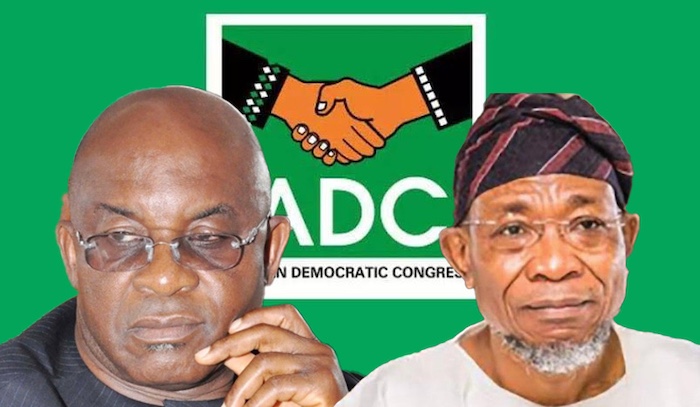

By John Chuks Azu
The Court of Appeal in Abuja has nullified the national convention of the African Democratic Congress (ADC) of April 14 and affirmed the order which barred the Independent National Electoral Commission (INEC) from recognising or participating in any of its state congresses.
A three-member panel of justices in a split decision, on Monday, held that the issues raised in the appeal by the National Chairman of the ADC, David Mark, the National Secretary, Rauf Aregbesola and others, were incompetent, lacked merit, and is therefore dismisses.
In the leading judgement read by Justice Okon Abang, the appellate court held that the state congresses and national convention of the ADC were held in violation of a subsisting motion of injunction of April 14, and imposed the sum of N10 million fine against the national executive.
The panel held that if the court failed to intervene in such breaches by political parties, it could result in a situation where “there would be absolute chaos.”
The appellate court affirmed the judgement ofJustice Joyce Abdulmalik of the Federal High Court in Abuja on April 29, which restrained the Mark-led national executive of the party from interfering with the functions and tenure of elected state executives, which was still running as of the time they were disolved based on Article 19(7)(8) of the ADC Constitution.
The Mark-led executive had in the appeal filed by its counsel S.E. Aruwa (SAN) that the action of the ADC Abia State chairman, Norman Obinna and six other state chairmen in March, 2026, against the national committe executive member David Mark, Patricia Akwashiki, Malam Bolaji Abdullahi, Rauf Aregbesola, Oserheimen Osunbor and INEC amounted to forum shopping having been previously determined by an Abia High Court in Umuahia in December 2025 between Obinna and Mazi Kanu O. Kanu on the state leadership of the party.
The ADC national committee members further submitted that the matter did not fall under the jurisdiction of the court, adding that the internal dispute resolution mechanism were not exalted before the action was brought to court.
But in his judgement, Justice Abang further ruled that the matter, bordering on Section 223(1)(A) of the Nigerian Constitution, which is on the statutory powers of INEC to regulate the registration and regulation of political parties, is clearly not within the internal affairs of the political party but that of the court.
The panel held that the matter was similar to the earlier appeals decided by the Supreme Court on April 30 in PDP vs Nwachukwu and PDP vs Sule Lamido, in which the party breached its constitution before the national convention of November 15 and 16 in Ibadan, Oyo State.
“My lord, the internal mechanism for the resolution of disputes by a political party can only be invoked and activated when the said matter constitutes an internal affair of the political party,” he said.
The justice dismissed the issue of forum shopping raised by the national executive committee for being raised suo moto without any decision on the matter reached by the Abia high court.
He said the national executive did not challenge the report of the mediation committee, which had in December 2023 extended the tenure of the state executives, and cannot challenge it.
“My lord, having not appealed against the findings that endorsed the mediation report, which had extended the tenure of the state executive committee members beyond four years, from May 2022 beyond 2026, the appellant (ADC executives) cannot contest or challenge the validity of that report,” Abang said.
Justice Donatus Okorowo, in his judgement, also agreed with the leading decision of Justice Abang.
However, in a dissenting judgement, Justice Abba Mohammed said the trial court lacked the jurisdiction to entertain the suit brought by the aggrieved state chairmen event if INEC, a federal agency, was joined in the case.
Justice Mohammed added that the subject matter of the suit was such that could have been determined by a state high court and not a federal high court as only the anciliary issues affected INEC.
“The law, as severally pronounced by the Supreme Court, is that it is the principal reliefs that invokes the jurisdiction of the court,” he said.
“Where a court has no jurisdiction to determine the principal relief, it cannot have jurisdiction over ancilliary and consequential claims, especially where, as in this case, the ancilliary and consequential claims are inextricably tied to the principal claim,” he added.
He emphasised that disputes relating to the internal affairs of a political party, as a voluntary association, are no go areas for the judiciary except they involve constitutional or statutory issues.
He maintained that there is nothing in the pleadings agitated against the functions of INEC to warrant the importation of Section 251(1) of the Nigerian Constitution, 1999 and 83(5) of the Electoral Act, 2026.
He said since the order of the high court was made on April 14, same day as the ADC convention, the party was not in disobedience of any court order, adding there was no evidence that the order was brought to its notice.
In the subsequent majority judgements also awarded N10m each against the separate appeals by the ADC executive members such as Mark, Aregbesola and the publicity secretary, Bolaji Abdullahi.