

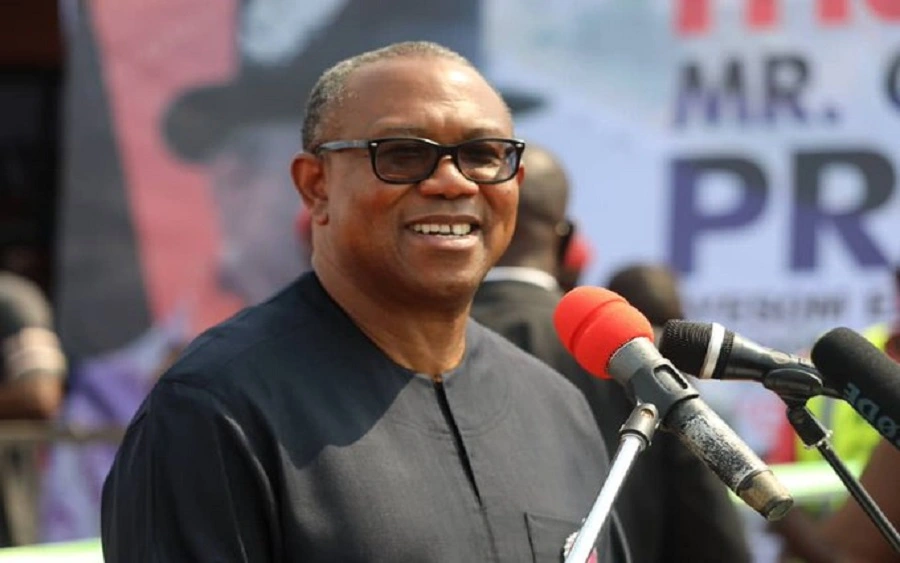

Presidential candidate of the Nigeria Democratic Congress (NDC), Peter Obi, has pledged to secure the release of detained Indigenous People of Biafra (IPOB) leader, Nnamdi Kanu, if elected President in 2027, arguing that his continued incarceration has failed to resolve the underlying grievances driving unrest in the South-East.
Obi made the declaration on Friday during an interactive session with Nigerians in Washington, D.C., United States, where he addressed members of the diaspora on issues of governance, national unity and Nigeria’s growing security challenges.
According to the former Anambra State governor, lasting peace in the South-East cannot be achieved through prolonged detention alone, stressing that political engagement and dialogue remain essential tools for addressing grievances and reducing tensions.
He said a future administration under his leadership would pursue peaceful and lawful solutions to national disputes while ensuring that criminal acts are dealt with in accordance with the law.
“We must understand that talking to aggrieved groups is not weakness, it is leadership,” Obi said.
The presidential hopeful maintained that engaging individuals or groups with legitimate concerns should be seen as a demonstration of responsible leadership rather than a sign of weakness, noting that negotiation and reconciliation are often necessary to restore stability.
Obi also said his administration would remain focused on governance, economic recovery and national development, rather than political confrontations.
“My focus will be on peace, stability and development, not endless confrontation,” he added.
Emphasising the importance of courageous and inclusive leadership, Obi argued that national unity can only be strengthened when citizens’ concerns are acknowledged and addressed.
“You cannot build a united country by ignoring the grievances of its people,” he said.
Kanu, the leader of IPOB, is currently serving a life sentence at the Sokoto Correctional Centre following his conviction on terrorism-related charges filed by the Federal Government.
Over the years, political leaders, traditional rulers and various groups in the South-East have repeatedly called for either his release or a political resolution of his case, but those appeals have yet to yield results.
His continued detention remains a contentious national issue, with supporters arguing that his release could help ease tensions and foster reconciliation in the region.
Obi’s comments are expected to reignite debate over the Federal Government’s approach to separatist agitation and the broader search for political solutions to insecurity in parts of the country, particularly as political activities ahead of the 2027 general election begin to gather momentum.