


630
By Godswill Michael
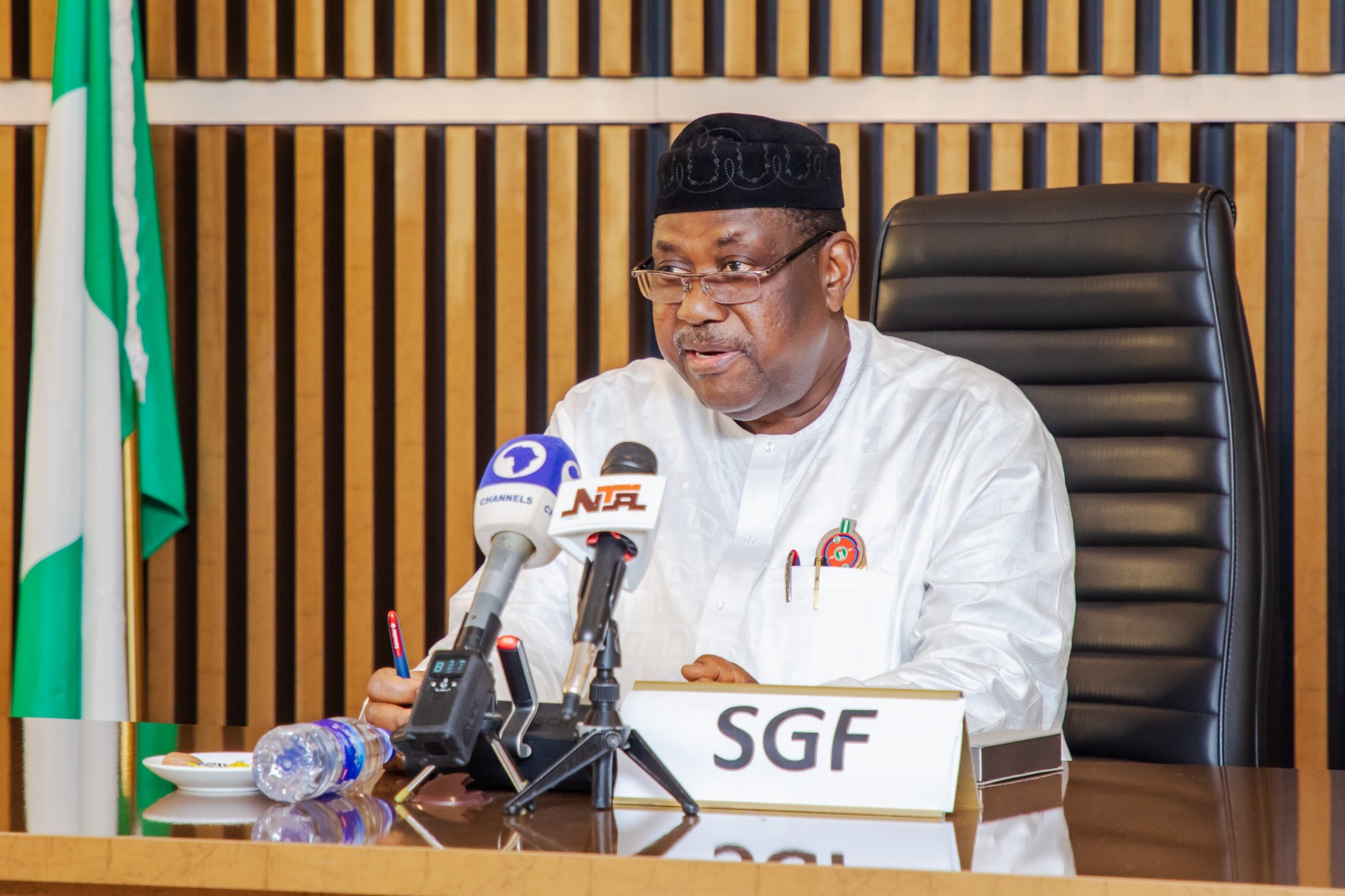
The Office of the Secretary to the Government of the Federation (SGF) has allocated more than ₦14.37 billion in the 2026 Appropriation Act to projects ranging from road construction and market development to health centres, school infrastructure, agricultural interventions and empowerment programmes, despite the office’s statutory responsibility being the coordination and monitoring of government policies and programmes.
An analysis of the 2026 Appropriation Act by THE WHISTLER shows that the SGF Headquarters budget contains at least ₦14,376,837,109 for constituency-style projects that appear unrelated to the office’s core mandate.
The SGF’s mandate is to monitor and coordinate the implementation of government policies and programmes, serve as the Presidency’s frontline advisory institution, drive policy formulation and harmonisation, and monitor institutions of governance.
However, the 2026 budget includes allocations for roads, markets, bridges, health facilities, police posts, classrooms, ICT centres, transformers, agricultural equipment, solar installations, vehicles and various empowerment initiatives spread across several states.
Among the largest allocations are ₦2 billion for the construction of a complex comprising classrooms, offices and laboratories at the Federal College of Agriculture and Technology, Nabanje, Katsina State, and ₦1 billion for a farm machinery shed at the same institution.
The budget also earmarks ₦500 million for the distribution of rice and assorted food items to indigent residents of Doguwa/Tudun Wada Federal Constituency in Kano State, ₦500 million for the procurement of Keke Napep tricycles and Bajaj motorcycles for youth empowerment in the constituency, and another ₦500 million for cash grants to vulnerable women and youths.
Other notable allocations include ₦350 million for the construction of a landing jetty in Rivers State, ₦350 million for the installation of 20KW solar panels in hospitals across Rivers West Senatorial District, ₦350 million for grain silos in Zamfara State, ₦350 million for the supply of motorcycles in Kaduna South Federal Constituency, and ₦300 million for the purchase of vehicles in Malumfashi/Kafur Federal Constituency of Katsina State.
The budget further provides ₦200 million each for the construction of Rumunkara Market in Rivers State, a health centre in Rumuolumeni Town, Eliochicha Road, Apa-Mini Gbei Road, shore protection and erosion control works, and solar street lights in Katsina State.
Additional projects include the construction of police posts and classrooms, provision of school furniture, installation of transformers, establishment of ICT centres, distribution of fertilisers and tractors, relief materials, sewing and grinding machines, as well as other empowerment items across different states.
The SGF Headquarters also budgeted for agricultural interventions, including women farmers’ empowerment in Zamfara State, skills acquisition programmes in Kebbi State, awareness campaigns on reducing post-harvest losses, farmers’ training programmes, tractor distribution, fertiliser support, relief materials and marine training for youths in Rivers State.
The spending pattern mirrors similar findings involving several federal institutions that have allocated substantial resources to projects outside their statutory responsibilities.
Earlier budget analysis by THE WHISTLER showed that the National Commission for Almajiri and Out-of-School Children Education, an agency under the Federal Ministry of Education established to reduce illiteracy and integrate Almajiri and out-of-school children into formal education and vocational training, allocated ₦8.4 billion of its 2026 budget to road construction projects across Ogun, Katsina and Ekiti states.
The commission received ₦29.4 billion in the 2026 budget, with almost 29 per cent of its allocation devoted to road construction and rehabilitation rather than education-focused interventions.
Similarly, the Federal Ministry of Information and National Orientation allocated ₦9.49 billion in its 2026 budget to roads, health centres, boreholes, classrooms, transformers, food distribution and empowerment programmes, despite its mandate centring on public information management, national orientation, image building and cultural promotion.
Among the ministry’s allocations were ₦2.1 billion for rural farming roads in the Niger Delta, ₦1.4 billion for transformers in southern communities, ₦1.4 billion for industrial sewing machines, another ₦1.4 billion for welding and vulcanising equipment, ₦700 million for classrooms, alongside hundreds of millions of naira for health centres, boreholes, culverts, food distribution and empowerment schemes.
The trend also follows earlier findings from Govspend data indicating that the Federal Co-operative College, Oji River, Enugu State, and the Federal College of Horticulture, Dadin-Kowa, Gombe State, spent a combined ₦25.92 billion on projects that appeared unrelated to their statutory mandates, while ₦2.85 billion of the transactions were flagged as duplicate payments.
Amid growing scrutiny of off-mandate spending by Ministries, Departments and Agencies (MDAs), the Minister of Agriculture and Food Security, Senator Abubakar Kyari, recently directed agencies under the ministry to comply strictly with their statutory responsibilities.
«”All programmes and initiatives of the ministry shall be aligned with the administration’s priorities of food security, economic growth, job creation, poverty eradication and inclusivity,” the minister said.»
He added that agencies must focus strictly on their statutory responsibilities and avoid executing unrelated projects.
The allocations in the SGF Headquarters budget are expected to intensify concerns over the increasing use of federal ministries, departments and agencies to execute constituency-style projects that appear to fall outside their legally assigned functions.