


675
By Lizzy Chirkpi
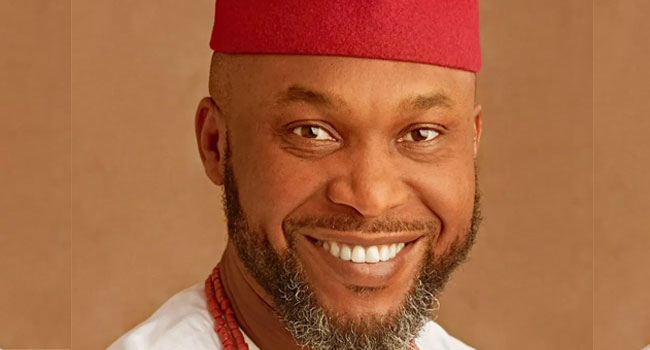
Nigeria’s total public expenditure on education stands at approximately ₦9.49 trillion against a projected nominal Gross Domestic Product (GDP) of ₦442.8 trillion in 2026, representing just 2.14 per cent of national output and falling significantly below international benchmarks, former Minister of Aviation and Chancellor of the Athena Centre for Policy and Leadership, Chief Osita Chidoka, has said.
Speaking at the 70th Anniversary Gala of the Ekulu Primary School Alumni Association (EPSAA) in Enugu, Chidoka described the country’s education funding profile as a “national emergency” that demands urgent and deliberate action.
He spoke while unveiling a report by the Athena Centre, which revealed that Nigeria’s consolidated public spending on education remains far below the 4 to 6 per cent of GDP recommended by the United Nations Educational, Scientific and Cultural Organisation (UNESCO) for developing countries.
According to the report, the 2.14 per cent figure was calculated from combined federal education expenditure, allocations to the Universal Basic Education Commission (UBEC), interventions by the Tertiary Education Trust Fund (TETFund), and education budgets across the 36 states and the Federal Capital Territory.
“Nigeria is not in the middle of the developing world on this measure. It is below its floor. We have been treating this as a routine budget conversation for too long. The figure is in fact a national emergency, and the country must now stop pretending otherwise,” Chidoka said.
The report compared Nigeria’s education spending with that of several developing countries, noting that South Africa allocates 6.7 per cent of GDP to education, Brazil 5.6 per cent, Kenya 4.8 per cent, India 4.1 per cent and Ghana 3.4 per cent.
Despite the grim national outlook, Chidoka commended some state governments for prioritising education funding and reforms.
Anambra State was identified as the highest spender by budget share, allocating 46.9 per cent of its 2026 budget to education. Enugu followed with 32.2 per cent and has embarked on the construction of 260 Smart Green Schools across the state.
The report also highlighted Kano State’s large-scale teacher recruitment programme, while Lagos, Kaduna, Katsina and Abia were recognised for significant investments in the sector. Together, the six states are projected to spend about ₦1.8 trillion on public education in 2026.
According to the Athena Centre, a notable shift has occurred in education financing between Lagos and Enugu. While Lagos still spends more in absolute terms, only 5.6 per cent of its 2026 budget is dedicated to education.
The report stated that Enugu’s education budget is now roughly twice that of Lagos in dollar terms, reversing a situation in 2000 when Lagos reportedly spent more than six times what Enugu allocated to the sector.
“The reform of Nigerian public education is no longer waiting to be born. It is being led, not from Abuja, not from Lagos, but from a handful of states that have made the decision the centres of power have not yet made,” Chidoka said.
Reflecting on the roots of the country’s educational decline, Chidoka pointed to the period between 1986 and 1999, which he described as Nigeria’s “years of the locust”.
The report indicated that the salary of a full professor fell from about $1,000 per month in 1985 to just $137 by 1997. It also noted that per-pupil spending in Lagos State declined sharply from $281 to $22 between 1980 and 1990.
At the tertiary level, the report found that annual operating expenditure per student at Ahmadu Bello University had dropped dramatically compared with the University of the Witwatersrand in South Africa, with a funding gap estimated at 1:28 in favour of the South African institution.
Chidoka, however, argued that Nigeria’s greatest failure was not the economic hardship of that period but the inability of successive governments to reverse the decline after the return to democratic rule.
“The deeper failure lies not in the locust years themselves but in the twenty-seven years of civilian rule since 1999, during which we accepted the empty field as the new harvest,” he said.
Using Ekulu Primary School as a symbol of Nigeria’s educational journey, Chidoka urged alumni associations across the country to take a more active role in supporting public schools.
He challenged the Ekulu Primary School Alumni Association to establish a digital learning dashboard within one year to track literacy and numeracy levels, attendance, examination performance, teacher availability and infrastructure needs.
He also proposed the creation of a Teacher Development and Recognition Fund, remedial programmes for pupils struggling with literacy and numeracy, and a partnership with the Nigerian Research and Education Network (NgREN) to expand digital learning opportunities.
“Let’s Get It Done is not charity. It is repayment. It is a clarion call from a generation that received much, to a generation now standing in the same classrooms, asking only what was once routinely given,” he said.
Nigeria’s education sector has long been challenged by inadequate funding, poor infrastructure, teacher shortages and declining learning outcomes. Successive administrations have repeatedly faced criticism for failing to meet UNESCO’s recommended funding benchmark despite sustained calls for greater investment.
Founded in 1956 as All Saints School by Reverend Timothy Bruce Fyffe of the Church of England, Ekulu Primary School is one of Enugu State’s oldest public schools. Chidoka said its history mirrors Nigeria’s broader story of promise, decline and the enduring possibility of renewal.