


636
By Oscar Okhifo
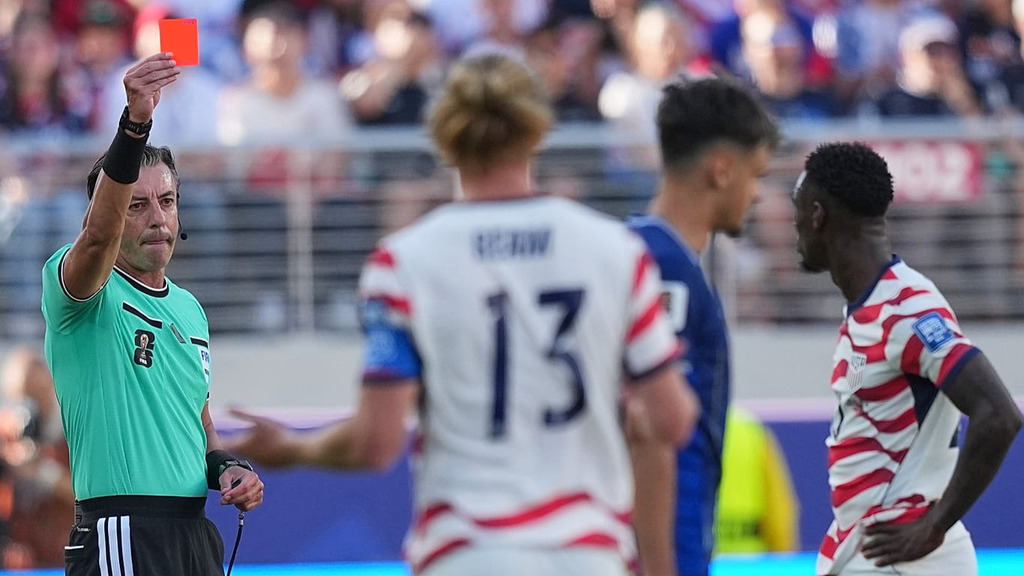
European football’s governing body, UEFA, on Monday accused the Federation of International Football Association (FIFA) of crossing “a red line” after the world football governing body controversially overturned the one-match suspension of United States striker Folarin Balogun, clearing him to feature in the hosts’ FIFA World Cup Round of 16 clash against Belgium.
The unprecedented decision followed reports that U.S. President Donald Trump appealed to FIFA President Gianni Infantino to review Balogun’s automatic suspension after the forward was sent off during the United States’ victory over Bosnia and Herzegovina.
Reacting to the decision, UEFA issued a strongly worded statement, warning that suspending an automatic disciplinary sanction undermined the integrity of football and the principle of the equal application of the game’s rules.
“Yesterday’s decision to suspend for a probationary period of a year the implementation of the one-match automatic suspension following the red card issued to the player Folarin Balogun crossed a red line,” UEFA said.
The European football governing body insisted that the credibility of the sport rests on the consistent enforcement of its rules, stressing that disciplinary sanctions must be applied fairly and without exception.
“Football, like any other sport, relies on rules, which are the basis for fair, honest and transparent competition. Sometimes rules are open to interpretation. In this case not,” UEFA added.
FIFA’s disciplinary committee ruled that although Balogun’s red card will remain on his disciplinary record, the accompanying one-match suspension has been suspended for a probationary period of one year, making the Monaco striker eligible for Monday’s knockout fixture against Belgium.
The decision has sparked criticism across European football, with the Royal Belgian Football Association reportedly questioning Balogun’s eligibility and football officials warning that the move could undermine confidence in FIFA’s disciplinary process and the integrity of the World Cup.
Former FIFA president Sepp Blatter also weighed in on the controversy, alleging that FIFA had bowed to political pressure by reversing Balogun’s suspension.
Blatter said the decision, reportedly taken after Trump’s intervention, risked damaging the credibility and independence of football’s global governing body.
The controversy has further fuelled debate over the influence of politics in football governance, with critics arguing that FIFA’s disciplinary decisions must remain free from external interference to preserve the integrity and credibility of the sport.
While FIFA has confirmed Balogun’s eligibility, the governing body has yet to provide a detailed explanation for suspending the automatic ban, a decision that has drawn widespread scrutiny from football stakeholders around the world.
With UEFA, former FIFA president Sepp Blatter and other football stakeholders openly questioning the decision, FIFA now faces mounting pressure to reassure fans, players and national associations that its disciplinary process remains independent, transparent and free from external influence.
Whether the governing body takes further steps to restore confidence or stands by its controversial ruling is likely to remain a subject of intense scrutiny in the days ahead.
The United States will face Belgium later on Monday for a place in the quarter-finals of the 2026 FIFA World Cup, with Balogun’s availability expected to be one of the major talking points ahead of the highly anticipated Round of 16 encounter.