

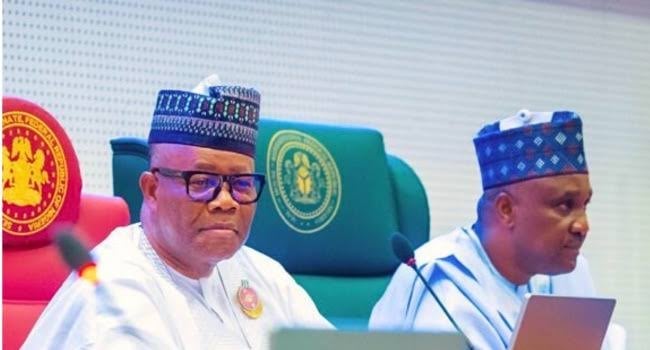

ABUJA — President of the Senate, Godswill Akpabio, on Tuesday defended the performance of the 10th National Assembly, urging Nigerians to familiarise themselves with laws enacted by the legislature before criticising lawmakers.
At the same event, Speaker of the House of Representatives, Tajudeen Abbas, unveiled the House’s three-year legislative scorecard, describing it as the most productive since Nigeria’s return to democratic rule in 1999. He also announced that the House would withdraw its earlier State Police Bill in favour of the executive version transmitted to the National Assembly by President Bola Tinubu.
Both leaders spoke at the opening of the 2026 National Assembly Open Week in Abuja, themed “Three Years of the 10th National Assembly: Advocacy, Transparency, Inclusion and Reforms,” an initiative aimed at promoting transparency, strengthening accountability and enhancing citizens’ engagement with the legislature.
Akpabio said much of the criticism directed at the National Assembly stems from a limited understanding of the legislative process, insisting that lawmakers should be assessed based on an informed reading of the laws they enact rather than public perception.
“I want all of us to attend this Open Week. Please try and read the laws we make. You can question us after you have finished reading the laws. You can also challenge us,” he said.
The Senate President recalled what he described as an example of uninformed public commentary during a recent television programme, where a university professor criticised the newly enacted tax reform laws without having read them.
“I saw somebody, a professor, on television condemning the tax bills. We asked him, ‘Which particular section of the Act are you against?’ He said he had not read any of the Acts. Sometimes before you comment on social media, take time to look at the work we have actually done,” he said.
According to Akpabio, the National Assembly is focused on enacting enduring legislation that advances Nigeria’s long-term development rather than pursuing short-term political gains.
“Our job here is to make laws that will last for generations. We are not making laws for ourselves. We are making laws for the protection of Nigeria’s future,” Akpabio stated.
He further described the 10th National Assembly as the most peaceful and productive legislature since the country’s return to democracy in 1999, attributing its achievements to sustained cooperation between the Senate and the House of Representatives.
“This is the most peaceful and most productive Assembly that we have seen since 1999,” he said, adding that although differences occasionally arise between both chambers, they are always resolved in the national interest.
On security, Akpabio commended security agencies for rescuing abducted schoolchildren in Oyo State, saying the operation reflected the government’s determination to tackle insecurity.
“The rescue of those children is an indication that government is not sleeping—that government is working round the clock to ensure that Nigerians can sleep with their two eyes closed,” he said.
The Senate President also defended the economic reforms introduced by President Tinubu, arguing that they had reduced Nigeria’s dependence on crude oil revenues while strengthening the fiscal position of state governments.
“The President has been able to transform Nigeria from a mono-economy. Today, most states are able to execute projects and pay salaries without depending entirely on borrowing,” Akpabio said.
House records highest legislative output
Presenting the House of Representatives’ Third-Year Legislative Scorecard, Speaker Abbas said the chamber had considered 2,747 bills over the past three years, passed 363 and secured presidential assent for 72, describing the figures as the highest legislative output since 1999.
“Behind each of those bills stands a Nigerian who believed that the law could better their condition. This morning, I wish to account for how this House has honoured that trust,” Abbas said.
He announced that the House would withdraw its previously passed State Police Bill to allow consideration of the executive version submitted by President Tinubu, saying the new proposal contains broader provisions and stronger safeguards.
“His Excellency the President has now transmitted to the National Assembly an Executive version of the state police bill, one that is more robust and more comprehensive than the version this House earlier passed.
“The House will therefore recall the version it earlier passed and accord the executive bill the expedited consideration that a matter of this urgency deserves,” he said.
Addressing concerns over transparency, Abbas assured Nigerians that the bill would undergo extensive public scrutiny before passage.
“Nothing here is concealed. The bill will pass through public hearing and open scrutiny. I give this assurance to every Nigerian that the framework will carry robust safeguards,” he stated.
He explained that no state would be allowed to establish its own police service without satisfying constitutional requirements relating to funding, accountability, human rights protections and independent oversight.
Beyond the state policing proposal, Abbas said the House had prioritised legislation aimed at expanding access to education, reforming Nigeria’s tax system, attracting investment, strengthening regional development and improving citizens’ welfare.
He maintained that legislative support for the Tinubu administration’s reform agenda was rooted in constitutional responsibility rather than political expediency.
“Every policy of the executive still had to become law, pass through appropriation and withstand legislative scrutiny. The President furnished the vision; the National Assembly furnished the laws that render the vision enforceable,” he added.
Gbajabiamila calls for deeper transparency
Chief of Staff to the President, Femi Gbajabiamila, urged lawmakers to deepen transparency, inclusion and accountability, describing them as essential to building a credible legislature.
“Transparency turns constitutional authority into public trust. Inclusion ensures that the voices of our diverse people are not only heard but reflected in national priorities. Reform keeps our institutions responsive to changing realities and capable of delivering better outcomes,” he said.
He urged the National Assembly to ensure that the annual Open Week develops into a sustained platform for public engagement rather than remaining a ceremonial exercise.
“An Open Week must be more than the ceremonial opening of the gates of Parliament. It should be an invitation to scrutiny, dialogue and partnership,” he said.
Gbajabiamila also reaffirmed the Presidency’s commitment to maintaining a constructive relationship with the legislature.
“While the executive and the legislature are separate arms of government, they share one ultimate mandate, which is to improve the lives of the Nigerian people. Constructive cooperation does not diminish legislative independence,” he added.
Stakeholders seek stronger oversight
In his goodwill message, Executive Director of the Policy and Legal Advocacy Centre (PLAC), Clement Nwankwo, commended the legislature’s achievements but urged lawmakers to strengthen oversight of the executive while improving transparency, accountability and public participation.
He argued that Parliament performs its constitutional role most effectively when it independently scrutinises executive actions and safeguards public resources.
Retired Catholic Archbishop of Abuja, John Cardinal Onaiyekan, also urged lawmakers to sustain regular engagement with their constituents, stressing that effective representation depends on continuous consultation with the people whose interests they serve.
The event attracted several prominent personalities, including former Speakers of the House of Representatives Aminu Masari, Patricia Etteh and Yakubu Dogara; the Coordinating Minister of Health and Social Welfare, Prof. Muhammad Ali Pate; former Deputy Speaker Emeka Ihedioha; and other senior government officials and stakeholders.