


By Oscar Okhifo
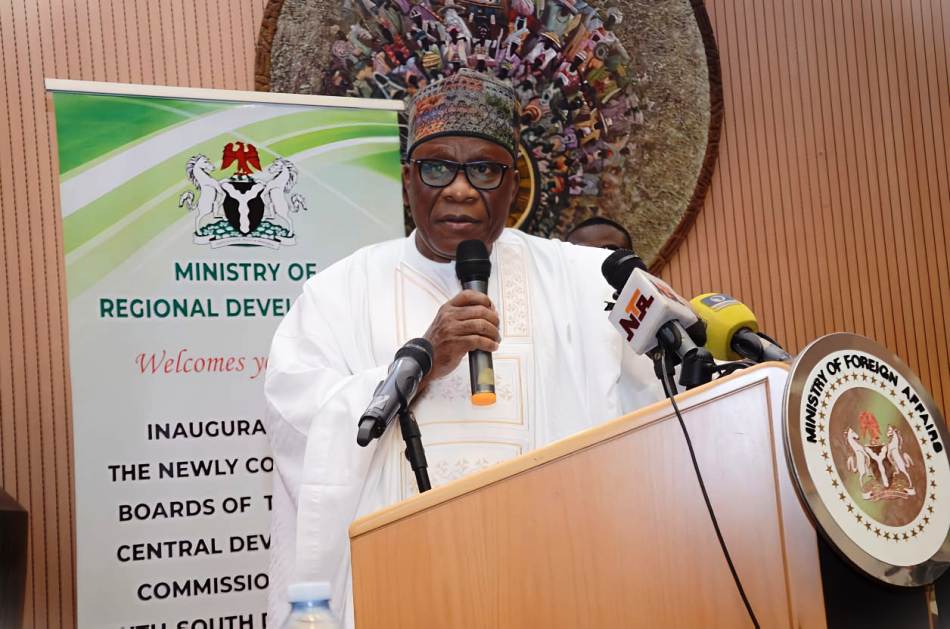
Minister of Regional Development, Engr. Abubakar Momoh, on Wednesday declared that the Niger Delta possesses the agricultural potential to become the cornerstone of Nigeria’s food security and economic transformation, urging investors to look beyond the region’s oil wealth and embrace its vast opportunities in modern agriculture.
Momoh spoke at the Niger Delta Agricultural Development and Investment Summit held at the Banquet Hall of the Presidential Villa, Abuja, where Vice President Kashim Shettima formally launched the Niger Delta Agricultural Development and Investment Fund and inaugurated a Coordinating Council to drive agricultural development and investment across the region.
The summit, organised by the Office of the Vice President and the Niger Delta Development Commission (NDDC) in collaboration with the governors of the nine Niger Delta states, was themed “Unlocking Investment for Sustainable Agricultural Transformation in the Niger Delta.” It attracted government officials, development partners, traditional rulers, investors and other stakeholders to chart a new course for agriculture in the region.
Addressing participants, Momoh urged investors to see the Niger Delta as more than an oil-producing region, describing it as one of Nigeria’s most strategic agricultural frontiers with the capacity to guarantee national food security through mechanised and innovative farming.
“The future of agriculture is in mechanised and innovative farming and the Renewed Hope Agenda of President Bola Tinubu has placed agriculture at the heart of Nigeria’s economic development,” he said.
The minister stressed that sustained investment in modern agriculture, rural infrastructure and agro-industrial value chains would unlock the region’s enormous economic potential, create jobs, reduce poverty and improve livelihoods across the nine Niger Delta states.
Launching the Agricultural Development and Investment Fund, Vice President Shettima described the initiative as a major pillar of President Bola Tinubu’s Renewed Hope Agenda aimed at repositioning agriculture as the engine of Nigeria’s economic prosperity.
“Before oil took centre stage in our economy, it was the soil that paid our bills. We must, therefore, return to agriculture for our economic development,” Shettima said.
The Vice President noted that while the Niger Delta has long been associated with crude oil production, its fertile land, abundant waterways and favourable climate offer even greater opportunities to build a resilient economy anchored on agriculture, agro-processing and value-chain development.
He called on governments, development partners, investors and local communities to work together to unlock the region’s agricultural potential, stressing that increased investment in the sector would strengthen food security, create jobs and promote inclusive economic growth.
Chairman of the NDDC Governing Board, Mr. Chiedu Ebie, said the Commission remains firmly aligned with the Federal Government’s agricultural agenda, noting that harnessing the Niger Delta’s fertile land and natural resources would accelerate economic growth while advancing the administration’s broader development priorities.
“We remain guided and aligned with the agricultural policies of the Federal Government.
“The eight presidential priorities encompassing food security, poverty eradication, job creation, and the fight against corruption serve as our roadmap toward a brighter and more prosperous Niger Delta,” Ebie stated.
In his welcome address, NDDC Managing Director, Dr. Samuel Ogbuku, reaffirmed the Commission’s commitment to supporting the Federal Government’s vision of transforming the Niger Delta into a thriving agricultural hub.
He said the Commission’s agricultural initiative is intended to change the long-held perception of the region as solely an oil-producing area, insisting that agriculture offers a more sustainable pathway to inclusive growth, investment, employment and long-term prosperity.
“The Niger Delta has for decades been known for oil, but it is time to unlock the enormous opportunities beneath its fertile soil. Agriculture offers the region a pathway to food security, employment, investment and lasting prosperity,” Ogbuku said.
Highlighting ongoing infrastructure projects designed to support agricultural development, Ogbuku announced that the NDDC is nearing completion of the 1.2-kilometre Kaa-Ataba Bridge, linking Khana and Andoni Local Government Areas of Rivers State, to improve access for farmers, agribusinesses and agricultural markets.
Representing the Minister of Agriculture and Food Security, Senator Abubakar Kyari, the ministry’s Permanent Secretary, Dr. Marcus Ogunbiyi, reaffirmed the Federal Government’s determination to achieve food security, noting that mechanisation and modern farming practices remain central to that objective.
Delivering the keynote address titled “Niger Delta: Awakening an Agricultural Giant,” Prince S. J. Samuel said the region possesses all the ingredients needed to emerge as Nigeria’s agricultural powerhouse and urged governments and investors to embrace mechanised agriculture as a catalyst for sustainable growth and wealth creation.
Akwa Ibom State Governor Pastor Umo Eno, represented by Deputy Governor Senator Akon Eyakenyi, commended the partnership between the Office of the Vice President and the NDDC, describing it as a timely intervention capable of accelerating agricultural revitalisation and stimulating economic development across the Niger Delta.
Also speaking, NDDC Executive Director, Projects, Dr. Victor Antai, underscored the importance of sustained collaboration among governments, development agencies, investors and host communities, noting that strong partnerships would be indispensable in translating the region’s agricultural vision into measurable outcomes.
Earlier, the Commission’s Director of Agriculture and Fisheries, Dr. Winifred Madume, said the Niger Delta is naturally positioned to become one of Africa’s leading agribusiness destinations because of its rich ecological resources and strategic access to domestic and international markets.
She said:
“The Niger Delta possesses the natural and economic fundamentals that investors seek. Our region is endowed with fertile land, abundant freshwater resources, diverse ecological zones, extensive coastline and inland waterways, and access to major domestic and export markets.
“Across our nine mandate states lies enormous potential for crop production, aquaculture, livestock, agro-processing and agricultural trade.”
Madume noted that unlocking those opportunities would require deliberate investment, improved infrastructure and stronger collaboration between the public and private sectors to build globally competitive agricultural value chains.
“This is not simply about growing more food. It is about building an agricultural economy that rewards investment, drives industrial growth and positions the Niger Delta as one of Nigeria’s leading destinations for agribusiness,” she added.
Security remains critical
Although stakeholders expressed optimism over the initiatives unveiled at the summit, concerns remain about insecurity in several farming communities across the Niger Delta.
From North Ibie in Etsako East, Edo State, to Abraka in Delta State and other agricultural communities across the region, residents affected by kidnappings and attacks by armed herders continue to argue that lasting agricultural transformation depends on improved security.
For many rural farmers, the promise of increased investment, mechanised agriculture and expanded agribusiness can only be fully realised when they are able to cultivate their land without fear, allowing the Niger Delta’s vast agricultural resources to fulfil their potential as a major pillar of Nigeria’s food security and economic diversification.