

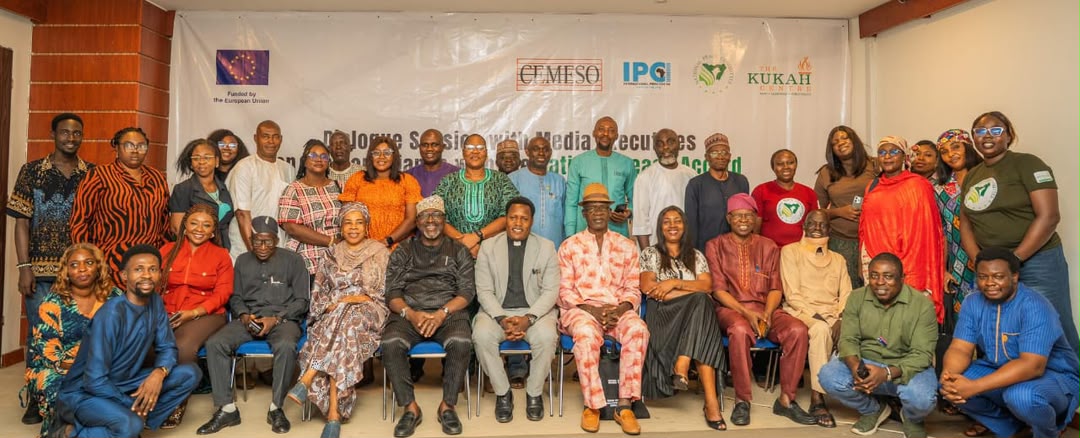

The Electoral Support Initiative (ESI) Hub has documented 109 alleged violations of the National Peace Accord and provisions of the Electoral Act across 27 states, raising concerns over political violence, intimidation, restrictions on political activities and the growing spread of disinformation ahead of the 2027 general elections.
The Research Manager of ESI Hub, Fatai Yusuf, disclosed this on Friday during a dialogue with media executives on compliance with the National Peace Accord in Abuja.
The session was organised by the Kukah Centre in collaboration with the International Press Centre (IPC) and the Centre for Media and Society (CEMESO).
Presenting the findings of a two-month monitoring exercise, Yusuf identified political violence, attacks on campaign activities, intimidation, threats against political opponents and information disorder as recurring challenges threatening peaceful political participation.
He said the findings showed that electoral violations extended beyond physical violence, with threats, intimidation, misinformation and restrictions on citizens’ political rights also contributing to an increasingly hostile electoral environment.
According to him, 52 per cent of the recorded incidents did not involve physical attacks but consisted of other forms of violations capable of undermining public confidence and participation in the electoral process.
Yusuf expressed particular concern over the increasing use of social media to circulate fabricated political information, manipulated images, recycled videos and other misleading content, warning that advances in artificial intelligence had made the problem more complex.
He said misinformation originating from social media could spill into the wider political environment, aggravating religious and ethnic divisions and influencing public perceptions of candidates and political parties.
He also cited attacks on political activities, obstruction of campaign movements, destruction of campaign materials and restrictions on freedom of expression and peaceful assembly as issues requiring urgent attention.
The researcher raised concerns over alleged attempts by some political actors and public officials to intimidate citizens, including civil servants, on account of their political affiliations and choices.
He cited reported threats against individuals who declined to support particular political parties, as well as attempts to exploit religious and ethnic sentiments to influence voting decisions.
On political campaigns, Yusuf warned that restricting opposition parties’ access to public spaces and campaign opportunities could undermine the principle of equal participation in the electoral process.
Recalling observations from previous political engagements in Ekiti State, he said campaign materials belonging to the ruling party were more visible than those of opposition parties, expressing concern that similar situations could occur in other states ahead of the 2027 elections.
He urged political parties to focus their campaigns on manifestos, policy proposals and practical solutions to the country’s challenges rather than resorting to personal attacks, threats and inflammatory exchanges.
Yusuf also called on political parties to take responsibility for the conduct of their supporters by publicly condemning violence, intimidation and other violations.
He urged security agencies to protect citizens and ensure that reported offences were properly investigated.
The researcher tasked journalists with strengthening fact-checking, verifying political claims and following up on electoral violations reported to law enforcement agencies and the courts.
He said the media had a critical responsibility to shape public understanding of electoral developments and ensure that citizens received accurate information about the conduct of political actors and institutions.
Peace Accord requires collective ownership
In his remarks, the Executive Director of the Kukah Centre, Fr. Atta Barkindo, said the National Peace Accord should not be regarded as the personal responsibility of political candidates or any single institution but as a collective commitment requiring the participation of all stakeholders.
Barkindo said the success of the accord depended on the willingness of political actors, media organisations, security agencies, civil society groups and citizens to take ownership of its commitments.
He stressed the need to move beyond the formal signing of the agreement and ensure that its principles translated into responsible political conduct and peaceful electoral engagement.
According to him, promoting peaceful elections should not be left solely to political candidates or organisations facilitating the agreement but should involve sustained public engagement and scrutiny.
He said the accord should be treated as a continuing national commitment rather than an agreement that attracts attention only when political candidates gather to sign it.
Akingbulu tasks media on accountability
Also speaking, the Executive Director of CEMESO, Dr. Akin Akingbulu, challenged media organisations to take a more deliberate role in monitoring compliance with the National Peace Accord and holding political actors accountable for their commitments ahead of the 2027 general elections.
Akingbulu said the media’s responsibility should go beyond reporting the signing of the agreement to consistently monitoring political parties, candidates and other stakeholders to ensure that they honoured their commitments.
He noted that although presidential candidates and political party leaders had signed the accord, the more important question was how the commitments would be sustained between the signing and the conduct of the elections.
He urged media executives to incorporate peace accord monitoring into their existing editorial programmes, including television and radio discussions, newspaper reports, online publications and fact-checking initiatives.
According to him, media organisations already had established platforms that could be used to scrutinise political conduct, promote accountability and keep electoral peace on the public agenda.
He challenged media executives to identify existing programmes that could be deployed to hold politicians accountable for their public statements and commitments, while making peace and electoral accountability a consistent part of their editorial agenda.
Akingbulu also advocated stronger collaboration among media organisations, particularly in information verification and the sharing of credible election-related information.
He expressed concern over the cost of verification and proposed that newsrooms explore the establishment of a shared verification platform to improve efficiency, reduce duplication of efforts and strengthen the credibility of election reporting.
He urged media executives to consider contributing to and using a common verification system, as well as developing the standards required to ensure its credibility and reliability.
On election results, Akingbulu distinguished between the independent collection and collation of polling-unit results by political parties, observers and other interested groups and the formal declaration of results, which he said remained the responsibility of the legally authorised electoral body.
He said political parties and citizens should be free to collate results obtained from polling units where they had representatives but cautioned against making independent declarations of election results.
He urged the media to exercise caution when reporting unofficial tallies, particularly where figures compiled by political parties and independent observers differed from those eventually declared by the electoral commission.
Akingbulu also raised concerns over the growing use of artificial intelligence to generate fabricated election-related images and misleading political content, urging newsrooms to strengthen their internal verification procedures before publication.
He cautioned against media polarisation, stressing that editorial independence and adherence to professional standards were essential to responsible election coverage, particularly in an environment where media organisations could face pressure from political interests.
He urged journalists to resist undue influence and ensure that their platforms were not used to promote misinformation or deepen political divisions.
The dialogue, held against the backdrop of preparations for the 2027 general elections, provided an opportunity for media executives and other stakeholders to examine practical approaches to monitoring compliance with the National Peace Accord, reporting violations and strengthening electoral accountability.
The discussions underscored the need for sustained collaboration among the media, political parties, security agencies, civil society organisations and electoral institutions to promote peaceful political participation and ensure that commitments under the accord were respected