

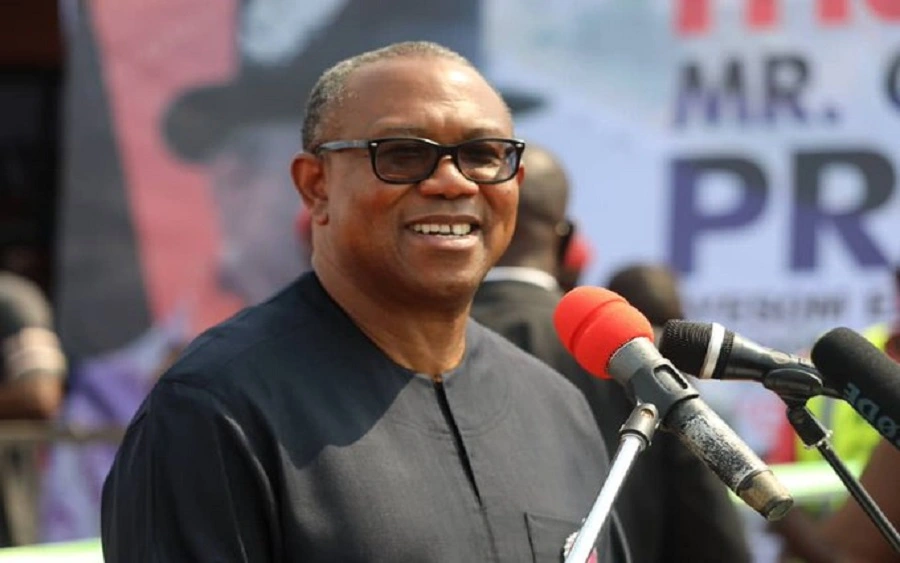

Presidential candidate of the Nigeria Democratic Congress (NDC) for the 2027 election, Peter Obi, has called on the Federal Government to account for the country’s growing debt profile, accusing the administration of President Bola Tinubu of excessive borrowing and a lack of transparency in the management of public finances.
In a statement issued on Tuesday by the Coordinator of the Peter Obi Media Office, Ibrahim Umar, the former Anambra State governor said Nigerians deserve clear explanations on how borrowed funds have been utilised amid worsening economic conditions.
Obi, writing on his X account, reviewed the borrowing record of successive All Progressives Congress (APC)-led administrations, from former President Muhammadu Buhari to the current Tinubu government, and argued that Nigeria’s debt burden has risen at an alarming rate.
According to him, the country’s total debt has climbed to about N200 trillion under the current administration.
“This represents an increase of over N100 trillion within a mere three years, a stark contrast to the roughly N49 trillion accumulated during President Muhammadu Buhari’s eight-year tenure, which would have projected to around N80 trillion,” Obi wrote.
“As millions of Nigerians grapple with the shock of this unsustainable debt accumulation, the situation is exacerbated by the government’s reckless approach to borrowing and a profound absence of accountability and transparency in the utilisation of these funds.”
The former presidential candidate cited data from the Federation’s Budget Office, claiming that the Federal Government borrowed N11.89 trillion between January and September 2025, exceeding its planned borrowing target of N10.34 trillion by about N1.54 trillion.
“For instance, data from the Federation’s Budget Office reveals that the Bola Tinubu government borrowed N11.89 trillion in the first three quarters of 2025 (January to September), exceeding the planned borrowing target of N10.34 trillion by approximately N1.54 trillion.
“Under a responsible and accountable government, such an overshoot would necessitate rigorous scrutiny and explanation from relevant governmental bodies.
“Regrettably, this is not the reality under the current administration.”
Obi further alleged that only N3.10 trillion of the borrowed funds was spent on capital projects during the same period, raising concerns over the deployment of the remaining funds.
“This constitutes a mere 17.66% of the N17.58 trillion earmarked for capital projects, leaving a deficit of roughly N14.48 trillion, or 82.34% of planned capital expenditure unfunded,” he wrote.
Questioning the government’s fiscal management, Obi demanded greater transparency regarding the utilisation of borrowed funds.
“The most disturbing aspect of the financial management fiasco under Bola Tinubu is that there is no explanation or information regarding how the balance was utilised or deployed.
“The question that Nigerians are rightly asking and deserve an answer to is what happened to the balance? Was it deployed for recurrent expenditure/ consumption, for the entertainment of guests to Aso Rock or transferred to the Renewed Hope Agenda 2027 Election Campaign Fund? Nigerians deserve an answer on how our economy and resources are most unpatriotically managed.”
Debt Profile
Recent figures released by the Debt Management Office (DMO) show that Nigeria’s total public debt stood at about N159 trillion, equivalent to approximately $111 billion, reflecting a sharp increase from the N87.38 trillion recorded at the end of the Muhammadu Buhari administration.
Available data indicate that more than N65 trillion has been added to the country’s debt stock during President Tinubu’s first two years in office, driven largely by fresh domestic and external borrowing as well as the impact of exchange rate adjustments on external debt obligations.
The growing debt profile has remained a subject of intense debate among economists, opposition politicians and policy analysts, with concerns centred on rising debt servicing costs, fiscal sustainability and the need to channel borrowed funds into productive investments capable of stimulating economic growth and improving infrastructure