


842
By Tracy Moses
Religious and traditional institutions have been identified as vital pillars for national unity, peacebuilding and social cohesion in Nigeria, as stakeholders called for deeper collaboration between community leaders, government and civil society to address growing social divisions and strengthen public trust.
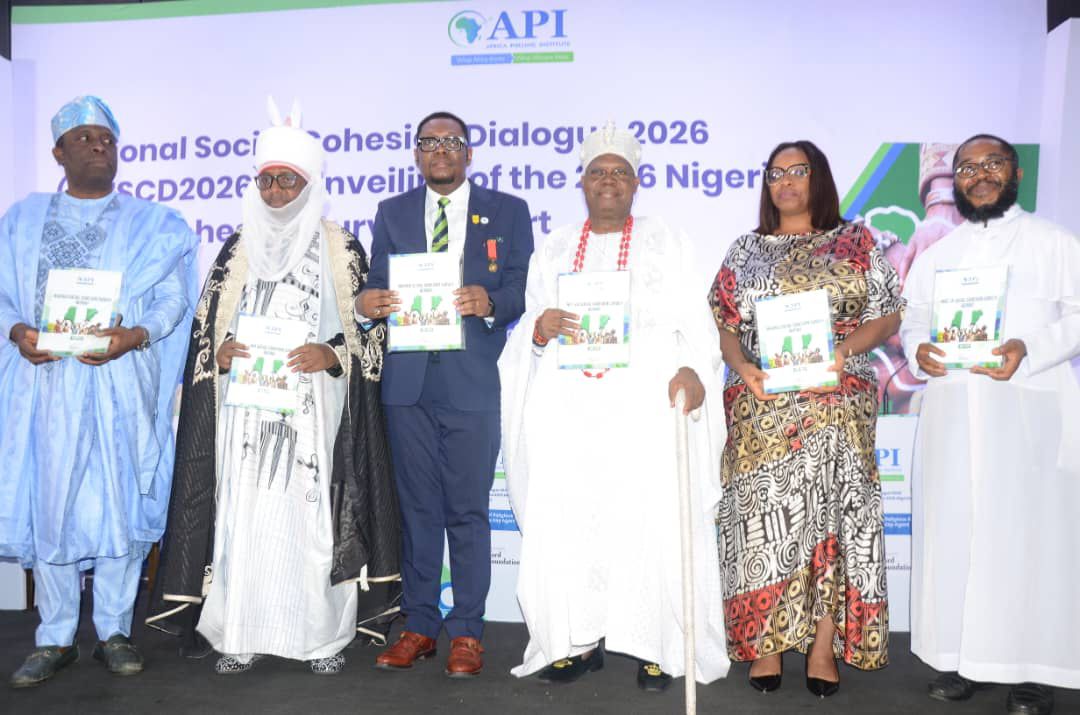
The position was advanced on Thursday at the 2026 National Social Cohesion Dialogue organised by the Africa Polling Institute (API) in Abuja, where policymakers, traditional rulers, religious leaders, development partners and civil society organisations gathered to examine the state of social cohesion in the country.
The dialogue, themed “Strengthening the Role of Religious and Traditional Institutions as Key Agents of Social Cohesion,” featured the presentation of findings from the 2026 Nigeria Social Cohesion Survey, a major research initiative supported by the Ford Foundation.
Presenting the report, Executive Director of the Africa Polling Institute, Professor Bell Ihua, disclosed that Nigeria’s Social Cohesion Index increased to 48.8 per cent in 2026, representing a two-percentage-point rise over the previous year and the highest score recorded since the survey commenced.
While noting that the figure remains slightly below the 50 per cent benchmark, Ihua said the improvement reflects Nigerians’ resilience and determination to coexist despite prevailing economic hardship, insecurity and other social pressures.
A key finding of the survey, he noted, was the growing embrace of a common national identity among citizens.
“For the first time since the inception of the study, a majority of respondents identified primarily as Nigerians rather than by ethnic, religious or regional affiliations. This shift represents an important milestone in the country’s nation-building journey and points to a strengthening sense of shared national identity,” he said.
Despite the positive trend, the survey found that public trust in government and state institutions remains weak, while religious and traditional leaders continue to command significantly higher levels of confidence among citizens.
According to Ihua, the Nigeria Social Cohesion Project measures the strength of social bonds among citizens and evaluates their willingness to work together across ethnic, religious and political lines for national progress and prosperity.
The 2026 assessment covered 14 key indicators, including identity, trust, social justice and equity, civic participation, tolerance, gender equality, disability inclusion, corruption, accountability, security, migration and future expectations.
Speaking on behalf of the Ford Foundation, Programme Officer Onyinye Onyema-Obi described Nigeria’s diversity as a valuable national asset that must be carefully managed through inclusive leadership and constructive engagement.
She said traditional and religious leaders occupy a unique position in society because of the confidence communities place in them.
“Beyond preserving heritage and spiritual values, they serve as authoritative voices that shape attitudes, influence behaviour and guide communal responses to evolving social realities,” she said.
Onyema-Obi noted that growing insecurity, misinformation and social polarisation have made the role of trusted community leaders increasingly important in fostering dialogue, understanding and peaceful coexistence.
“The establishment of a peaceful Nigeria cannot be achieved solely through policies and institutions. It must be built on interpersonal relationships and the exemplary conduct of leaders who inspire communities to prioritise cooperation over division,” she added.
Also speaking, the Archbishop of the Catholic Archdiocese of Abuja, Most Rev. Ignatius Ayau Kaigama, whose remarks were delivered by Rev. Fr. Emmanuel Unamba, said the survey findings highlighted the urgent need to rebuild confidence in national institutions while leveraging the trust enjoyed by traditional and religious leaders.
According to him, social cohesion remains essential for national development and stability, particularly at a time when many citizens feel disconnected from public institutions.
Drawing from both Christian and Islamic teachings, Kaigama emphasised that peace, solidarity and mutual respect remain foundational principles for nation-building.
“It is dangerous when people prioritise private identity above national identity. Citizens should proudly retain their cultural and religious identities, but these should not supersede commitment to the Nigerian project,” he said.
The Archbishop maintained that religious and traditional institutions are well-positioned to foster unity because of their strong community presence, ability to mediate disputes and contribution to education, healthcare and social welfare.
He advocated greater involvement of traditional and religious leaders in governance and public policy discussions, arguing that their grassroots connections provide valuable insights into the needs and concerns of local communities.
Among his recommendations were formal consultation frameworks, enhanced recognition of traditional authorities, increased autonomy in the selection of traditional rulers and stronger support for faith-based and community development initiatives.
Kaigama also cautioned religious and traditional leaders against partisan politics, stressing that public trust can only be sustained through neutrality and independence.
“Religious and traditional leaders should never be partisan. Once they become aligned with political interests, they risk losing the moral authority and public trust that make them effective agents of social cohesion,” he stated.
He further criticised the practice of awarding traditional titles based solely on wealth, warning that such actions could erode societal values and send negative messages to younger generations.
To enhance their effectiveness, he called for specialised training programmes for religious and traditional leaders in conflict resolution, community development and social cohesion management.
Earlier, in a goodwill message delivered on his behalf by the Falakin Kano, Mukhtar Ibrahim Bello, the Emir of Kano, Muhammadu Sanusi II, described religious and traditional institutions as indispensable instruments for dialogue, mediation and reconciliation in a diverse society.
He said the confidence reposed in religious and traditional leaders by citizens comes with a responsibility to promote justice, tolerance, peaceful coexistence and national integration.
Sanusi also urged leaders across faiths and traditional institutions to reject extremism, divisive narratives and discrimination, while strengthening partnerships with government and civil society actors to advance social cohesion.
Participants at the dialogue agreed that strengthening trusted community institutions remains critical to overcoming Nigeria’s social and developmental challenges.
They stressed that lasting peace, national unity and sustainable development would depend on collective efforts rooted in trust, inclusion and a shared commitment to the common good.