


1.3K
By Tracy Moses
The Nigeria Correctional Service (NCoS) has revealed that awaiting trial inmates now make up 64 per cent of the country’s total prison population, highlighting persistent congestion and pressure on correctional facilities nationwide.
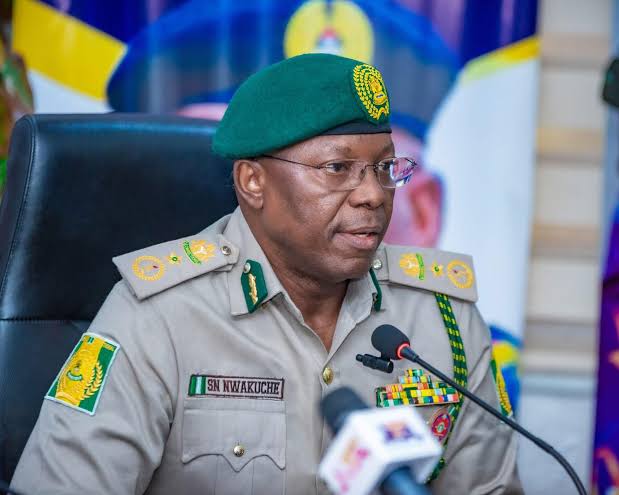
Controller-General of the Service, Mr. Sylvester Nwakuche, made the disclosure on Wednesday while presenting the agency’s 2025 budget performance and 2026 estimates before the House of Representatives Committee on Reformatory Institutions in Abuja.
According to Nwakuche, as of February 9, 2026, Nigeria’s total inmate population stood at 80,812, with 51,955 awaiting trial inmates, 24,913 convicted inmates, and 3,850 in other detention categories.
“The high proportion of awaiting trial inmates underscores the urgent need for reforms in our correctional system,” Nwakuche said.
“The Nigeria Correctional Service is a critical institution within the criminal justice system, responsible not only for custodial services but also for the rehabilitation and reintegration of inmates as law-abiding citizens.”
He stressed that the Service is mandated to ensure inmates are adequately fed in line with the United Nations Minimum Standard Rules for the Treatment of Offenders.
On the 2025 budget, Nwakuche disclosed that the Service received ₦184.63 billion, covering personnel, overhead, and capital expenditure. Of the ₦124.31 billion approved for personnel costs, ₦112.68 billion, representing 90.6 per cent, was released and fully utilized for salaries, pensions, and health insurance contributions under the Integrated Payroll and Personnel Information System (IPPIS).
Recurrent overhead releases stood at 73.7 per cent, with the final tranche for October 2025 released in December. From these funds, ₦27.28 billion, or 71.7 per cent, was spent on inmate feeding nationwide, leaving outstanding obligations for food rations at ₦10.75 billion.
Operational costs, including staff training, fuelling of vehicles for court duties, electricity, security services, and facility maintenance, amounted to ₦6.49 billion.
Capital funding recorded the lowest implementation level. Of the ₦14.50 billion appropriated for capital projects, only ₦3.22 billion, 22.2 per cent, was released and utilized, leaving ₦11.27 billion in unreleased funds. Nwakuche explained that capital expenditure is vital for constructing and rehabilitating custodial centres, procuring operational vehicles, arms and security equipment, ICT systems, biometric inmate registration, and agricultural inputs for prison farms.
Despite not being a revenue-generating agency, the Service realized ₦84.65 million in internally generated revenue in 2025.
It currently employs 33,024 staff, including uniformed personnel, medical professionals, and civilian employees deployed across national headquarters, zonal formations, state commands, and custodial facilities.
For 2026, Nwakuche presented a proposed ₦198.85 billion budget aimed at addressing operational and infrastructure needs.
This includes ₦138.30 billion for personnel costs to cater to a projected staff strength of 37,541, and ₦50.40 billion for recurrent overhead expenditure. Of this, ₦14.83 billion is earmarked for feeding an estimated 91,100 inmates at a daily rate of ₦1,125 per inmate.
He appealed for an additional ₦90.38 billion to boost capital funding, which would raise total capital allocation to about ₦100.50 billion to tackle infrastructure deficits and capacity development across facilities. A dedicated ₦37.99 billion is also requested to support the implementation of non-custodial measures across Nigeria’s 774 local government areas.
The Controller-General further sought approval to clear outstanding liabilities, including ₦30.38 billion in promotion arrears covering 2019 to 2024, and ₦25.16 billion owed to local contractors for services rendered between 2023 and 2025.
Chairman of the House Committee on Reformatory Institutions, Hon. Chinedu Ogah, emphasized the need for urgent reforms, increased funding, improved infrastructure, and presidential assent to the Correctional Service Trust Fund Bill.
He lamented that many facilities were built over a century ago and have deteriorated, contributing to recurring security breaches and operational strain.
“Our core duty today is the budget defence of the 2026 Appropriations as presented by President Bola Ahmed Tinubu,” Ogah said, noting that improved funding and decentralized infrastructure would strengthen rehabilitation programmes, vocational training, and agricultural initiatives, allowing correctional centres to function as genuine reform institutions.
He highlighted ongoing efforts to expand access to education within prisons, revealing that about 10 study centres of the National Open University of Nigeria have been established nationwide, including at Abakaliki Correctional Centre, offering free programmes to inmates.
He urged private sector organisations to support correctional institutions through corporate social responsibility initiatives to reduce recidivism and strengthen national security.
Ogah also called on the National Security Adviser to support the operational needs of the Service, emphasizing that while other agencies arrest and prosecute suspects, correctional authorities shoulder the responsibility of custody, rehabilitation, and reintegration.
He commended correctional officers for maintaining operations under challenging conditions and noted that members of the National Assembly have actively supported oversight activities to address urgent needs within the system.
The committee will now examine the Service’s 2025 performance before concluding deliberations on the 2026 budget estimates.