


By Tracy Moses
Nigeria recorded a trade surplus of N7.55 trillion in the first quarter of 2026, with exports valued at N21.173 trillion and imports at N13.623 trillion, Vice-President Kashim Shettima has said.
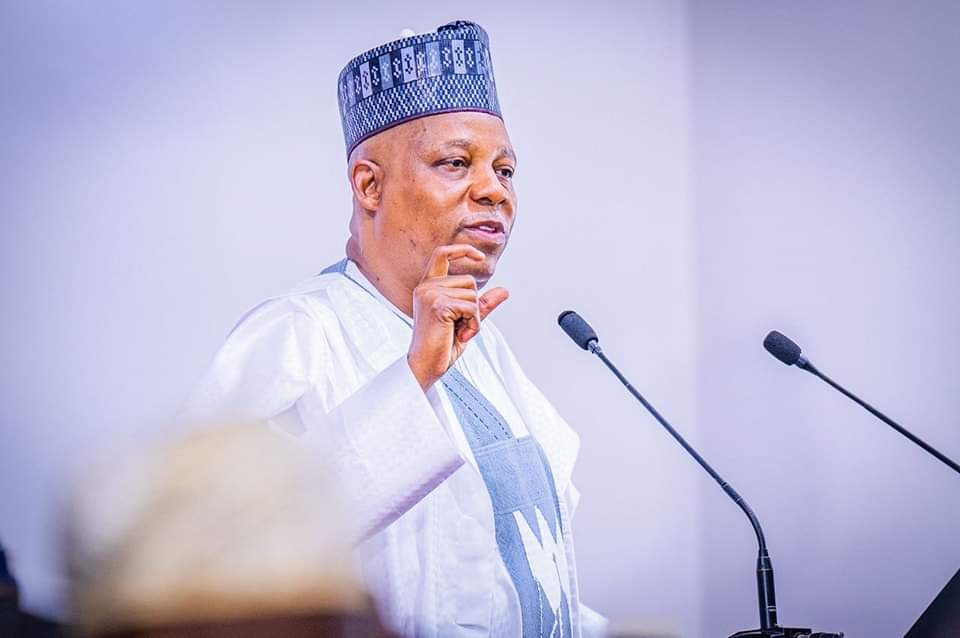
Shettima disclosed this on Monday in Abuja while representing President Bola Tinubu at the opening of the 32nd Nigerian Economic Summit, organised by the Nigerian Economic Summit Group (NESG).
The summit, which runs from October 26 to 27, is themed, “Growth That Works: Delivering Jobs, Productivity and Shared Prosperity.”
The Vice-President said the trade surplus reflected Nigeria’s export position but stressed the need to diversify exports and retain more value within the domestic economy.
He noted that crude oil accounted for 52.9 per cent of total exports during the period, while non-oil exports stood at N3.193 trillion.
“Yet crude oil accounted for 52.9 per cent of exports while non-oil exports was N3.193 trillion. We must add more value from agricultural products, manufactured goods, processed minerals and digital services,” Shettima said.
He said Nigeria’s economic transformation depended on moving away from exporting raw materials and importing finished goods towards building industries that could process local resources, create jobs and expand domestic production.
Shettima said the Federal Government was pursuing measures to improve electricity supply, boost oil production and support industrial development.
“We are revamping the electricity market to improve supply and attract investment in generation, transmission, distribution and in June 2026 our crude oil production hit 1.735 million barrels per day,” he said.
He also identified improved energy supply and increased agricultural output as critical to economic recovery, adding that investment in manufacturing, food processing, gas processing and petrochemicals would strengthen Nigeria’s productive capacity.
“This will sustain months of growth while food output attains a 74-month high. Our vision is to sustain recovery in industrial strength, food processing, gas processing, petrochemicals and manufacturing,” he said.
On agriculture, Shettima said the government was working to link farms with storage facilities, processing centres and markets while expanding irrigation, mechanisation, access to agricultural inputs and rural infrastructure.
In the solid minerals sector, he said the priority was to move beyond extraction to domestic processing, industrial production and exports.
The Vice-President also described Nigeria’s youthful population as a major economic asset, citing the growth of local businesses in technology, financial services and the creative industries.
He said Nigerian entrepreneurs had built some of Africa’s unicorn companies, demonstrating the country’s capacity to compete globally when businesses operate in an enabling environment.
Shettima further disclosed that the government had introduced a reform and ward development programme targeting key priorities across 8,809 wards and 774 local government areas.
He said economic growth must translate into tangible improvements in communities, urging government and private-sector participants at the summit to develop practical solutions and agree on measures to accelerate national development.
NESG Seeks Shift from Reforms to Results
In his welcome address, NESG Chairman, Olaniyi Yusuf, urged the Federal Government to ensure that its economic reforms translated into more jobs, higher productivity, improved household incomes and better living standards.
Yusuf acknowledged that the administration had undertaken difficult reforms to restore macroeconomic stability but warned that stabilisation alone would not guarantee prosperity for households and businesses.
“This Summit comes at a consequential moment. Nigeria has undertaken difficult but necessary reforms to restore macroeconomic stability.
“These reforms have imposed considerable pressures on households and businesses, but they have also created an opportunity to reconsider the foundations of our socio-economic development,” he said.
He said the national economic debate should move beyond whether the reforms were necessary to focus on how they could strengthen businesses, create better jobs, raise incomes and improve living standards.
“Our responsibility now is to ensure that reform translates into stronger enterprises, better jobs, more productive workers, rising incomes, improved living standards and shared prosperity. This is the central purpose of NES #32,” Yusuf said.
He listed petrol subsidy removal, foreign exchange liberalisation, fiscal restructuring, tax reforms and banking sector recapitalisation among the major changes to Nigeria’s economic policy framework.
According to him, the measures were intended to address economic distortions that weakened public finances and hindered the efficient allocation of resources.
However, he cautioned that macroeconomic stability should be seen as a foundation for progress rather than an end in itself.
“However, stabilisation creates the conditions for progress; it does not automatically deliver it.
“For instance, a more stable exchange rate does not, by itself, make a manufacturer competitive,” he said.
Yusuf said households needed decent jobs, greater purchasing power, improved security and reduced poverty, while businesses required lower production costs, reliable infrastructure, particularly electricity, higher productivity and affordable financing.
He urged the government to sustain its reform programme while paying greater attention to the outcomes Nigerians experience in their daily lives.
“Therefore, the task before us is not to reverse or suspend reforms. We must stay the course. The urgent task before us is to move decisively from economic reform to socio-economic results,” he said.
UN Deputy Chief Warns Against Policy Inconsistency
In her remarks, United Nations Deputy Secretary-General Amina Mohammed warned that Nigeria could lose the opportunity to turn its demographic advantage into economic strength without sustained and consistent policies.
She noted that Nigeria was projected to become the world’s third-most populous country by 2050, describing the projection as a test of the country’s leadership and its ability to create opportunities for its growing population.
Mohammed said Nigeria had the interest, capacity and resources to realise its potential, but stressed that progress depended on maintaining sound policy choices across successive administrations.
“We have the interest, capacity and resources to achieve 100 per cent of our potential.
“But that has to be sustained. That policy choice has to be sustained. Administrations will come and go, Nigeria must be sustained,” she said.
The 32nd Nigerian Economic Summit brought together government officials, business leaders, investors and economic experts to discuss strategies for accelerating economic transformation, attracting investment, improving productivity and strengthening private-sector participation.
The discussions come amid continuing debate over the effects of the Federal Government’s economic reforms, particularly on business costs, household purchasing power, employment and the cost of living.
While the government has pointed to improvements in selected macroeconomic indicators as evidence of progress, the NESG has called for greater emphasis on ensuring that economic stabilisation delivers measurable benefits to businesses and ordinary Nigerians.