

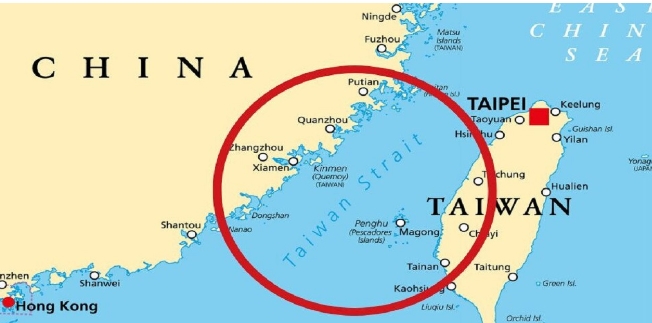

Experts have attributed the continued management of tensions across the Taiwan Strait to a combination of strategic restraint, historical experience, diplomatic traditions and military deterrence, arguing that these factors have prevented the long-running dispute from escalating into full-scale conflict.
The Taiwan Strait, a strategic 180-kilometre waterway separating mainland China from Taiwan, remains one of the world’s busiest shipping routes and one of its most sensitive geopolitical flashpoints. The dispute pits the People’s Republic of China against the self-governed island of Taiwan, whose democratic system and security ties with Western countries, particularly the United States, have remained a source of friction.
Military tensions have flared periodically, with Beijing conducting exercises around Taiwan in response to what it describes as external interference and moves toward Taiwanese independence.
Speaking on cross-strait relations, former Vice-Chancellor of Nasarawa State University, Keffi, Professor Suleiman Bala Mohammed, said the relative restraint demonstrated by both sides reflects deeper diplomatic traditions.
“It is a fair assessment if it is viewed more scientifically because there are underlying cultural norms for diplomacy in both parties,” he said.
Also speaking, Professor Ghali Ibrahim, an international relations scholar at Nasarawa State University, said the restraint shown by Beijing and Taipei stems from their shared historical and philosophical background.
According to him, the conduct of both sides has been shaped by centuries of political and philosophical conditioning that favours caution in the management of disputes.
In his 2024 book, The Struggle for Taiwan: A History of America, China and the Island Caught Between, Sulmaan Wasif Khan argues that the continued absence of direct war is also a product of military deterrence, particularly the strategic balance created by the presence of both Chinese and American forces in and around the Taiwan Strait.
Offering another perspective, Professor Yusuf Zoaka of the University of Abuja said the China-Taiwan dispute differs fundamentally from conflicts such as those involving Russia and Ukraine, Israel and Palestine, or the United States and Venezuela.
“The China-Taiwan conflict may be viewed in the context of its different typology from those of Russian-Ukraine, Israel-Palestine and US-Venezuela which all witnessed violent invasions.
‘Cross-strait relations are fundamentally about unresolved civil war legacy and competing claims to legitimacy,'” he said.
Analysts also point to the influence of classical Chinese philosophy on approaches to conflict resolution. The teachings of Confucius and Lao Tze have long emphasised harmony, moderation and the peaceful management of disputes.
In The Tao that Can be Told, Qiguang Zhao describes Confucian philosophy, writing: “He teaches you how to build good relations and the way to follow and the five virtues – ‘benevolence, uprightness, propriety, knowledge and good faith’.”
While scholars differ on the relative importance of each factor, there is broad agreement that deterrence, diplomatic restraint and what some observers describe as the policy of “strategic ambiguity” pursued by several key international actors have contributed to preserving stability across the Taiwan Strait.
Beijing continues to maintain that Taiwan is an inseparable part of China, while Taiwan has sought to preserve its de facto independence under a democratic system with continued support from the United States and other Western partners.
Despite recurring military tensions, the dispute has remained largely contained since 1949, when Chiang Kai-shek and the Kuomintang government retreated to Taiwan following their defeat by Mao Zedong’s Communist forces in the Chinese Civil War.
Subsequent flashpoints, including the 1995-96 Third Taiwan Strait Crisis, the 1999 state-to-state dispute and the near collision between a Chinese warship and a United States destroyer in June 2023, stopped short of open conflict, allowing the status quo to endure.
Beyond security concerns, the two sides remain deeply interconnected economically. Mainland China is Taiwan’s largest trading partner, while Taiwanese companies continue to rank among the leading investors in mainland China’s manufacturing and technology sectors, underscoring the complex relationship that combines strategic rivalry with extensive commercial ties.