


By Oscar Okhifo
Minister of the Federal Capital Territory (FCT), Nyesom Wike, is banking on his administration’s infrastructure projects, the performance of his political allies in the area council elections and his cross-party Rainbow Coalition to mobilise support for President Bola Tinubu’s re-election in 2027.
Wike’s declaration that the FCT would not repeat the outcome of the 2023 presidential election reflects his determination to convert his political influence and record in office into electoral support for Tinubu in the nation’s capital and Rivers State.
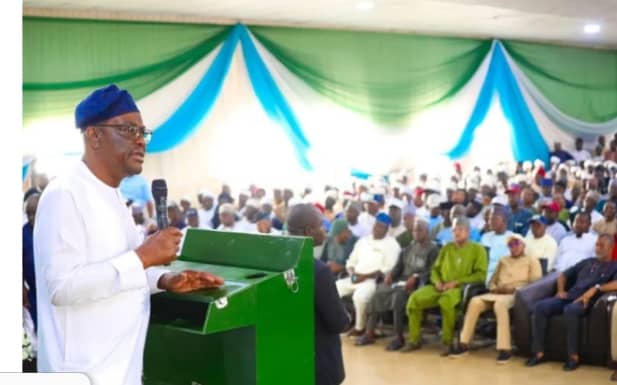
Speaking at a meeting of the Rainbow Coalition in Bwari, Abuja, the minister challenged residents to consider whether they were prepared to repeat the outcome of the last presidential election.
“The mistake we made in 2023, would we make that mistake again? If it was an error, would we make that error again?” he asked.
The challenge underscores the political significance Wike attaches to the FCT, where the Labour Party’s presidential candidate, Peter Obi, defeated Tinubu in the 2023 election.
Wike’s strategy appears to rest partly on the performance of his political allies in the area council elections and their grassroots structures, which he hopes to build on ahead of the 2027 general election.
His mobilisation drive, however, extends beyond the traditional structures of any single political party.
Defending his decision to bring politicians from different parties together under the Rainbow Coalition, Wike argued that party affiliation should not prevent Nigerians from supporting a presidential candidate of their choice.
“It doesn’t matter the party. After all, party is a vehicle that conveys you to where you are going. When you get there, you come down from the vehicle and you now work for the interest of the people,” he said.
The position reflects Wike’s political trajectory since 2023, when he supported Tinubu’s presidential bid while serving as governor of Rivers State under the Peoples Democratic Party (PDP).
Tinubu subsequently appointed him FCT minister despite his continued membership of the PDP, placing him in an unusual political position: a member of an opposition party working to secure the re-election of an All Progressives Congress (APC) president.
Wike’s access to the President and his position in the Federal Government have reinforced his argument that politicians can support Tinubu without abandoning their existing parties.
He has maintained that Tinubu is aware of his political activities, dismissing suggestions that the Rainbow Coalition is working against the President’s interests.
However, the strategy has generated friction with APC governors, who fear that the coalition could weaken the ruling party’s candidates in governorship and legislative elections or create divided loyalties among party supporters.
The Progressive Governors’ Forum, chaired by Imo State Governor Hope Uzodimma, has opposed political arrangements it considers capable of undermining the APC’s structures.
Some APC governors have also challenged Wike to join the ruling party if he intends to mobilise support for its candidates.
Wike, in turn, has criticised the governors for opposing his approach, arguing that support for Tinubu should not automatically translate into support for every APC candidate.
The disagreement has exposed a broader contest within the President’s support base over party loyalty, candidate selection and control of the structures expected to mobilise votes in 2027.
Wike’s alternative is to rally supporters from different political parties behind Tinubu while allowing them to retain their party identities and pursue their preferred candidates in other elections.
The minister has also staked his political credibility on Tinubu’s performance in the two territories he considers his primary areas of influence: the FCT and Rivers State.
At an earlier engagement with members of the Apo Mechanics and Traders Association in Abuja, Wike pledged to resign as FCT minister if Tinubu failed to win both territories in 2027.
“If I cannot deliver where I work, then I’m not worthy to be here,” he said.
He added: “If I lose FCT, I’m not supposed to be FCT Minister. By January 17, 2027, I will announce my resignation as FCT Minister should the President lose in Rivers State and the FCT.”
The pledge raises the stakes for Wike, effectively turning the presidential election results in the two territories into a test of the political influence he claims to wield.
Beyond political alliances and grassroots mobilisation, the minister is also counting on his administration’s infrastructure record to strengthen his appeal to voters.
Road construction and rehabilitation have featured prominently in his tenure, with projects across the FCT aimed at opening up developing districts, improving connectivity and easing movement within the capital.
At the Bwari meeting, Wike offered a specific assurance on the Gombi–Kubwa road, linking his infrastructure programme to the daily experiences of residents.
“Let me authoritatively tell you today, by the grace of God, this December, you will do Christmas on this road, Gombi to Kubwa,” he said.
The promise illustrates the importance Wike places on visible project delivery as a basis for public support.
His infrastructure drive has attracted commendation from residents and supporters who see the pace of road construction as evidence of a more visible approach to development in the FCT.
However, the emphasis on roads and bridges has also prompted questions about whether physical infrastructure alone is sufficient to measure development, particularly against the need for affordable housing, efficient public transport, accessible healthcare, quality education, improved sanitation and relief from the rising cost of living.
For supporters, the projects provide tangible evidence of government activity. Critics, meanwhile, argue that the ultimate test should be whether the investments translate into measurable improvements in residents’ living conditions.
Wike’s political calculations extend beyond Abuja. His decision to support Tinubu while remaining in the PDP has made him a prominent figure in the debate over how the President’s re-election campaign should be organised and which political structures should drive it.
Although opposition from APC governors has exposed divisions within Tinubu’s support base, Wike has continued to promote the Rainbow Coalition as a vehicle for cross-party mobilisation.
His argument is that securing Tinubu’s re-election should take precedence over disagreements about party affiliation and other candidates on the ballot.
Whether Wike can turn his infrastructure record, political alliances and grassroots networks into the electoral victories he has promised in the FCT and Rivers State will ultimately be decided by voters in 2027.