

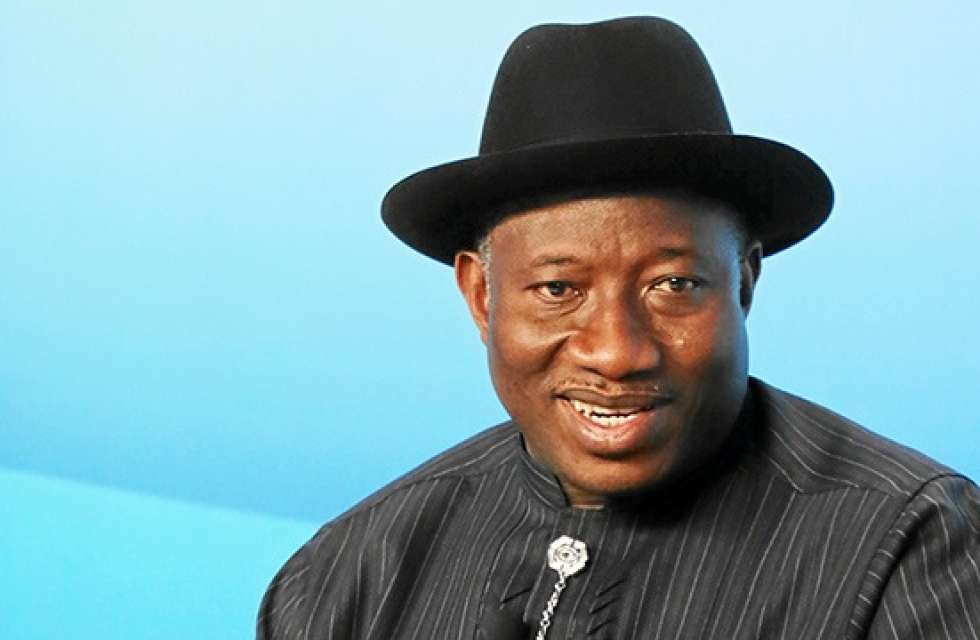

Ex-President Goodluck Jonathan, has said that “If, as a nation, we do not
kill religious persecution and extremism, then religious persecution and
extremism will kill Nigeria.”
He also said that, “the potential danger associated with the level of
conflicts going on across the country is so glaring that no sane mind can
ignore.” He said it is not in the best interest of the U.S. and indeed the
international community to ignore Nigeria.” Jonathan gave the statement in
a speech he delivered at the U.S. House Sub Committee on Africa on
February 1, 2017. The speech is titled, “Challenges of Nigerian Christians
and the Niger Delta Question-A Summary.”
Read the full speech below:
Challenges of Nigerian Christians and the Niger Delta Question-A Summary A
Presentation by Dr. Goodluck Jonathan, Chairman of the Goodluck Jonathan
Foundation to the U.S. House Sub Committee on Africa, February 1, 2017
Let me start by thanking Congressman, Christopher H. Smith, Chairman U.S.
House Sub-Committee on Africa, Global Health, Global Human Rights and
International Organizations for inviting me to share my views on the
crisis facing Christians in Nigeria today and the Niger Delta question.
The U.S. Congress is a powerful institution not just for good governance
in the U.S. but also for global peace and development. Over the years, the
U.S. Congress has shown consistent interest in African affairs and I thank
you for this and for showing interest in Nigeria. Congressman Smith has
personally visited troubled spots in Nigeria and especially those
geo-political zones that are considered the frontline of ethnic and
religious conflicts. He has also visited the Niger Delta. I sincerely
thank him for these efforts
Over the years, the U.S. Congress has shown consistent interest in African
affairs and I thank you for this and for showing interest in Nigeria.
Congressman Smith has personally visited troubled spots in Nigeria and
especially those geo-political zones that are considered the frontline of
ethnic and religious conflicts. He has also visited the Niger Delta.
I sincerely thank him for these efforts. File: Former President Jonathan
giving his speech at Oxford In your invitation letter, you highlighted a
number of very sensitive issues you wanted me to touch on. I group all
these issues under ‘Challenges Facing Nigerian Christians and the Niger
Delta Question’. A full discussion on even one of these issues may take a
minimum of two hours, but here, I am expected to be very brief.
I will therefore present a bird’s eye view, but when next your committee
visits Nigeria, even more detailed presentations will be made by other
stake holders.
2. Nigeria and the World
I read a paper presented by Princeton N. Lyman, a former U.S. ambassador
to Nigeria, suggesting that Nigeria is no longer strategic to U.S.
interests in Africa and the world as it used to be. Ambassador Lyman may
have had valid reasons for such a view point, but I make bold to say that
the relationship between the U.S. and Nigeria has come a long way since
Prime Minister Abubakar Tafawa Balewa’s State Visit to the U.S. in July of
1961 and that relationship should not only endure, but be built upon.
Nigeria, as a nation, is relevant to the U.S. in my opinion especially
when you consider such parameters as:
Mineral Resources Economy/Trade Biotic Resources Population/Human
Resources, etc Nations such as Nigeria can impact the globe positively
when things are handled properly. They may also affect the world
negatively if things go wrong. It is not in the best interest of the U.S.
and indeed the international community to ignore Nigeria.
3. Killing of Christians in Nigeria
Your invitation letter profusely highlighted the issues of the killing of
Christians in Nigeria, the last major incident being the recent killings
in Southern Kaduna in Kaduna state, and I do not need to elaborate on
that. The challenge is how do we stop that from recurring.
How do we ensure that Christians and Muslims cohabit peacefully in Nigeria
and practice their religions freely without discrimination, molestation
and killings? One school of thought believes that these killings reoccur
because of impunity.
Security and law enforcement bodies unfortunately have a history of
failing to apprehend the culprits of previous killings and disturbances
and punishing according to the law.
Such impunity has emboldened and encouraged persons with such tendencies.
Indeed, though there have been over 10 major incidences of ethnic and
religious conflagration in the frontline state of Kaduna since 1979, there
has only ever been one incidence where the authorities took action,
according to the law, to punish the culprits of the disturbances.
This was in 1992, after the Zangon Kataf riots in which the official death
toll was 300.
The military administration of General Ibrahim Badamasi Babangida
constituted the Civil Disturbances Special Tribunal to try arrested
persons and a total of 14 persons were sentenced to death, although the
Babangida administration commuted the sentences to five years
imprisonment. Within the period I served as a Vice President and later as
President, it became very clear to me that if the issue of religion is not
handled properly, the unity of the country would be in great jeopardy.
Religious and other ethnic issues were becoming a stumbling block towards
societal cohesion and economic development. I therefore set up a National
Conference with the mandate of looking into all the grey areas militating
against the peace, progress and development of Nigeria. On the issue of
religion, let me quote unedited the position of the 2014 National
Conference.
Nigeria has over 350 ethnic nationalities and that: ‘“This multi-ethnicity
has been compounded by pronounced religious differences, exploited usually
for political considerations by avid political classes in contexts of
extreme poverty and very low educational development among the mass of the
populace.
Whereas Nigeria is supposed to be a secular state,” one nation bound in
freedom, peace and unity”, the prevalence of religiosity and its related
nepotism at all levels, has effectively undermined the objectivity which
secularity would have ordinarily imbued in national politics.” The
Conference further stated that: “In view of the fact that religion plays a
vital role in many aspects of our national life especially in the aspect
of national security and national unity, it is highly imperative that it
be singled out from other fundamental rights and given a special attention
via the creation of an Equity Commission whose sole mandate will be to
focus on religious rights and their promotion.
This is in line with best global practices as many advanced democracies
have special legal and institutional arrangements for some very sensitive
aspects of their national life. Examples of such specialized agencies from
other countries are presented below:
a) In the United Kingdom, despite the existence of the UK Equal
Opportunities Commission (UK-EOC), a Commission for Racial Equality
(created by the Race Relations Act, 1976) which existed alongside UK-EOC
for many years. This was done because at the time, issues of racial
discrimination were very sensitive and crucial that it was thought
necessary to create a special commission for it. b) In the United States,
despite the existence of the US State Department Bureau of Democracy,
Human Rights and Labor, it has other special human rights enforcement
agencies created to promote specific rights. One of such agencies is the
Equal Employment Opportunity Commission (EEOC) which is a federal law
enforcement agency that enforces laws against workplace discrimination.
The EEOC investigates discrimination complaints based on an individual’s
race, color, national origin, religion, sex, age, disability, genetic
information, and retaliation for reporting, participating in, and/or
opposing a discriminatory practice. c) Canada has a similar arrangement to
that of the United States. The Canadian Human Rights Act has long
prohibited discrimination on the basis of gender,COM FINAL CONFERENCE
REPORT PAGE 433 race, ethnicity, and certain other grounds. In 1986, the
Canadian government passed the Employment Equity Act which was meant to
protect certain restricted vulnerable categories of persons. The Canadian
Human Rights Act continues to be in force alongside the Employment Equity
Act. d) In Australia, there are 3 different commissions addressing the
issues of human rights, namely: Human Rights Commission,
Anti-Discrimination Commission and Equal Opportunities Commission” I
totally agreed with the 2014 National Conference on the need to establish
the Religious Equity Commission that will have powers to arrest and
prosecute those who contravene the law. If, as a nation, we do not kill
religious persecution and extremism, then religious persecution and
extremism will kill Nigeria. The potential danger associated with the
level of conflicts going on across the country is so glaring that no sane
mind can ignore.
Even before I set up the National Conference in 2014, my government took
certain initiatives to end impunity and reorient the minds of Nigerians.
First was education. I established twelve conventional Federal
Universities and two specialized universities. Nine of the twelve Federal
Universities were located in those states in Northern Nigeria that
previously did not have any Federal University. The Specialized Police
University was located in Kano state, also in the North, bringing the
total number of universities I established in the North of Nigeria to ten.
The Specialized Maritime University was located in the Niger Delta. In
addition to these, I also established 165 Almajiri elementary and high
schools in each of the nineteen states of Northern Nigeria to combine
Islamic education with Western education. In the area of law enforcement,
it was quite challenging, but we were determined.
When the Boko Haram Islamic terrorists bombed St. Theresa’s Catholic
Church, Madalla, in Niger state of Nigeria on Christmas Day of 2011, I
physically visited the scene of the bombing at which 44 people died on
Saturday the 31st of December 2011 and I promised Nigerians that those
responsible for that heinous act would be brought to book. That promise
was fulfilled on the 20th of December 2013 when Kabiru Umar, aka Kabiru
Sokoto, was sentenced to life imprisonment after my administration
investigated that crime, identified him as the mastermind, arrested him
and diligently prosecuted him and some of his associates.
Might I add that this was the first and only successful prosecution of a
crime of deadly terrorism against a religious place of worship inspired by
religious extremism since Nigeria’s return to civil rule in 1999. Before
then, my administration had also diligently carried out the first
successful prosecution of terrorists of the Islamic extremist group, Boko
Haram, for another terror attack, but this time not in a place of worship
but on the offices of the Independent National Electoral Commission also
in Madalla, Niger state, an act which led to the deaths of sixteen persons
on April 8th, 2011. We were in the process of prosecuting Aminu Ogwuche,
the mastermind of the April 14, 2014 Nyanya bombing in Nasarawa state
which killed 75 people but unfortunately that prosecution was ongoing as
at the time I left office in 2015.
But the point I want to emphasize by citing these incidences is that my
administration had the political will to halt impunity in Nigeria and that
is why killings due to religious extremism was localized to the Northeast
with occasional killings in other zones of the North. And even in the
Northeast, we had rolled back the Islamic terrorist sect, Boko Haram, by
the end of the first quarter of 2015 after we were able to get weapons to
arm our military. The killings did not spread to the mainly Christian
south and I believe that the fight back against impunity by my
administration was the main reason for this. Of course, there were other
reasons for this.
For instance, through my personal reach out to the then President of the
Christian Association of Nigeria, Pastor Ayo Oritsejafor, I was able to
persuade the Body of Christ in Nigeria not to engage in any retaliation or
reprisal killings.
My job was made easier in this regards when the Christian Association of
Nigeria saw a genuine desire on my part to bring religious extremists to
book. Using the same approach with the head of the Muslim Ummah in
Nigeria, His Eminence, the Sultan of Sokoto, I was able to get the
mainstream of the Islamic faith to publicly condemn Islamic extremism in
Nigeria.
This was important to show that a clampdown on Islamic extremism was and
is not a clampdown on Islam. Going a step further, I worked through a body
known as the Nigeria Inter-Religious Council (NIREC) to bring Christian
and Muslim leaders together so they could talk to each other not at each
other.
To summarize on the issue of ethnic and religious conflicts, I recommend
the establishment of the Religious Equity Commission, enforcement of our
laws without fear or favor and maximum cooperation by all Nigerians
especially our revered religious leaders and clerics.
4. The Niger Delta Question
The issue of the Niger Delta is an issue of exploitation of natural
resources, economy and development. The complaints and restiveness is not
unique to the Niger Delta of Nigeria alone. In most African nations where
resources are domiciled in minority regions and the control of such
resources are in the hands of majority regions, such agitations are
commonplace.
The people in these regions feel that though they suffer from the
environmental hazards of the exploitation of the God given resources, they
do not commensurately benefit from the exploitation of these resources. In
the Niger Delta, these agitations predate Nigeria’s existence in 1914. Oil
palm produce (palm oil and kernel) were major raw materials that fed the
growth of the Industrial Revolution in Europe, and they largely came from
the Niger Delta. Various tribal kings and chiefs such as King Jaja of
Opobo and Nana Olomu, resisted British exploitation of these resources and
were both arrested, deposed and exiled to the West Indies (King Jaja) and
the Gold Coast (Nana) by the British Imperial Government as punishment for
their agitations.
Let me add that the punitive measures against these kings did not end the
agitations. With the discovery of petroleum, in the Niger Delta, similar
agitations surfaced. On February 23, 1966, these agitations culminated in
the declaration of the first secessionist state in post independent
Nigeria, the Niger Delta Republic, proclaimed by Isaac Jasper Adaka Boro.
His twelve day revolution was crushed by the Federal Government.
It is instructive to note that Isaac Boro declared the Republic of the
Niger Delta a full year and three months before May, 1967 when then
Colonel Chukwuemeka Odumegwu Ojukwu declared the secession of the Eastern
Region to form the Republic of Biafra leading to the thirty month civil
war. From the end of the civil war to date the Federal Government has come
up with many interventionist initiatives to pacify the Niger Delta.
I was a pioneer staff and worked as an Assistant Director of Environmental
Protection at one of these early interventionist agencies called the Oil
Mineral Producing Areas Development Commission (OMPADEC), set up by the
military administration of General Ibrahim Badamasi Babangida. With the
advent of democracy in 1999, then President Olusegun Obasanjo established
the present body, the Niger Delta Development Commission (NDDC).
The greatest stumbling block of these interventionist agencies was lack of
continuity, resulting from an over politicization of projects as each
successive management awarded new contracts rather than continue with
those awarded by their predecessors and as such, the Niger Delta is
littered with many abandoned projects with very few completed projects to
show for the huge monies spent. During the Obasanjo era, the Federal
Government, in line with our constitution and revenue laws, set aside 13%
of oil revenues to be paid as derivation funds to oil producing states and
shared on the basis of proportion of oil they produce.
As a person from the Niger Delta, I can say that the 13% derivation has
benefitted Niger Delta states and their people more than the
interventionist agencies. For example, those who knew Akwa Ibom state
before the 13% derivation become law will agree that the derivation fund
has changed the face of that state making it almost overnight one of the
most developed states in Nigeria.
The same is true with other oil producing states though with varying
degrees of development. From the foregoing, the only option that will
solve the agitation in the Niger Delta is true and Fiscal Federalism as
practiced in the United States from whom we copied the Presidential model
of government.
States should be allowed to exploit their natural resources as they deem
fit and pay adequate taxes to the Federal Government.
This is also the position of the 2014 National Conference. The Conference
strongly recommended the adoption of Fiscal Federalism as the only panacea
to these agitations and other challenges.
5. The Role of the Goodluck Jonathan Foundation
Resolving both the religious crises and the Niger Delta question requires
a new legal framework, thus the Federal Government and the National
Assembly have major roles to play.
The Goodluck Jonathan Foundation working with Elder statesmen and Civil
Society groups can, through dialogue and advocacy, encourage religious
leaders, traditional rulers, youth groups and women groups to participate
in the formulation of a new legal framework.
They will also be impressed upon to abide by these laws when put in place.
Without a new legal framework, successes by any advocacy group will at
best be transient, it will not endure. Also, the military crackdown in the
Niger Delta will not end the agitation there.
It will have the opposite effect of provoking the youths which will cause
them to seek to acquire sophisticated weapons to defend themselves and
their communities.
This may in turn lead to secessionist movements and the reincarnation of
the Isaac Jasper Adaka Boro led revolution and the Biafran Civil War. The
Federal Government and the international community must work to avoid
this.
6. Global Terror and Boko Haram in Nigeria
The Boko Haram Islamic terrorist sect has been classified as the most
deadly terror group in the world by the Global Terrorism Index.
Herdsmen operating in and around Nigeria are listed as the fourth most
deadly terror group.
However, I do not intend to discuss global terror because it is a subject
well known to all and the U.S. government has been working hard with
various governments to address these issues.
My belief is that the day the U.S. government and the Russian government
decide to work together, that will surely mark the beginning of the end of
global terror.
7. Conclusion
In my capacity as head of the Goodluck Jonathan Foundation, I visited
former Nigerian leaders to call for unity of purpose to fend off some of
these challenges I have listed above.
And finally today I am here, calling on this august body and the new
American administration of President Donald J Trump, of whom we are very
confident, to please work with the government and people of Nigeria by way
of capacity building and intelligence gathering and sharing and indeed in
any way possible to bring an end to religious extremism in Nigeria.
Mr. Chairman, distinguished ladies and gentlemen, I thank you for giving
me the opportunity to share my ideas on these sensitive subject with you.