


By Mercy Abang
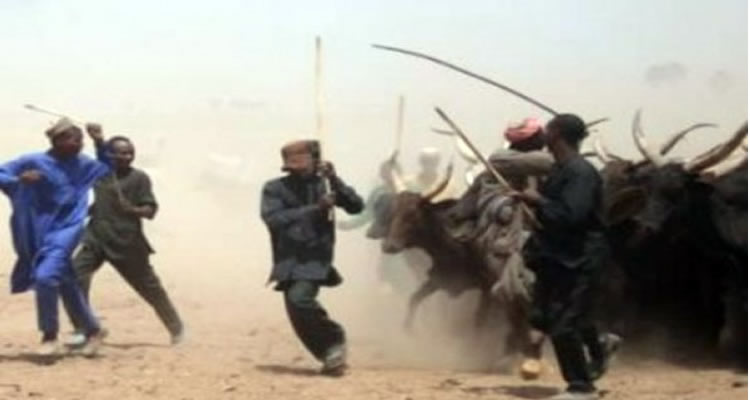
In Sabondaga, a small village of predominantly farmers in Niger State, many
of the locals are still counting their losses following the invasion of
Fulani Herdsmen. The attacks have continued even as concerns remain
unabated over the possibility of unprecedented hunger and famine in Nigeria
as a result of drought, conflicts and economic instability.
One of them is 55-year old yam farmer, Yusuf Dangwari who spoke to me with
his cap in his hand and tears in his eyes. “The herdsmen attacked us on
Tuesday, 10th January 2017 at about 11:am”, he started, pausing to cry
profusely as we inspected the farm. “We were helpless. As you can see, they
moved from one yam barn to another burning all we have worked for over the
years – about 500 million naira gone.”
Sabondaga community of about 20,000 people has been turned into a ghost
town – the villagers have all fled for their lives – hunted by the fear of
getting killed should they return.
The attacks by migrant herdsmen on indigenous farmers has gone on unabated
for decades but has heightened within the last two years, with the
nomads wrecking havoc from Enugu state to Southern Kaduna region and Agatu
community in Benue State.
Dangwari was inconsolable. “This is the height of man’s inhumanity to man,
where do I start from? Who will even give me the seedlings to start all
over?”
At some point again in the course of this inspection, he paused, stopped
talking, sat on the debris and screamed; his voice reverberated across the
empty walls and into the empty village, a testimony to the absence of his
fellow villagers who had all fled following the invasion.
A recent study by a United States-based group, the Famine Early Warning
Systems Network has revealed that already people in 45 countries were
unable to feed themselves largely because of different forms of disasters
and economic crises.
The study by FEWS NET shows that, “the combined magnitude, severity and
geographic scope of anticipated emergency food assistance needs during 2017
are unprecedented in recent decades and about 70 million people were in
need of food aid”.
For Nigeria, however, with a seven-year insurgency by the Boko Haram group
in the North-East leading to famine in the area in 2016, and an ongoing
Economic recession that appears to coexist with inflation, where cost of
items have continued to go up – Mamman Dawu, another middle aged farmer
says “with the magnitude of grains, crops, yams burnt during the attack –
we will not have food items to take to the market”.
For the Gbagy/Gbari people of Niger State, farming has been their major
occupation for centuries, “this attack will take a long time to heal”,
said Dauda Musa, also a farmer. “The herdsmen say they want to take over
our land and chase us out – but we will rather die than submit to this
level of bullying.”
But the crops have not been the only losses. 62-year old Alhaji Isa Dogo
said it wasn’t only the crops that was destroyed, “On the 17th of January
2017, when the herdsmen invaded us in Barkuta Nuwakobi village along Garuta
road – they stole 300 of our cows, killed our brother, Ibrahim Saidu who
confronted them – he was slaughtered”.
“In jubilation, they attacked our community, burning all our people labour
for, armed with cutlass and AK47 riffles – destroying all they could set
their eyes on” Alhaji Dogo claims Policemen, civil defence officials as
villagers were all slaughtered in the process.
In November 2015, Global Terrorism Index named Nigeria’s Fulani militant as
fourth deadliest terror group in the world.
The report revealed that the “little-known group, formed of individuals
from the semi-nomadic pastoral ethnic group Fula people existing across
several West African nations, has seen a dramatic escalation of its
activities in the past year”.
A 35- year old Fulani who spoke in his native Fufulde language told this
reporter through a local interpreter that the invasion of the community was
to retaliate the killing of a Fulani by the community. The man who stays at
the IDP Camp provided for only the Fulanis by General Abdulsalami Abubakar
(a farm land settlement) insisted that villagers often attack his people
too and the stories go unreported but no Fulani man will forgive the
killing of another Fulani”.
Only recently, a lawmaker from Niger East Senatorial district, Senator
David Umaru, claimed that cattle rustlers and armed bandits murdered over
400 people across various communities in the zone in 2016.
Senator Umaru, told reporters in Minna that several livestock including
cows were rustled, while women and girls were abducted and raped by the
marauders who also burnt houses and other property.
He listed some of the communities to include Kaure, Kusasun, Mwaignu, Sabon
Gida, Kwaki, Ajata, Kushaka, Bagna, Bassa/Kukoki, Allawa in Shiroro and
Rafi local government areas.
Dangwari who lost all he had is seeking refuge in Suleja (a community
kilometres away from Abuja, the capital city) with his paternal uncle – he
hopes to get a capital to start life in the city and never go back to his
village.
***
*Mercy Abang** is a Journalist – Media Fixer with Sunday Times of London,
BBC, Aljazeera and a former Stringer with the Associated Press – She tweets
at @abangmercy..*